
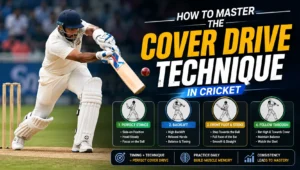

The cover drive technique is one of the most elegant strokes in cricket. A cover drive technique in cricket requires good balance, footwork, head position, timing, and controlled bat movement. As a classic off-side batting stroke, the cricket cover drive can become a reliable scoring shot when its basic cover drive fundamentals and cover drive mechanics are practiced correctly.
A front-foot cover drive technique is usually played against a fuller delivery outside off stump, allowing the batsman to move forward and strike through the cover region. Learning the cover drive technique basics, cover drive execution, and cover drive batting technique helps players develop a smooth grounded cover drive, powerful cover drive shot, and dependable run-scoring stroke without sacrificing control.
Table of Contents
Grip, Stance & Bat Setup
A good batting grip gives you control without creating unnecessary tension. Place the top hand grip firmly but comfortably on the handle, while the bottom hand grip should remain relaxed so it does not overpower the shot. Think of soft hands, relaxed wrists, and a firm top hand rather than squeezing the bat tightly. This combination helps maintain control when playing the cover drive technique .
Your batting stance should provide a stable base and allow easy movement toward the ball. A balanced stance with a shoulder-width stance, comfortable batting posture, and still head helps keep your eye level steady. Keep the head position aligned with the ball, then use a controlled backlift or bat lift with a comfortable bat angle. Avoid an excessively high lift; the bat should come down smoothly with a straight bat or slightly open bat face depending on the delivery and intended shot.

Footwork & Body Movement
Effective front-foot movement is the foundation of a reliable cover drive technique . Start with a small trigger movement or split step to stay ready, then use a controlled front-foot stride and forward stride toward the pitch of the ball. Good footwork technique allows smooth movement towards the pitch of the ball, while proper weight transfer from the back leg to the front leg keeps the stroke balanced and controlled.
As you move forward, maintain body alignment with your head over the ball and keep the front knee comfortably flexed. Controlled knee flexion and hip flexion help create stability, while natural hip rotation and trunk rotation add fluency to the shot. The back leg should support your movement without collapsing, allowing strong lower-body movement, body control, and balance throughout the front-foot movement.
Visit this: Why Head Position Matters in Cricket Batting? Improve Balance, Timing & Shot Control
Ball Selection & Timing
- Ideal cover drive ball: Look for a full-length delivery, half-volley, or full ball outside off stump that enters your drive zone.
- Judge line and length: A good outside-off delivery in the off-stump channel can become a strong scoring zone when the ball length is suitable.
- Use early judgment: Develop length judgment, shot selection, and quick decision making before committing to the stroke.
- Avoid forcing the shot: A good-length delivery is not always a cover-drive opportunity, so be prepared to leave the ball when it is too far from your ideal hitting area.
- Attack overpitched balls: An overpitched delivery allows you to move forward and get the ball under the eyes, creating better control and timing.
- Focus on timing: Strong hand-eye coordination helps you meet the ball cleanly. Avoid rushing the shot and allow timing to generate power.
- Control late contact: If the ball moves away or arrives later than expected, use late contact rather than reaching too far outside your body.
Bat Swing & Contact
- Controlled bat swing: Begin the downswing smoothly, maintaining a straight bat path and natural swing plane toward the target.
- Smooth downswing: Avoid a rushed high-to-low swing. A controlled movement helps maintain bat speed while keeping the bat face angle stable.
- Contact point: Aim for the contact under the eyes, ideally meeting the ball around the middle of the bat or sweet spot.
- Timing over power: Prioritize timing over power instead of forcing the stroke. Good hand control and clean contact can produce excellent results without excessive effort.
- Bat through the line: Allow the bat through the line of the delivery after contact, helping with accurate shot placement through the covers.
- Follow-through: Finish with a controlled follow-through rather than an exaggerated swing. A balanced finish keeps your body stable and supports consistent execution.

Types of Cover Drive Technique
| Type of Cover Drive | Key Technique | Best Use |
|---|---|---|
| Classic Grounded Cover Drive | A controlled ground stroke played along the ground with balance and clean timing. | Reliable percentage shot for finding gaps safely. |
| Lofted Cover Drive | Uses a higher bat swing to hit over the infield while maintaining control. | An attacking cover drive technique when fielders are inside the circle. |
| Back-Foot Cover Drive | Played from the back foot against a shorter outside-off delivery. | Useful for creating a gap-finding shot through the cover region. |
| Check-Drive | A shortened swing with limited follow-through and excellent control. | Ideal for a controlled cover drive technique when placement matters more than power. |
| Aggressive Cover Drive | Combines strong footwork, bat speed, and full extension through the ball. | Effective when looking for boundaries with an aggressive cover drive. |
| Aerial Cover Drive | The ball is intentionally struck into the air over the cover fielders. | A high-risk aerial cover drive technique for attacking open spaces. |
| Cover Drive Through Extra Cover | The bat face is directed toward the extra-cover region with precise placement. | Useful for targeting gaps between cover and extra cover. |
| On-the-Up Cover Drive | The batsman meets the ball while it is rising rather than waiting for it to reach the full length. | Effective against certain fuller or slightly shorter deliveries. |
| Defensive Cover Drive | A softer, controlled stroke focused on keeping the ball along the ground. | Useful as a defensive cover drive when minimizing risk. |
| Attacking Cover Drive | Full commitment through the shot with positive footwork and a strong finish. | Used as an attacking cover drive to score boundaries. |
Common Cover Drive Mistakes to Avoid
One of the most common cover drive technique mistakes is reaching for the ball instead of moving the feet toward it. Overreaching, poor footwork, and lazy feet can cause the batsman to lose balance, resulting in edging the ball or finding the outside edge. Keep the head behind the ball, avoid falling over, and focus on proper weight transfer throughout the shot.
Another common problem is an incorrect bat path, often caused by a closed bat face or excessive bottom-hand use. A hard grip can also restrict natural bat movement and lead to a mistimed shot. Avoid playing too early, driving the wrong length, or driving too wide outside the off stump. If the head falling outside off stump becomes a habit, control and balance will suffer, so stay patient and choose the right delivery before committing to the drive.
Visit this also: Back-Foot Batting Technique In Cricket: Improve Footwork, Timing & Shot Control
Cover Drive Drills & Practice
Effective cover drive drills help batsmen develop reliable technique through repetition and focused batting practice. Start with shadow batting and a mirror drill to check your stance, head position, footwork, and bat path. A drop-feed drill, one-pad challenge, and front-foot drive drill can then improve movement toward the ball, while a cone-gate drill teaches accurate shot placement through the covers.
As your technique improves, progress to throwdowns, net practice, and bowling machine practice to experience different lines and lengths. A tennis ball drill can make training more enjoyable while developing timing, and a wall batting drill can encourage quick reactions and controlled contact. Include target practice in your practice routine to measure consistency and build muscle memory. Regular cricket training, combined with purposeful repetition, turns individual drills into meaningful skill development.
Video Analysis & Technique Improvement
- Record your batting: Use smartphone recording to capture your cover drive technique from both front and side-on footage angles. This makes batting video analysis easier and provides useful visual feedback.
- Check head and body position: Use slow-motion analysis to review head-ball alignment, weight distribution, and overall movement analysis. Look for unnecessary movement or falling away during the shot.
- Review the bat path: Perform bat face analysis to check whether the bat stays controlled through contact. Review the contact point and follow-through analysis to identify technical flaws.
- Study your movement: Basic batting biomechanics can reveal problems with footwork, balance, and body alignment. Compare your movement with technically sound examples to support technique correction.
- Track consistency: Use regular performance review to monitor shot consistency rather than judging a single attempt. Repeated video analysis can reveal patterns that are difficult to notice while batting.

Professional Batting Examples
Studying a Virat Kohli cover drive, Babar Azam cover drive, or Kumar Sangakkara cover drive can help players understand what makes a professional cover drive so effective. These batsmen demonstrate excellent professional footwork, balance, timing, and control, making their strokes useful cover drive examples for anyone learning an elite batting technique.
When studying professional batsmen, focus on the principles behind their movements rather than trying to copy every detail. International batting styles differ because every player has a unique body shape, stance, and rhythm. Copying principles not technique is the better approach: observe their head position, movement toward the ball, bat path, timing, and decision-making, then adapt those ideas to your own game through player technique analysis.
Coaching & Skill Development
Good cover drive technique coaching starts with strong batting fundamentals rather than focusing only on hitting boundaries. Through cricket batting coaching and technical coaching, players can improve their beginner batting technique, footwork, balance, grip, and timing. Regular coaching tips and individual batting correction help identify technical problems early and build a repeatable batting technique.
For developing players, youth cricket training, academy cricket, and club cricket provide valuable opportunities to practice under realistic conditions. Combining structured drills with match practice improves batting confidence, consistency, and decision-making skills. Coaches should also emphasize shot selection and disciplined batting, teaching players when to attack, when to defend, and when to leave the ball.
Frequently Asked Questions About Cover Drive Technique in Cricket
What is the cover drive technique in cricket?
The cover drive technique is a front-foot batting stroke played mainly against fuller deliveries outside off stump, with the bat directed through the cover region for controlled scoring.
How can I play the perfect cover drive?
To play a perfect cover drive, maintain a balanced stance, keep your head over the ball, move the front foot toward the delivery, use a straight bat path, and focus on timing rather than power.
What is the best ball to play a cover drive?
A full-length or overpitched delivery outside off stump is generally ideal for a cover drive. Avoid forcing the shot against short or excessively wide deliveries.
What are the common mistakes when playing a cover drive?
Common mistakes include poor footwork, reaching for the ball, falling over, playing with a closed bat face, using too much bottom hand, and driving deliveries that are too wide or too short.
How can I improve my cover drive technique?
Practice cover drive drills such as shadow batting, throwdowns, front-foot drive drills, target practice, and net sessions. Video analysis can also help identify problems with footwork, head position, bat swing, and timing.


[…] Visit this: How to Master the Cover Drive Technique in Cricket […]