
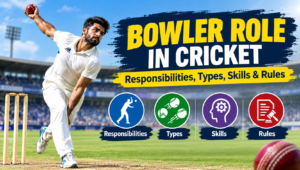

Understanding the bowler role in cricket is important because a bowler does more than simply deliver the ball. The role of a bowler depends on the match situation, pitch conditions, and opposition. A cricket bowler has specific bowling responsibilities and bowling duties within the team.
As part of the bowling team, bowlers work with the fielding side to follow a defensive strategy or lead a bowling attack. A specialist bowler may focus on wicket taking, taking wickets, and dismissing batsmen, while others concentrate on restricting runs, controlling scoring rate, and stopping boundaries. Both an attacking bowler and defensive bowler help the bowling unit build pressure and support different cricket player roles, including the contribution of an all-rounder.
Table of Contents
Main Objectives of a Bowler Role in Cricket
The main objectives of a bowler are to take wickets, dismiss the batter, and create wicket chances through accurate and purposeful bowling. Bowlers may aim to hit the stumps, induce edges, or beat the batter with changes in line, length, pace, or movement. A good bowling strategy can also force mistakes, break partnerships, and attack the batsman when the opportunity arises.
Bowlers also need to restrict runs and control run rate by limiting boundaries and stopping scoring opportunities. When the team needs to defend a total or protect a target, disciplined bowling can create pressure and control the game. A successful spell can even change match momentum, making the bowler an important part of the team’s overall strategy.

Types of Bowlers in Cricket
There are different types of bowlers in cricket, and each has a specific style, role, or method of creating pressure. They can broadly be divided into pace bowlers and spin bowlers.
- Pace Bowler: Uses speed, bounce, and movement to challenge the batter.
- Fast Bowler: Delivers the ball at high speed and often relies on pace and bounce.
- Fast-Medium Bowler: Combines good pace with swing or seam movement.
- Medium-Fast Bowler: Operates at a slightly lower pace while using accuracy and movement.
- Medium Pace Bowler: Focuses on line, length, and variations rather than extreme speed.
- Slow Pace Bowler: Uses slower deliveries and changes of pace to disrupt the batter.
- Spin Bowler: Relies on turning the ball, flight, and variations instead of raw pace.
- Spinner: A general term for a bowler who specializes in spin.
- Wrist Spinner: Uses the wrist to generate turn and includes leg spinners and chinaman bowlers.
- Finger Spinner: Uses the fingers to spin the ball and includes off spinners and left-arm orthodox bowlers.
- Leg Spinner: A right-arm wrist spinner who turns the ball from leg side toward off side for a right-handed batter.
- Off Spinner: A finger spinner who generally turns the ball from off side toward leg side for a right-handed batter.
- Left-Arm Orthodox: A slow left-arm spinner who uses finger spin to turn the ball away from a right-handed batter.
- Chinaman: A left-arm wrist spinner who generally turns the ball into a right-handed batter.
- Swing Bowler: Uses movement through the air to make the ball curve toward or away from the batter.
- Seam Bowler: Uses the seam and pitch conditions to create sideways movement after pitching.
- Express Fast Bowler: A high-speed fast bowler whose main weapon is extreme pace.
- Strike Bowler: A bowler primarily used to take wickets and create breakthroughs.
- Opening Bowler: Usually bowls at the beginning of an innings when the ball is relatively new.
- First-Change Bowler: Comes into the attack after the opening bowlers and often provides a different bowling style or angle.
- Death Bowler: Specializes in bowling during the final overs, focusing on yorkers, slower balls, and limiting runs.
Visit this: Return Crease in Cricket: Rules, Position, Measurements & No-Ball
Bowling Techniques & Delivery Types
A good bowling technique starts with a controlled bowling action and efficient bowling mechanics. The bowler uses the bowling grip, run-up, and approach to build momentum before the pre-delivery stride and bound. During back foot contact, front foot contact, and the delivery stride, the bowler must maintain balance and coordinate the body effectively.
At the point of release, the ball release, release point, seam position, wrist position, and arm position all affect the direction, pace, and movement of the ball. A consistent delivery technique helps improve bowling accuracy, bowling consistency, and bowling control. Good line and length, balance, and athleticism then allow the bowler to repeat the desired bowling delivery while maintaining an effective follow-through.

Common Bowling Deliveries
Cricket bowlers use different bowling deliveries to deceive the batter, restrict runs, and create wicket opportunities. A yorker, bouncer, short ball, full ball, and good length delivery are common pace options, while a length ball can be used to maintain pressure. Bowlers also use a full toss, slower ball, slower bouncer, cutter, off cutter, and leg cutter to change pace and movement.
Spin bowlers have their own variations, including the googly, doosra, carrom ball, flipper, top-spinner, arm ball, off break, and leg break. Pace bowlers can use an inswinger, outswinger, reverse swing, seam delivery, or swing delivery depending on conditions. Choosing the right delivery at the right time can make it harder for the batter to predict the bowler’s next ball and can help create scoring and wicket-taking opportunities.
Bowler Role in Cricket & Field Placement
Bowler field setting plays an important role in helping a team create wickets and control scoring. The captain and bowler usually discuss the plan before each over, with bowler-captain communication helping them choose the right field placement for the batter and match situation. A bowling field may include slip fielders, gully, point, third man, fine leg, square leg, mid wicket, mid on, mid off, long on, and long off.
An attacking field normally uses more close catchers around the batter to create catching positions for edges and mistimed shots. A defensive field, on the other hand, may use more boundary fielders to prevent fours and sixes. The ideal field depends on the bowler’s style, delivery, batter’s strengths, pitch conditions, and current match situation.
Visit this also: What Is Batting Average in Cricket? Formula, Calculation & Examples
Bowler Skills & Qualities
A successful bowler needs more than pace or spin. Bowling accuracy and bowling consistency help a player maintain the right line and length, while physical fitness, stamina, strength, and endurance allow them to perform effectively throughout long spells. Concentration, mental toughness, and pressure handling are also important when facing difficult match situations.
Bowlers also need strong tactical awareness, game awareness, and analytical skills to understand batters and adjust their approach. Adaptability, hand-eye coordination, discipline, precision, and control support consistent execution. Good communication, teamwork, and decision making help bowlers work with the captain and fielders. Through continuous improvement, regular training and practice, and detailed performance analysis, a bowler can identify weaknesses and develop their skills over time.

Bowler Rules & Laws
The laws of cricket define how bowlers must deliver the ball and how an over is completed. Under the bowling laws, a legal delivery must meet the required conditions, while an illegal delivery can result in penalties. A bowler’s bowling action must also be legal; throwing or chucking the ball is not permitted. The bowling action is assessed in relation to elbow extension, with the 15-degree limit used under the relevant regulations.
Bowlers must deliver from behind the crease, including the bowling crease and popping crease markings. An umpire determines whether a delivery is a fair delivery or unfair delivery. A no-ball is called for certain illegal deliveries, while a wide ball is called when the ball is too far from the batter to be reasonably playable. An over consists of six legal deliveries, after which the bowler changes ends. Bowlers cannot normally bowl consecutive overs from the same end, so the teams observe the required change of ends during an innings.
FAQs About Bowler Role in Cricket
What is the role of a bowler in cricket?
A bowler’s main role is to take wickets, dismiss batters, restrict runs, and create pressure. Bowlers also work with the captain and fielders to execute the team’s bowling strategy.
What are the main responsibilities of a bowler in cricket?
The main bowler responsibilities include delivering accurate balls, taking wickets, controlling the run rate, preventing boundaries, building pressure, and adapting to different match situations.
What are the different types of bowlers in cricket?
The main types include fast bowlers, fast-medium bowlers, medium-pace bowlers, swing bowlers, seam bowlers, and spin bowlers. Spin bowlers include leg spinners, off spinners, and left-arm orthodox bowlers.
What skills does a good cricket bowler need?
A good cricket bowler needs accuracy, consistency, pace or spin control, stamina, concentration, discipline, tactical awareness, adaptability, and mental toughness. Regular training and practice also help improve performance.
How does a bowler help the team win a cricket match?
A bowler can help the team by taking wickets, breaking partnerships, restricting scoring, stopping boundaries, and creating pressure. Effective bowling can also change match momentum and make it difficult for batters to score freely.


