
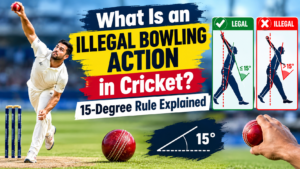

An illegal bowling action in cricket occurs when a bowler’s delivery involves throwing instead of a legal bowling action. The illegal bowling action meaning and illegal bowling action definition are mainly connected to bowling arm straightening or elbow extension during delivery. A bent arm is not automatically illegal; the concern is excessive elbow straightening that turns the delivery into a throwing action or chucking in cricket.
Under the Laws of Cricket, Law 21, and relevant ICC rules and ICC regulations, umpires assess whether a bowler’s action is legal. Understanding bowling action in cricket, bowling technique, straight arm, throwing in cricket, illegal delivery, fair delivery, and no-ball helps explain the illegal bowling action cricket rules and how they are applied.
Table of Contents
15-Degree Elbow Extension Rule
The 15-degree rule means that, under ICC regulations, a bowler’s elbow extension must not exceed the 15-degree limit from the point when the bowling arm reaches horizontal until ball release. This elbow extension limit allows some natural flexing and natural elbow movement, so a slightly bent arm is not automatically illegal. The ICC defines legal elbow extension as staying within the permissible extension during this measured phase.
For bowling action measurement, specialists assess the change in elbow angle and use elbow angle measurement from the horizontal position through the delivery swing to the point of release. If 15 degrees elbow extension is exceeded, it is classified as illegal elbow extension under ICC regulations. The rule is therefore about how much the elbow joint straightens during delivery, rather than simply whether a bowler starts with a bent arm.

Throwing, Chucking & Illegal Bowling Action in Cricket
Throwing in cricket means delivering the ball with a throwing action rather than a normal bowling motion. Terms such as chucking, chucking in cricket, thrower, thrown delivery, and illegal throw are commonly used to describe this type of unfair bowling action. Under ICC regulations, an illegal bowling technique is determined by the amount of bowling arm straightening during delivery, with an elbow extension exceeding 15 degrees classified as an Illegal Bowling Action.
An umpire may identify a suspect bowling action or abnormal bowling action during a match, but a report does not automatically mean the bowler has been proven illegal. If an umpire believes a deliberate throw or obvious throw has occurred under the relevant playing conditions, the ball can be no-balled for throwing, and the umpire calls no-ball. A reported action can then undergo formal assessment using specialist testing to determine whether it exceeds the permitted limit.
Visit this: Return Crease in Cricket: Rules, Position, Measurements & No-Ball
Umpire Decision & Match Procedure
The on-field umpire or match official may identify a suspected illegal action by observing the bowler during the match. In international cricket, officials use their normal umpire observation and experience to assess the action. If concerns remain, an umpire and/or match referee can complete a bowling action report after the match. A bowler reported for a suspected action is then subject to the ICC review process rather than being automatically declared illegal.
If the illegal delivery call is made during play under the applicable bowling regulations, the no-ball call and other match procedures can apply. The field umpire may direct the captain to suspend the bowler from bowling in that innings, with another bowler completing the over where required. The relevant match report and official report are then passed through the required channels, including the team manager and ICC in international matches.
Bowler Reporting, Suspension & Review
A bowler reported for a suspected illegal action may receive an illegal action report and enter the ICC review process. A bowling action review can involve an expert panel, human movement specialists, or an ICC panel conducting an action assessment and bowling action investigation. In some cases, an independent review, appeal, or hearing may also form part of the process.
If an assessment confirms an illegal action, the bowler can face suspension or international cricket suspension. A suspended bowler may undertake remedial work, correcting bowling action, and action correction before reassessment of bowling action. Successful reassessment can result in bowling action clearance, allowing the cleared bowler to return, subject to applicable ICC or domestic cricket rules and cricket board supervision.

Hyperextension & Natural Arm Movement
Hyperextension means the elbow moves beyond its normal straight position. Under ICC regulations, elbow hyperextension is specifically excluded when calculating the 15-degree elbow-extension limit, so a hyperextended elbow does not automatically make a bowling action illegal. This distinction is important when considering elbow architecture, arm flexibility, and natural elbow movement.
During bowling biomechanics, some natural flexion and natural extension can occur as the arm moves through delivery. A bowler may therefore appear to have a negative elbow angle or unusual movement without actually using an illegal action. What looks like an apparent throwing action or an illusion of throwing must be assessed through proper measurement; legal hyperextension itself is discounted when determining whether the action exceeds the permitted elbow-extension limit.
Types of Bowlers & Bowling Actions
| Bowler Type | Bowling Action | Key Point |
|---|---|---|
| Fast bowler | Pace bowling action | Uses speed and power. |
| Medium pacer | Medium-pace action | Focuses on control and movement. |
| Spin bowler / Spinner | Spin bowling action | Relies on turn and flight. |
| Off-spinner | Finger-spin action | Can use variations such as the doosra. |
| Left-arm spinner | Left-arm spin action | Creates turn with the left arm. |
| Right-arm bowler | Pace or spin action | Can bowl either pace or spin. |
| Unconventional bowler | Unusual action | A unique action is not automatically illegal. |
Regardless of the bowling technique, delivery variation, or faster delivery, legality depends on the applicable elbow-extension rules.

Famous Illegal Bowling Action in Cricket Controversies
- Muttiah Muralitharan & Darrell Hair: Muralitharan’s action became one of cricket’s most discussed bowling action controversies after umpire Darrell Hair called him for throwing during the 1995 Boxing Day Test. Later biomechanical assessments led to Muralitharan being cleared.
- Saeed Ajmal: Pakistan spinner Saeed Ajmal was reported in 2014, and an independent assessment found his deliveries exceeded the permitted 15-degree tolerance, resulting in a suspension from international bowling.
- Mohammad Hafeez: Hafeez faced repeated illegal action controversies, including suspensions and later reassessments. In 2018, his remodeled action was found to be legal.
- Shane Shillingford: The West Indies spinner was reported over concerns about his action, with testing finding a mean elbow extension of 17 degrees. After remedial work, he was later cleared to bowl again.
- Marlon Samuels: Samuels was among the reported bowlers involved in repeated reviews. His quicker deliveries were previously restricted, and he later received a suspension before successfully modifying his action.
- Johan Botha: Botha was suspended after testing found excessive straightening in both his off-break and doosra deliveries.
- Shabbir Ahmed: Pakistan fast bowler Shabbir Ahmed was suspended for 12 months after a second finding of an illegal action within the relevant period.
Other names associated with historical discussions include Shoaib Akhtar, Harbhajan Singh, Saqlain Mushtaq, and Brett Lee. These cases and discussions varied considerably, so each should be considered according to the specific match reports, testing procedures, and regulations in force at the time.
Visit this also: What Are Powerplay Rules in Cricket? Overs, Fielding Restrictions & Strategy
Consequences of Illegal Bowling Action in Cricket
- No-ball: An illegal delivery can result in a no-ball and a penalty run for the batting team.
- Free hit: In limited-overs cricket, a no-ball can give the batsman a free hit on the next delivery.
- Bowler reported: A bowler reported for an illegal action may undergo official testing and assessment.
- Bowler suspended: If confirmed illegal, the bowler can face suspension from international cricket.
- Correction & reassessment: The bowler may need remedial training, bowling action correction, and reassessment before returning.
- Repeat report: A repeat report can lead to further bowling restrictions or another suspension, depending on the applicable ICC regulations.
FAQs About Illegal Bowling Action in Cricket
What is an illegal bowling action in cricket?
An illegal bowling action occurs when a bowler exceeds the permitted elbow-extension limit while delivering the ball, making the action illegal under cricket regulations.
What is the 15-degree rule in bowling?
The 15-degree rule allows a bowler’s elbow to extend up to 15 degrees during the relevant part of the delivery. Exceeding this limit can result in an illegal bowling action.
Is a bent arm illegal in cricket bowling?
No. A naturally bent arm is not automatically illegal. The important factor is how much the bowling arm straightens during the delivery.
What happens when a bowler has an illegal action?
A bowler may be reported for a suspected illegal action and undergo an official bowling action assessment. If confirmed, the bowler can be suspended from bowling until reassessment.
What is the difference between chucking and legal bowling?
Chucking involves excessive straightening of the elbow during delivery, while legal bowling stays within the permitted elbow-extension limit.


