
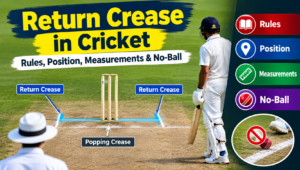

When you watch a cricket match, the return crease in cricket may look like a simple line on the pitch, but it has an important role in defining where players can legally stand and move. As part of the cricket crease system, the return creases are among the key cricket pitch markings that help officials judge whether a bowler has delivered the ball legally. Understanding the crease in cricket also makes it easier to read the pitch layout, especially around the bowling end.
These crease lines are part of the wider cricket field markings, along with the wicket crease and batsman’s crease. Usually shown as white lines, each crease marking has a specific purpose under the cricket laws and Laws of Cricket. Under MCC Law 7, the return crease in cricket forms an essential part of the pitch markings used when setting up the game. Learning this basic piece of cricket terminology helps players and fans understand how a legal delivery is determined.
Table of Contents
Return Crease Position & Measurements
The return crease position is marked at both sides of the pitch and runs at right angles to the popping crease and bowling crease. The return crease in cricket location is determined from the centre of the stumps, with the relevant pitch measurements used to ensure the lines are correctly positioned. Each return crease is 4 ft 4 in (1.32 metres) from the imaginary line running through the middle stumps, measured perpendicular to that line. These crease measurements help define the area in which the bowler must deliver the ball legally.
For the return crease dimensions, the marked return crease extends at least 8 ft (2.44 metres) from the popping crease toward the bowler’s end, although the line itself can have unlimited length behind the popping crease. In simple terms, the return creases establish the side boundaries of the bowling area, while the popping crease helps determine the batter’s position. Understanding the distance from stumps, pitch measurements, and exact return crease position makes the pitch layout easier to understand.

Return Crease in Cricket vs Other Creases
The difference between creases becomes clearer when you understand their position and purpose on the cricket pitch. The main crease types in cricket include the return crease in cricket, popping crease, and bowling crease, with the terms batting crease and wicket crease also commonly used. A cricket crease diagram can help show how these crease markings relate to the stumps and each other.
- Return crease vs popping crease: The return crease in cricket runs perpendicular to the popping crease and marks the side boundary of the bowler’s delivery area. The popping crease is the front crease that helps determine the batter’s ground and is positioned in front of the stumps.
- Return crease vs bowling crease: The bowling crease is a parallel crease to the popping crease and runs across the pitch through the bases of the stumps. The return crease in cricket meets it at a right angle and extends along the sides of the pitch.
- Batting crease / wicket crease: These terms are often used to describe the popping crease, depending on the context. The crease’s back edge and inside edge can be important when officials determine whether a batter is safely within their ground.
So, while all these lines form part of the cricket crease markings, they serve different purposes. The return crease in cricket mainly defines the lateral limits for the bowler, whereas the popping and bowling creases help establish the positions of the batter, bowler, and wickets.
Visit this: Playing Time in Cricket: Test, ODI & T20 Match Duration Explained
Role & Purpose of the Return Crease in Cricket
The purpose of the return crease in cricket is to help define the bowler’s delivery area and control the bowler position during the delivery. Its main function is to provide a clear reference for the bowler’s feet, particularly the bowler’s back foot during the delivery stride. Correct foot placement is essential because the bowler must stay within the crease restrictions to make a legal delivery.
The importance of the return crease in cricket is most noticeable when checking a possible no ball. During the bowling action, the bowler’s back foot must land within the permitted area without touching or crossing the return crease. The back foot landing is therefore closely watched by the umpire, making the return crease an important part of the bowler’s delivery and its role in cricket.

Return Crease in Cricket & No-Ball Rules
A return crease no ball can occur when a bowler’s back foot lands outside the permitted area during delivery. Under the no ball rules, the bowler must ensure the back foot does not touch or cross the return crease in cricket. Bowler crossing return crease, putting a foot outside return crease, or committing another foot fault can result in a no-ball.
A back foot no ball is different from a front foot no ball, which involves the front foot and popping crease. The bowling crease rules determine the permitted foot position for a legal bowling delivery. If the bowler commits a crease violation, the umpire can call an illegal delivery and signal a no-ball. Simply standing outside return crease in cricket between deliveries is not itself a no-ball; the foot position during the delivery is what matters.
Cricket Pitch & Wicket Terminology
The cricket pitch is the central playing area where the wicket is positioned at both ends. Each wicket consists of three stumps, including the middle stumps, with the batting crease, bowling crease, popping crease, and return crease forming important pitch markings around them.
The pitch area extends between the bowling end and striker’s end, while the opposite side is known as the non-striker’s end. Understanding the wicket area and these terms makes it easier to follow the layout of a cricket ground and understand how players and officials use the marked areas during play.
Visit this also: Best T20 Bowling Variations to Outsmart Batters in 2026
MCC Laws & Official Cricket Rules
The MCC Laws of Cricket define how the pitch and its creases must be marked and used. Law 7, The Creases, covers the main crease markings and their required positions, while Law 6 deals with the area of pitch. These official cricket laws provide the foundation for the crease regulations, crease dimensions, and laws governing the pitch.
Under the MCC regulations, umpires apply these cricket rules during matches, including when checking whether a bowler has complied with the crease markings. While the laws set the requirements, umpire interpretation can be relevant when judging a specific delivery or crease violation.

Practical Cricket & Umpiring
During a crease inspection or pitch inspection, the umpire, particularly the on-field umpire or bowling umpire, checks the pitch markings and the bowler’s foot position. The foot position during the delivery stride is important for determining whether the bowling action results in a legal delivery.
If the bowler commits a foot fault, the umpire makes the appropriate umpire call and gives the no-ball signal when required. These decisions are part of cricket officiating, with the match officials responsible for applying the playing laws consistently.
FAQs About Return Crease in Cricket
What is the return crease in cricket?
The return crease in cricket is a line on each side of the cricket pitch that runs at a right angle to the popping and bowling creases. It helps define the bowler’s permitted delivery area.
How far is the return crease from the stumps?
The return crease is positioned 4 ft 4 in (1.32 metres) from the imaginary line through the centre of the middle stumps.
Can a bowler touch the return crease?
A bowler’s back foot must not touch or cross the return crease during delivery. If it does, the delivery can be called a no-ball.
What is the difference between a return crease and a popping crease?
The return crease runs perpendicular to the popping crease and marks the side limit of the bowler’s delivery area. The popping crease runs across the pitch and helps determine the batter’s ground.
Why is the return crease important in cricket?
The return crease is important because it helps umpires judge the bowler’s foot position and determine whether the delivery complies with the cricket laws.
Conclusion
Knowing what is the return crease in cricket makes the pitch layout easier to understand. The return crease meaning in cricket refers to the lines beside the pitch that define the bowler’s delivery area. The return crease rules in cricket, dimensions, and distance from stumps help umpires judge legal deliveries.
Understanding return crease vs popping crease and return crease vs bowling crease also clarifies the main cricket crease types. If the bowler crosses the permitted return crease area, it can result in a return crease no ball.


[…] Visit this: Return Crease in Cricket: Rules, Position, Measurements & No-Ball […]
[…] Visit this: Return Crease in Cricket: Rules, Position, Measurements & No-Ball […]