
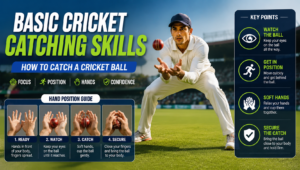

A good catch can quickly change the momentum of a cricket match. Basic Cricket catching starts with learning how to catch a cricket ball using the correct catching technique, soft hands, and proper positioning. Beginners should focus on basic catching fundamentals, fielding fundamentals, and a safe catching technique before attempting difficult catches.
Good cricket fielding requires strong fielding skills, hand-eye coordination, anticipation, and concentration. Regular catching practice improves ball tracking, reaction time, body balance, and quick movement, helping players develop reliable catching skills and become more confident with basic Cricket catching.
Table of Contents
Hand Position and Basic Cricket Catching Technique
The correct hand position makes a big difference when learning basic Cricket catching. For a ball arriving above the waist, keep your fingers pointing up with palms facing upwards, and bring your hands together to form secure cupped hands. Keep your hands relaxed rather than stiff, with thumbs together and the little fingers touching where appropriate. When catching lower balls, the fingers pointing down position is more suitable. Try to catch with the base of the fingers instead of letting the ball strike directly into your palms.
For better control, use soft hands and flexible elbows when receiving the ball. Keep your hands close to the body while catching in front of the body or catching at eye level, depending on the height of the delivery. Even with strong hands, avoid stopping the ball suddenly; instead, absorb the ball, cushion the ball, and give with the ball by slightly moving your hands backward. This reduces the impact and helps prevent the ball from bouncing out.
Visit this: Timed Out Rule in Cricket: When Is a Batsman Out?
High Basic Cricket Catching Technique
A high catch is used when a high ball, overhead catch, or lofted catch comes down from above. First, track the ball carefully and judge the flight instead of rushing toward it. Move into position and get underneath the ball, keeping your eyes on it throughout. For a traditional Australian cup, bring your hands above eye level with fingers pointing upward, creating a secure inverted cup shape. Keep your thumbs locked and index fingers touching to help guide the ball safely into your hands.
As the ball drops, try to catch at eye level whenever possible rather than reaching too far above your head. Bend the knees slightly and keep your body balanced so you can absorb impact when the ball reaches your hands. The reverse cup or reverse cup method can also be useful depending on the direction and height of the delivery, while an inverted cup provides extra security for many overhead catches. With regular practice, players become more confident at judging flight, moving into position, and completing difficult high catches under match pressure.

Mid-Level and Flat Basic Cricket Catching
- Mid catch: Used for a ball arriving around chest height or slightly below.
- Flat catch: Suitable for a fast, relatively straight ball that does not require a large movement.
- Orthodox cup: Keep the hands together in the traditional catching shape to secure the ball.
- Orthodox catching technique: Maintain a stable body position and watch the ball closely into the hands.
- Chest-height catch: For a chest-height catch, keep the hands in front of the body with palms facing outward.
- Below chest catch: When the ball drops lower, use fingers pointing down and adjust the hands to the ball’s height.
- Pinkie fingers touching: Keep the pinkie fingers touching to create a secure catching area.
- Elbows slightly bent: Keep the elbows slightly bent so the hands can move naturally with the ball.
- Bring the ball toward the chest: After contact, gently bring the ball toward the chest to secure it.
- Controlled catch: Avoid snatching at the ball; use relaxed hands and controlled movement.
- Balanced stance: Stay in a balanced stance with the feet stable and the body ready to move if the ball changes direction.
Slip and Close Basic Cricket Catching
Slip catching requires sharp reflexes, excellent anticipation, and a stable catching stance because an edged ball can reach the fielder very quickly. In slip fielding, players in the slip cordon should maintain a low body position, keep their knees bent, and place their weight on the balls of the feet. Keeping the feet slightly inward allows a close-in fielder to react quickly in either direction. This setup is especially important for quick reaction, fast reaction, and reflex catching when the ball deviates unexpectedly.
For close catching, stay alert and watch the batter closely so you can anticipate the direction of the ball. A wicketkeeper and close fielders often need similar habits: stay balanced, keep the hands ready, and move quickly toward the ball rather than waiting for it to arrive. Regular practice of slip catch drills can improve reaction speed, confidence, and the ability to complete difficult catches close to the bat.
Body Position and Footwork
Good body alignment and footwork help a fielder reach the ball safely and maintain control during a catch. Start in a shoulder-width stance with a balanced body, steady head, and head position directly behind the line of the ball. Try to get in line with the ball rather than reaching sideways. Keep your weight forward in an athletic position, allowing you to react quickly and adjust your positioning as the ball moves.
Use quick feet to make small adjustments, while lateral movement helps you move across the field. Use forward movement when attacking a catch, and backward movement when judging a ball moving away from you. A drop step can help create space quickly, while a running catch requires controlled steps and good balance. When possible, move behind the ball for added security on ground-level catches and move underneath the ball when judging a higher delivery.
Visit this also: What Is a Maiden Over in Cricket? Rules, Types & Importance
Soft Hands and Ball Control
Using soft hands is one of the most important parts of soft catching in cricket. Instead of stopping the ball suddenly, keep a relaxed grip and use flexible elbows to absorb the pace. Your hands should work like shock absorbers, helping you cushion the ball, give with the ball, and control the impact as it reaches your hands.
After making contact, gently bring the ball into the body and, when appropriate, pull the ball into the chest to prevent the ball from popping out. This controlled movement allows you to secure the catch rather than simply making contact with the ball. Regular practice with soft hands improves ball control and makes difficult catches much more reliable.

Running, Diving and Difficult Basic Cricket Catching
| Basic Cricket Catching Types | Technique | Key Focus |
|---|---|---|
| Running catch | Use a drop step and sprint into position while keeping your eyes on the ball. | Timing, speed, and coordination |
| Diving catch | Dive for the ball only when it cannot be reached safely with normal footwork. | Body control and safe landing |
| Low catch | Get your body low and extend your hands toward the ball. | Balance and hand position |
| Difficult catch | Adjust your body quickly and focus on tracking the ball until contact. | Spatial awareness and concentration |
| Boundary catch | Move quickly toward the boundary and prepare to control your momentum before catching. | Balance, timing, and awareness |
| Moving catch | Maintain visual contact while adjusting your body and hands as the ball travels. | Coordination and positioning |
| Catch while running | Keep moving smoothly and avoid reaching too early for the ball. | Speed, timing, and control |
| Catch over the shoulder | Track the ball carefully and use controlled movement to judge its flight behind you. | Spatial awareness and positioning |
| Full-stretch catch | Extend the body and hands fully when the ball is just beyond normal reach. | Athletic ability and coordination |
| Athletic fielding | Combine quick footwork, balance, speed, and controlled movement during challenging situations. | Overall fielding ability |
Cricket Fielding Equipment and Training
Effective catching training does not always require expensive cricket training gear. Start with a cricket ball for realistic fielding practice, but beginners can use a training ball or tennis ball to build confidence and improve catching technique. Catching mitts, other catching equipment, and suitable fielding equipment can also make drills easier and more controlled, especially during beginner sessions.
For reaction training, catching practice equipment such as tennis balls can be used for unpredictable bounce and quick-response drills. Players should also use appropriate protective equipment when practicing harder or faster deliveries. Combining safe training, consistent practice, and gradual increases in difficulty helps develop reliable catching skills while reducing unnecessary risk.

Performance and Match Impact
A successful catch can completely change a match situation, especially when it becomes a wicket-taking catch that helps dismiss the batsman through a caught dismissal. On the other hand, a dropped catch can give the opposition another opportunity to score. This is why catching consistency and fielding awareness are essential parts of strong fielding performance.
An important catch or pressure catch can boost fielding confidence and contribute directly to team performance. A match-winning catch may remove a key batter at a crucial moment, while a well-timed catch or sharp fielding effort can also save runs. With regular practice and better awareness, players become more reliable when facing high-pressure situations and are better prepared to make the catch that matters most.
Frequently Asked Questions About Basic Cricket Catching Skills
What are the basic cricket catching skills?
The basic cricket catching skills include correct hand position, soft hands, good body balance, ball tracking, hand-eye coordination, proper footwork, and concentration. Regular catching practice helps players develop confidence and consistency.
How do you catch a cricket ball correctly?
To catch a cricket ball correctly, watch the ball closely, get your body in line with its path, keep your hands relaxed, and cushion the ball as it reaches your hands. Avoid stiff hands because they can cause the ball to bounce out.
What is the best hand position for catching in cricket?
The best hand position depends on the height of the ball. For higher catches, keep your fingers pointing upward, while lower catches generally require fingers pointing downward. Keep your hands relaxed and use soft hands to control the impact.
How can I improve my cricket catching skills?
You can improve your cricket catching skills through consistent practice. Start with simple catches using a tennis ball or training ball, then gradually practice faster, higher, moving, and reaction-based catches to improve coordination and reaction time.
Why is catching important in cricket?
Catching is important because a successful catch can dismiss a batsman and change the match situation. Reliable catching improves overall fielding performance, saves runs, builds fielding confidence, and can contribute significantly to team performance.


