
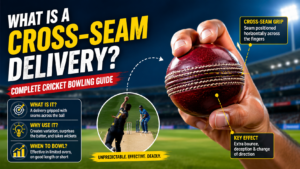

Cross-seam delivery is a useful bowling variation in cricket where the cricket ball seam is held across the direction of travel instead of upright. Using a cross-seam grip, bowlers change the seam orientation, seam position, and seam presentation to make the ball behave unpredictably after pitching.
For fast bowlers, cross-seam bowling is a practical fast bowling variation that can produce inconsistent bounce and movement from the pitch. Unlike a traditional seam-up delivery, the bowler may use a scrambled seam, tilted seam, or altered ball rotation through the release technique, adding variety to their pace bowling and overall bowling mechanics.
Table of Contents
Grip, Release & Seam Position
A good cross-seam grip starts by placing the fingers across the seam, creating a grip across the seam rather than holding the ball with the seam upright. The bowling hand position, finger position, and wrist position should remain comfortable and controlled. Depending on the intended result, the bowler can keep the seam horizontal, rotated, or slightly angled to change the seam orientation and the ball rotation axis.
During the delivery stride, the bowler should maintain a consistent release point while controlling the release angle through the normal bowling action. A scrambled seam release can reduce the chance of a stable seam or upright seam, creating more seam oscillation after release. Small changes in seam rotation, wrist position, and release point can therefore influence how the ball travels and reacts after pitching.

Movement Through the Air
A cross-seam swing can create subtle lateral movement or sideways movement as the ball travels toward the batter. Unlike conventional swing in traditional swing bowling, cross-seam bowling relies more on unpredictable air movement, airflow, and changes in ball aerodynamics caused by the seam. The altered seam can influence the boundary layer around the ball, potentially affecting boundary-layer separation, asymmetric airflow, and wake deflection.
The exact swing mechanism can vary with seam position, release, speed, and atmospheric conditions. A seam-shifted wake may contribute to seam-induced movement and lateral deviation, while factors such as the Magnus effect can also influence the ball’s path when it has significant rotation. As a result, movement in the air may appear as late movement, making the delivery more difficult to read and adding another dimension to a fast bowler’s attack.
Movement Off the Pitch
Cross-seam delivery can produce noticeable seam movement and seam deviation when the ball lands with the seam positioned across its usual direction. The result depends heavily on the pitch response, surface friction, and how the seam hitting the pitch affects seam contact and seam impact. On a worn or uneven wicket, this can create pitch deviation, abrupt movement, and unexpected deviation off the wicket.
One of the biggest advantages is unpredictable movement, including extra bounce, variable bounce, or a skid with lower-than-true bounce. Differences in leather contact, seam position, and surface conditions can change the ball behavior from delivery to delivery. This bounce variation and wicket movement make cross-seam bowling particularly useful when a bowler wants to disrupt a batter’s timing and create uncertainty after pitching.
Visit this: Most Sixes in ODI Cricket: Rohit Sharma, Afridi & Top Six Hitters
Bowling Conditions & Pitch Factors
- Green-top pitch: A pitch with visible grass can offer extra assistance to seam bowlers.
- Grassy pitch: Grass can increase the chances of seam movement when the ball lands on or near the surface.
- Hard pitch: A firm surface can make cross-seam deliveries especially effective by producing variable bounce and pace.
- Bowler-friendly conditions: Helpful when the surface provides movement, bounce, or grip.
- Seam-friendly conditions: Moisture, grass, and a pronounced seam can increase seam assistance.
- Moisture: Dampness can increase surface friction and influence how the ball reacts after pitching.
- Pitch grass: The amount and distribution of grass can affect seam contact and ball behavior.
- Hard seam: A pronounced or firm seam can interact more noticeably with the pitch.
- Pronounced seam: A clearly raised seam may provide additional grip from the surface.
- Kookaburra ball: Its condition and seam shape can influence how a cross-seam delivery behaves.
- Cricket ball condition: The state of the ball affects grip, seam response, and movement.
- New ball: Usually has a prominent seam and can provide greater seam assistance.
- Old ball: May offer different levels of grip and movement as its surface changes.
- Worn ball: A worn surface can alter the interaction between the leather and pitch.
- Surface condition: Cracks, rough patches, grass, and moisture all influence the delivery.
- Pitch hardness: Harder surfaces can produce sharper bounce, while softer surfaces may reduce pace.
- Seam visibility: A visible seam helps the bowler control the intended cross-seam position.
- Grip from the surface: The amount of friction available at impact can determine how sharply the ball deviates.
- Seam assistance: The combination of seam position, surface, and bowling conditions determines how effective the cross-seam delivery becomes.

Cross-Seam vs Seam-Up & Scrambled Seam
| Feature | Cross-Seam | Seam-Up | Scrambled Seam |
|---|---|---|---|
| Technique | Seam is positioned across the ball | Seam is kept upright | Seam rotates unpredictably |
| Seam position | Deliberately across the ball | Vertical seam position | Changing seam position |
| Seam presentation | Limited seam presentation | Clear seam presentation | Inconsistent seam presentation |
| Seam position control | Relatively deliberate | High seam position control | Low seam position control |
| Movement | Can produce unpredictable bounce and movement | Usually aims for controlled seam movement | Often creates unpredictable seam movement |
| Bowling style | Cross-seam variation | Seam-up bowling | Scrambled seam bowling |
| Seam angle | Often horizontal or across the ball | Upright seam / vertical seam | Random or changing angle |
| Tilted seam delivery | Can be used as an intermediate variation | Usually maintains a straight seam | May naturally become tilted during rotation |
| Main purpose | Change bounce and disrupt timing | Generate conventional seam movement | Make seam behavior difficult to predict |
| Best use | Useful bowling variation on suitable pitches | Conventional seam bowling conditions | Adding unpredictability to pace attacks |
| Pace bowling role | Provides variation in pace bowling | Reliable attacking option | Useful change-up option |
Tactical Uses of a Cross-Seam Delivery
A cross-seam delivery is a useful change-up delivery because it can create unpredictable bounce and make the batter unsure about what will happen after pitching. Bowlers can use it as a surprise delivery or variation ball to disrupt timing, beat the bat, and induce mistakes. When used intelligently, this attacking variation can test the batter, create false shots, and increase pressure on batsman during an innings.
Key Tactical Uses
- Wicket-taking option: Use unpredictable bounce to challenge the batter and create chances.
- Change of pace: Combine a cross-seam ball with a change of pace to disturb timing.
- Change of trajectory: Alter the length and change of trajectory to increase batsman uncertainty.
- Short-ball variation: A cross-seam delivery can work as a short-ball variation, particularly when extra bounce is available.
- Defensive variation: Bowl it into difficult areas to restrict scoring and maintain pressure.
- Death bowling variation: In T20 cricket, it can be used as a death bowling variation when batters are expecting predictable yorkers or slower balls.
- T20 bowling tactic: As a T20 bowling tactic, cross-seam bowling can complement other variations and make scoring opportunities less obvious.
- Bowling plans: The delivery should fit the bowler’s overall bowling plans, pitch conditions, batter’s weaknesses, and match situation.

Cross-Seam Swing & Modern Aerodynamics
Modern cricket aerodynamics helps explain why a cross-seam ball can behave differently in the air. The seam changes the boundary-layer profile around the ball, influencing separation points, wake movement, and the seam-shifted wake. Differences in seam-induced airflow and air pressure difference can create an aerodynamic force that contributes to sideways force and lateral deviation. While baseball aerodynamics also examines seam-related effects, cricket-ball behavior depends on its specific seam shape, surface, speed, and orientation.
The result can vary according to the ball’s spin axis, rotation axis, and seam fixed points. A delivery dominated by spin may show spin-dominated movement and involve the Magnus effect, while a cross-seam delivery is generally more associated with seam-dominated movement and changes in the wake. Modern ball-tracking data, including Hawkeye tracking, can help researchers study these effects and better understand swing mechanics and how small changes in seam orientation influence the ball’s flight.
Visit this also: How Cricket Captains Decide When to Change Bowlers
Bowling Performance & Batting Challenge
A fast bowler, seam bowler, or pace bowler can use a cross-seam delivery to make batsman reaction more difficult by creating uncertainty around bounce and movement. Whether delivered by a right-arm fast bowler or left-arm fast bowler, the ball can challenge batter timing, reading the delivery, and judging bounce. This often forces the batter to make a late reaction, which can affect shot selection and lead to an edge or mistimed shot.
For the bowler, effectiveness still depends on bowling accuracy, consistent line and length, and choosing the right moment to use the variation. A batter may respond with defensive batting when uncertain about bounce or attempt attacking batting to counter the pressure. Good batting technique helps a player adapt by playing off the pitch and reacting quickly, but a well-executed cross-seam ball can become a genuine wicket-taking delivery when it exploits the batter’s weaknesses.
Frequently Asked Questions About Cross-Seam Delivery
What is a cross-seam delivery in cricket?
A cross-seam delivery is a bowling technique where the cricket ball’s seam is positioned across the direction of travel rather than upright. It can produce unpredictable bounce, movement, and pace after pitching.
How does a cross-seam delivery work?
A bowler uses a cross-seam grip and changes the seam orientation before release. When the ball hits the pitch, the seam can interact with the surface differently, creating variable bounce and deviation.
When should a bowler use a cross-seam delivery?
A bowler can use a cross-seam delivery as a bowling variation when the pitch has uneven bounce, cracks, grass, or a hard surface. It can also be effective as a surprise delivery against batters who have settled into a rhythm.
What is the difference between cross-seam and seam-up bowling?
In seam-up bowling, the bowler aims to keep the seam upright to generate controlled seam movement. A cross-seam delivery positions the seam across the ball and is generally used to create more unpredictable bounce and pitch deviation.
Is cross-seam bowling effective in T20 cricket?
Yes, cross-seam bowling can be an effective T20 variation, particularly when bowlers want to disrupt batter timing. It can be combined with changes in pace, length, and trajectory to create uncertainty and potential wicket-taking opportunities.
Conclusion
Cross-seam is a practical seam bowling technique that gives fast bowlers another option alongside the seam-up, scrambled seam, and wobble seam approaches. By changing the seam position, seam control, wrist control, finger control, and delivery angle, bowlers can create different types of bounce, deviation, skid, and lateral movement. Unlike a traditional swing bowling technique, which focuses more on swing movement, cross-seam bowling often aims to produce unpredictable movement from the pitch.
The effectiveness of cross-seam depends heavily on pitch conditions and ball condition, while pace variation and other bowling variations can make it even harder for batters to predict the delivery. Bowlers can combine cross-seam with cutters, including an off-cutter and leg-cutter, or experiment with a tilted seam to strengthen their fast-bowling tactics. Understanding cricket ball physics and aerodynamic effects can also help explain how seam orientation and release influence the ball’s behavior.


[…] Visit this: What Is a Cross-Seam Delivery? Complete Cricket Bowling Guide […]