
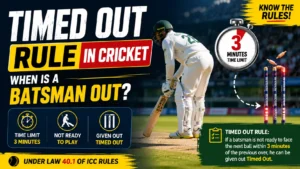

The timed out rule in cricket is one of the rarest ways a batter can be dismissed. Under Law 40, an incoming batter must be ready to play within the prescribed time after a wicket falls or a batter retires. The standard MCC Law provides three minutes, although tournament or match-specific playing conditions may set a shorter period. If the new batter is not ready within the allowed time and the fielding team appeals, the umpire can declare the batter timed out. This rule helps prevent unnecessary delays and ensures the game continues smoothly.
Unlike most dismissals, a timed out rule wicket does not involve the bowler delivering a ball, so the bowler does not receive credit for the dismissal. The rule became widely discussed during the 2023 ODI World Cup when Angelo Mathews was dismissed timed out against Bangladesh, becoming the first batter to suffer this dismissal in men’s international cricket.
Table of Contents
Timed Out Rule & Cricket Law
- The timed out rule in cricket is an official method of dismissal covered under Law 40 cricket, specifically Law 40 timed out in the Laws of Cricket. It applies when an incoming batter fails to be ready to receive the ball within the prescribed time after a wicket falls or a batter retires. Under the current MCC wording, the standard period is three minutes, although competition playing conditions can specify a different limit.
- The basic timed out rule in cricket is intended to prevent unnecessary delays between dismissals and the arrival of the next batter. If the required time expires, the incoming batter can be given a timed out rule dismissal following an appeal. This makes a timed out wicket one of the most unusual cricket dismissal rules, because the batter can be dismissed out without facing a ball.
- In simple terms, the timed out meaning or timed out rule definition is a batter dismissal caused by failing to become ready within the permitted time, rather than by what happens during a delivery. The bowler does not receive credit for a cricket timed out wicket, which distinguishes it from many conventional methods of dismissal.
- The rule also applies after a batter retirement, not only after a wicket falls. The incoming batter must be ready to receive the ball, or the other batter must be ready to receive the next ball, within the relevant time limit. This requirement is part of the wider cricket rules and regulations designed to keep play moving.

Time Limit for Incoming Batter
Under the timed out rule time limit, an incoming batter must be ready to receive the ball within the prescribed time after the fall of wicket or when the previous batter retired. The MCC standard is three minutes, although competition rules may specify a shorter period. Simply reaching the batting crease or preparing to take guard is not enough if the batter is not ready to face the ball.
The time limit in Test cricket, ODI cricket, and T20 cricket can vary according to specific playing conditions. These rules are designed to reduce the time between wickets, prevent batting delay, and keep the match moving smoothly after a wicket.
Visit this: What Is a Maiden Over in Cricket? Rules, Types & Importance
Match Format & Time Limits
The timed out rule can have different limits depending on the cricket format rules and competition playing conditions. The MCC standard is three minutes, while current ICC international conditions use shorter limits in some formats.
| Match Format | Timed Out Rule Time Limit | Applicable Conditions |
|---|---|---|
| Test cricket timed out rule | 2 minutes | Test match playing conditions |
| ODI timed out rule | 2 minutes | ODI playing conditions |
| One Day International timed out rule | 2 minutes | Competition playing conditions |
| T20 timed out rule | 90 seconds | T20 playing conditions |
| Twenty20 International timed out rule | 90 seconds | ICC T20I conditions |
| First-class cricket timed out rule | Usually 3 minutes | Match-specific playing conditions |
| MCC standard timed out rule | 3 minutes | Laws of Cricket, Law 40 |
The three-minute rule is the MCC standard, while the two-minute rule applies in current ICC Test and ODI conditions and 90 seconds is used for T20Is. Always check the specific match-specific playing conditions because they can override the standard Law.
Appeal & Umpire Decision
A timed out rule appeal must come from the bowling team before the next delivery begins. Under the cricket umpire rules, an umpire cannot normally give a batter out without an appeal. The on-field umpire considers whether the incoming batter was ready within the prescribed time and, if the conditions are satisfied, gives the timed out decision.
The umpire authority also includes checking the timing and circumstances of the appeal. A valid appeal for timed out must be made before the bowler starts the run-up or delivery action for the next ball and before Time is called. Once the umpire confirms the requirements, the batter is given out, making it a dismissal on appeal. The appeal can be a general “How’s That?”, which covers all methods of dismissal.
Batting Order & Incoming Batter
The incoming batter can be any nominated batter who has not yet batted; cricket does not require players to follow a fixed batting order. When a wicket falls, the captain can choose the next batter from the remaining batting lineup, including a number 11 batter if appropriate. The incoming batsman must make their way to the wicket promptly and be ready to receive the ball within the applicable time limit.
Simply being a batsman waiting to bat, batter entering the field, or reaching the crease is not always enough. The new batter must be ready to face the delivery, or the batting partner must be ready to receive the next ball. This means a replacement batter or other remaining batter should avoid unnecessary delays after the previous batter is dismissed. The batting captain may also change the intended batting order before a batter takes the field.

Reasons for Being Timed Out Rule
- Late arrival at crease: A batter arrives late and fails to become ready within the prescribed time after the wicket falls.
- Failure to enter the field: A delayed batter may be dismissed if they do not come onto the field and become ready in time.
- Unprepared batter: Simply reaching the crease is not enough; the batter must be ready to receive the ball.
- Dressing room or equipment delay: A helmet problem, broken helmet strap, waiting for equipment, or other equipment issue can cause a delay. However, players should immediately inform the umpires if a genuine equipment problem occurs. MCC noted that equipment-related delays can potentially be handled differently when reported before the relevant time expires.
- Confusion over batting order: Uncertainty about who should bat next can contribute to an unnecessary delay.
- Injury delay: An injury delay may affect a player’s ability to enter the field, but the umpires assess the circumstances rather than automatically giving a timed out dismissal.
- Travel delay or delayed flight: These are generally not valid excuses once a player is required to bat; a player unavailable to enter and become ready within the applicable period can face the rule.
- Failure to be ready: The key issue is whether the incoming batter has become ready to receive the ball within the prescribed time. Under MCC Law 40, the standard period is three minutes, although competition playing conditions may specify a different limit.
- Failure to take guard: Under the current MCC wording, the requirement is no longer specifically to take guard; the batter must be ready to receive the ball.
Note: Not every delay automatically results in a timed out rule dismissal. The applicable playing conditions, communication with the umpires, and whether the batter was actually ready within the required period all matter.
Visit this also: What Happens When a Cricket Match Is Tied? Rules, Super Over, ODI, T20 & Test
Famous Timed Out Incidents
| Incident | Match & Year | What Happened |
|---|---|---|
| Angelo Mathews timed out | Sri Lanka vs Bangladesh, 2023 Cricket World Cup | Angelo Mathews was dismissed timed out after arriving at the crease and experiencing a helmet strap incident. Bangladesh captain Shakib Al Hasan made the appeal, and the umpire upheld it. It became the first timed out dismissal in international cricket. |
| 2023 World Cup timed out incident | Delhi World Cup match, 2023 | The incident occurred during Sri Lanka’s innings after Sadeera Samarawickrama was dismissed. Under the World Cup two-minute rule, Mathews had to be ready to receive the ball within two minutes. |
| Sourav Ganguly nearly timed out | South Africa vs India, 2007 Test | Sourav Ganguly was nearly given out after taking more than six minutes to reach the crease. South Africa captain Graeme Smith chose not to appeal, allowing Ganguly to bat. |
| First-class cricket incidents | Various matches | Before Mathews, there had already been six recorded instances of timed out dismissals in first-class cricket, showing that the rule was not new but was extremely rare at international level. |
The Angelo Mathews dismissal became a major timed out controversy and World Cup cricket controversy because of the broken helmet strap and the Shakib Al Hasan appeal. Mathews argued that the equipment failure caused the delay, while Bangladesh maintained that the dismissal was permitted under the applicable playing conditions. The incident remains one of the most discussed examples of a controversial cricket dismissal and cricket law controversy.
T20 & International Cricket Examples
- Godfred Bakiweyem timed out: Ghana’s Godfred Bakiweyem became the first T20I batter to be dismissed timed out when Ghana played Sierra Leone in the 2023 Africa Cricket Association Africa T20 Cup. This made it the first men’s T20I timed out dismissal, shortly after Angelo Mathews’ ODI incident.
- Ghana timed out: Bakiweyem’s dismissal is one of the rarest examples of a T20 timed out in international cricket. The incident showed that the rule also applies in shorter formats, where the available time is typically much shorter. Current ICC T20I playing conditions specify 90 seconds for the incoming batter to be ready.
- Ritschi Choden timed out: Bhutan’s Ritschi Choden became the first woman cricketer to be dismissed timed out in a women’s international match. Her case added another unusual chapter to the history of the timed out rule and demonstrated that the dismissal can occur in women’s T20I cricket as well.
- Why these incidents matter: The examples involving Ghana, Sierra Leone cricket, Bhutan women’s cricket, and Nepal women’s cricket highlight how uncommon this international cricket dismissal remains. A timed out wicket can happen without the batter facing a delivery, making it one of cricket’s most rare cricket dismissals.

Cricket Strategy & Prevention
Teams can avoid being timed out by preparing the next batter before a wicket falls. Good dressing room communication, clear batting order communication, and dugout preparation ensure that players are ready to bat immediately. The incoming batter should respond quickly after a wicket, complete their batting preparation, and reach the crease without unnecessary delays. Under Law 40, the batter must be ready to receive the ball within the applicable time limit.
Effective team coordination, match awareness, cricket discipline, and captaincy decisions can help prevent a timed out dismissal. A quick changeover, clear communication between the dressing room and players, and proper incoming batter preparation reduce the risk of delay. In formats with shorter limits, such as T20 cricket, teams need an especially quick response after wicket because the available time can be as little as 90 seconds under relevant playing conditions.
What is the timed out rule in cricket?
The timed out rule in cricket is a method of dismissal under Law 40. An incoming batter must be ready to receive the ball within the prescribed time after a wicket falls or a batter retires.
How much time does a batter get to avoid being timed out?
The standard MCC timed out time limit is three minutes, but international competitions can use different playing conditions. For example, ICC Tests and ODIs use two minutes, while T20Is use 90 seconds.
Can a batter be timed out without facing a ball?
Yes. A batter can be dismissed timed out before facing a delivery if they fail to become ready within the applicable time limit and the fielding side appeals.
Who was the first international cricketer to be timed out?
Sri Lanka’s Angelo Mathews became the first batter to be dismissed timed out in international cricket during the 2023 Cricket World Cup match against Bangladesh.
Does the bowler get credit for a timed out wicket?
No. Under Law 40, the bowler does not receive credit for a timed out wicket because the dismissal occurs before the batter faces a delivery.


[…] Visit this: Timed Out Rule in Cricket: When Is a Batsman Out? […]
[…] Visit this also: Timed Out Rule in Cricket: When Is a Batsman Out? […]
[…] Visit this: Timed Out Rule in Cricket: When Is a Batsman Out? […]
[…] Visit this also: Timed Out Rule in Cricket: When Is a Batsman Out? […]