
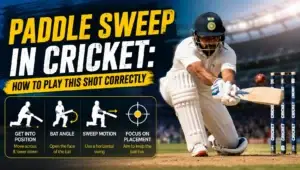

The paddle sweep in cricket is a clever paddle sweep shot used to guide the ball toward fine leg or behind square on the leg side. This paddle sweep cricket shot is based on a soft-handed shot, controlled bat angle, good timing, and the bowler’s pace rather than a powerful swing. As a variation of the sweep shot, the paddle sweep technique gives batters another option when playing spin and looking for easy runs.
Unlike a conventional sweep batting technique, paddle sweep batting focuses more on placement and control. It is a controlled sweep, fine sweep, and deflection shot that can work as an attacking batting shot when the field is set defensively. As an unconventional cricket shot, the paddle shot in cricket has become a valuable option among modern cricket batting shots, particularly for finding gaps around the fine leg shot area.
Table of Contents
Paddle Sweep in Cricket Technique
A good paddle sweep in cricket technique starts with a balanced batting stance and an early reading of the delivery. Move into a low batting position with bent knees, using a small front foot movement toward the ball while keeping the front knee bend controlled. Your head position is crucial—keep your head over the ball and allow your head moving towards the ball to support balance and weight transfer. Maintain strong body alignment and body balance rather than falling across the line.
At contact, keep the bat position close to the ball and use a suitable bat angle with the bat face directed toward the intended fine-leg area. A slightly horizontal bat, extended arms, and relaxed wrists help create a controlled deflection. Focus on wrist control, soft hands, and good hand-eye coordination instead of a forceful swing. Keep the controlled bat swing compact, transfer your weight smoothly, and focus on timing the ball. The point of impact and ball contact should allow you to use the bowler’s pace, guiding the delivery rather than trying to hit it hard.

Ball Selection & Ideal Delivery
The paddle sweep in cricket is most effective when the batter is reading the bowler and judging the length early, rather than playing the shot to every delivery. The ideal ball is usually a fuller delivery or full ball on or around leg stump, particularly from spin bowling. A delivery on middle stump can also be suitable when the batter gets into position early, while a ball outside leg stump may provide a natural angle for guiding the ball fine. The length of delivery and batting line should always be considered before committing to the shot.
Good shot selection is especially important because a quicker delivery, straight delivery, or good length delivery can reduce the batter’s time to get into position. The paddle sweep in cricket is generally more suitable against spin bowling than pace bowling, particularly when a spinner offers a fuller ball around the leg-side line. A fast bowler delivery should not automatically be attacked with this shot because the extra pace can make control difficult. Successful appropriate ball selection means waiting for the right opportunity, attacking the right delivery, and using the bowler’s pace to redirect the ball rather than forcing the stroke.
Visit this: How to Throw a Cricket Ball Accurately for Better Fielding
Execution & Shot Direction
To execute the paddle sweep in cricket effectively, get low and move your body toward the line of the ball as the delivery arrives. Keep your head and shoulders stable, bring the bat out early, and use a compact movement rather than a large swing. At the moment of contact, extend the arms naturally and keep the hands relaxed. The key is to deflect the ball with the pace of the delivery instead of trying to hit it hard.
The ideal shot direction is very fine behind square on the leg side, often between the wicketkeeper and fine leg. Slightly adjusting the bat face allows you to guide the ball finer or more square depending on the field placement. Good timing and a controlled bat face are more important than power, helping the batter find gaps, rotate the strike, and put pressure on the bowler.
Footwork & Body Mechanics
| Element | How to Use It in the Paddle Sweep in cricket |
|---|---|
| Quick footwork | Move early toward the delivery so you can get into position without losing body control. |
| Front foot | Step the front foot toward the line of the ball while maintaining a stable base. |
| Front knee | Bend the front knee to create a low, comfortable position for the shot. |
| Back leg | Allow the back leg to bend or collapse naturally as you lower your body. |
| Low stance | Use a low stance to bring your eyes closer to the ball and improve control. |
| Crouched position | A crouched position helps you get underneath the delivery and guide it fine. |
| Balanced stance | Maintain a balanced stance throughout the movement instead of falling across the line. |
| Body weight forward | Keep your body weight forward as you move into the shot, while remaining stable. |
| Weight transfer | Smooth weight transfer toward the front side helps maintain control at contact. |
| Head position | Keep the head position steady and close to the line of the ball, ideally over the front foot. |
| Shoulder alignment | Maintain shoulder alignment with the delivery so the arms can extend freely. |
| Hip rotation | Use controlled hip rotation to support the movement without over-rotating the body. |
| Wrist movement | Keep wrist movement soft and controlled to guide the ball rather than hit it forcefully. |
| Arm extension | Allow natural arm extension at impact to direct the ball toward fine leg. |
| Bat swing | Keep the bat swing compact, using the pace of the delivery instead of a large backswing. |
| Balance at impact | Stay stable at the moment of contact so the bat face remains under control. |
| Stable base | A stable base gives you better direction, timing, and consistency. |
| Body control | Good body control allows the batter to stay balanced while making a delicate deflection. |
These mechanics are especially important because the paddle sweep in cricket depends more on balance, timing, and controlled movement than power. A stable lower body and steady head allow the batter to guide the ball accurately behind square on the leg side.

Paddle Sweep in Cricket Against Spin
The paddle sweep against spin is a useful scoring option when facing spinners, particularly during middle overs batting. The batter should focus on reading spin, watching the flight of the ball, and judging its turn and drift before committing to the shot. Against off spin, a paddle sweep off spin can be effective when the ball comes into the batter on a suitable line, allowing the batter to use the bowler’s pace and guide it fine on the leg side.
The same principle can work for a paddle sweep against leg spin, but the batter must carefully assess the line and length because wrist-spin variations can change the direction and amount of turn. Rather than blindly attacking spin bowling, good batters use the paddle sweep in cricket as part of a wider spin bowling strategy, combining placement, footwork, and manipulating spin to create gaps. Using spinner’s pace can make the shot easier and safer, helping with scoring against spin and preventing the bowler from settling into a predictable rhythm.
Visit this also: How to Use Bouncer as a Bowling Tactic in Cricket
Paddle Sweep in Cricket Against Pace
The paddle sweep against pace can be effective when a batter reads the bowler early and uses the speed of the delivery rather than trying to generate power. Against a fast bowler, a quicker ball or fast delivery around the leg-side line can sometimes be guided fine with a compact movement. The key to paddle sweep against fast bowling is using pace and deflecting pace with relaxed hands, allowing the ball to travel toward the scoring area behind the wicket. The paddle is primarily a touch shot, so it generally works better when there is enough pace on the ball.
Because batting against pace leaves less reaction time, the batter should avoid forcing the shot and instead focus on late contact, soft hands, and controlled contact. A well-executed fine deflection can beat the wicketkeeper or leg-side fielders and create valuable runs through scoring behind square. However, changes in pace variation, yorkers, and straight deliveries can make the shot risky, so careful judgment of the delivery and field is essential.

Paddle Sweep in Cricket vs Other Sweep Shots
- Paddle sweep vs sweep shot: The paddle sweep in cricket is a finer, softer variation of the conventional sweep. It uses an angled bat face and touch to guide the ball toward fine leg, while the traditional sweep generally targets square leg or behind square.
- Orthodox sweep: This is the more traditional sweep shot, usually played with a horizontal bat toward square leg or fine leg. It emphasizes controlled power and placement against spin.
- Slog sweep: The slog sweep is an attacking variation designed to generate power and elevation, commonly targeting mid-wicket or deep square leg. The slog sweep technique requires a stronger swing than the paddle sweep in cricket technique.
- Reverse sweep: The reverse sweep changes the direction of the conventional sweep, sending the ball toward the off side, commonly through backward point or third-man areas. Its reverse sweep technique requires greater timing and control.
- Conventional sweep: The conventional sweep is generally a dependable option for putting a fuller spin delivery into the leg-side scoring areas, whereas the paddle sweep in cricket focuses more on fine placement and using the bowler’s pace.
- Sweep variations: Modern batters can choose from several sweep variations, including the orthodox sweep, paddle sweep in cricket, slog sweep, and reverse sweep. Each offers a different combination of placement, power, direction, and risk.
- Sweep shot types: Different sweep shot types allow batters to respond to field settings and delivery conditions instead of relying on one stroke.
- Cricket shot variations: These cricket shot variations expand a batter’s scoring options, particularly against spin, and help manipulate gaps in the field.
- Attacking sweep: An attacking sweep is generally associated with greater bat speed and boundary intent, making the slog sweep more aggressive than the paddle sweep in cricket.
- Defensive sweep: A defensive sweep prioritizes control and safe placement rather than maximum power. The paddle sweep in cricket can serve this purpose when the batter simply wants to rotate the strike.
- Shot selection: Good shot selection is essential. The batter should consider the bowler, line and length, field placement, pace, and match situation before choosing between the paddle sweep in cricket and other sweep shot types.
Frequently Asked Questions About Paddle Sweep in Cricket
What is a paddle sweep in cricket?
A paddle sweep in cricket is a controlled batting shot used mainly against spin bowling. The batter gently guides the ball toward fine leg or behind square on the leg side rather than hitting it with a powerful swing.
How do you play the paddle sweep shot?
To play the paddle sweep shot, get into a low stance, watch the ball closely, keep your head steady, and use soft hands with a slightly angled bat face. The goal is to use the bowler’s pace and guide the ball into an open area.
When should you play a paddle sweep?
The paddle sweep is most effective against a fuller delivery around the leg or middle stump, particularly from a spinner. Good shot selection and awareness of the field are important before attempting it.
Is the paddle sweep effective against fast bowlers?
Yes, but it requires excellent timing and judgment. A paddle sweep against pace works best when the batter can use the bowler’s speed and make controlled, often late contact to guide the ball behind square.
What is the difference between a paddle sweep and a slog sweep?
A paddle sweep relies mainly on touch, placement, and soft hands, usually directing the ball toward fine leg. A slog sweep is a more aggressive shot that uses a bigger swing and aims to hit the ball powerfully toward areas such as mid-wicket or deep square leg.


