
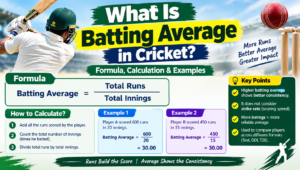

If you have ever compared two cricket batters, you may notice that total runs do not tell the whole story. Batting average in cricket is an important part of cricket statistics because it shows how many runs a batter scores, on average, each time they are dismissed. The batting average definition is based on total runs divided by dismissals, making it different from simply measuring runs per innings.
When asking “what is batting average in cricket ?”, the statistic helps explain a batter’s run scoring ability, batting consistency, and batting reliability. A career batting average is especially useful for evaluating individual batting performance, comparing cricket player statistics, and understanding a player’s long-term batting performance through their average runs per dismissal.
Table of Contents
Batting Average in Cricket Formula & Calculation
The batting average formula in cricket is simple:
“Batting Average = Total Runs Scored ÷ Total Dismissals.”
To understand how to calculate batting average in cricket , take the batter’s total runs scored and divide them by the number of times dismissed. This batting average calculation measures the average runs calculation per dismissal rather than simply dividing runs by innings played.
For example, if a batter scores 600 career runs and is dismissed 20 times, the batting average is 600 ÷ 20 = 30. Not out innings and not outs are important because an innings where the batter remains unbeaten does not increase the total dismissals. This batting average equation is the standard cricket average calculation and is widely used in batting statistics formula and cricket scoring statistics to assess a batter’s consistency.

Not-Out Innings & Dismissals
A not out means a batter finishes an innings without being dismissed. These unbeaten innings do not count toward the batter’s number of dismissals or times out. For example, if a player scores 250 runs across 10 innings and remains not out twice, they have been batter dismissed eight times. The batting average denominator is therefore based on eight dismissals, not all 10 innings.
This explains the effect of not outs on batting average in cricket. The calculation is essentially innings minus not outs, with the resulting number representing the dismissal denominator. Since runs before dismissal are divided by the number of times a batter is out, not outs and batting average are closely connected. A batter with fewer wickets lost and more unbeaten innings can have a higher average, making dismissal statistics important when evaluating batting performance.
Good Batting Average in Cricket
A good batting average in cricket depends on the format, level of competition, and a batter’s role. In general, a good cricket batting average shows consistent run scoring, while an excellent batting average in cricket indicates strong and reliable performance. At professional and international levels, batting averages above 40 are often considered very good, while an average of 50 or more can represent a world-class average in many contexts. However, batting average benchmarks vary between Test, ODI, and T20 cricket.
The batter’s position also matters when comparing batting performance benchmarks. A top-order batter average or opener batting average may differ from a middle-order batter average because of different responsibilities and match situations. Similarly, a number three batter average can be judged differently from a lower-order batter average. Therefore, professional batting average, international batting average, and club cricket batting average should be evaluated according to appropriate batting standards, cricket batting benchmarks, and role-specific batting average rather than one fixed acceptable batting average in cricket.
Visit this: How to Rotate Strike in Cricket: Techniques, Tips & Batting Strategy
Factors Affecting Batting Average in Cricket
Several factors can influence a batter’s average throughout a season or career:
- Pitch Conditions: A difficult pitch can make stroke-making harder, while a flat pitch may create more scoring opportunities.
- Bowling Quality: The strength of the opposition bowling attack, including fast bowlers and spin bowlers, can directly affect batting results.
- Quality of Opposition: Facing a strong quality of opposition can make it harder to maintain a high average.
- Batting Position: A batter’s batting position influences the number of opportunities and situations they face.
- Match Conditions: Different match conditions, playing conditions, and the overall cricket environment can affect scoring.
- Batting Technique & Style: A sound batting technique and suitable batting style can improve consistency, while aggressive batting may involve greater risk-taking.
- Match Situation: Pressure situations, required run rates, and the importance of the match situation can change how a batter approaches an innings.
- Player Experience: Experienced players often handle pressure and changing conditions better, helping maintain consistency over time.
Batting Position & Role
A batter’s batting position and batting order can strongly influence their statistics because each position comes with different responsibilities. An opening batter or opener faces the new ball and must handle new ball batting, while a top-order batter, such as a number three batter, often has more time to build an innings. A middle-order batter usually enters when the game is already developing, whereas a lower-order batter, such as a number six batter or number seven batter, may have a more specialized role.
The batting role also affects role-specific performance. A specialist batter may focus mainly on run scoring, while an all-rounder or wicketkeeper batter may have additional responsibilities. An anchor batter generally prioritizes stability and middle-order batting, while an aggressive batter may take more risks in a finishing role. Because batting responsibility varies by position, batting averages are best compared between players with similar roles rather than treating every batter the same.

Batting Average in Cricket vs Strike Rate
Both batting average and strike rate are important cricket batting metrics, but they measure different aspects of a batter’s performance. Batting average in cricket focuses on consistency and runs scored per dismissal, while strike rate measures scoring speed, usually expressed as runs per 100 balls. The average and strike rate comparison is especially useful in limited overs batting, where both reliability and quick scoring matter.
| Metric | Batting Average in Cricket | Strike Rate in Cricket |
|---|---|---|
| What it measures | Batting consistency | Scoring speed |
| Basic idea | Runs scored per dismissal | Runs per 100 balls |
| Main focus | Batting efficiency and reliability | Scoring rate and attacking intent |
| Uses balls faced? | No | Yes, balls faced are essential |
| Attacking batting | Does not directly measure it | Helps show aggressive batting |
| Consistency vs scoring speed | Better for consistency | Better for scoring speed |
| Test batting performance | Very important | Useful but less emphasized |
| ODI batting performance | Important | Very important |
| T20 batting performance | Useful | Extremely important |
| Modern batting statistics | Measures run production per dismissal | Measures the pace of run production |
In simple terms, batting average vs strike rate is a comparison between how consistently a batter scores and how quickly they score. A batter can have a high average but a lower strike rate, or combine a strong average with a high strike rate, depending on their batting role and format.
Batting Average in Cricket & Player Comparison
When you compare cricket batters, batting average in cricket provides a useful way to measure batter consistency and long-term performance. To compare batting averages, look at players from the same format, period, and similar batting roles. A player comparison should consider both runs versus average because a player with more career runs may have a lower average due to being dismissed more often.
For a meaningful career comparison, combine batting average with career statistics, batting records, and average versus strike rate. International records and domestic records can also provide useful context when evaluating career performance. While batting average is valuable for cricket player evaluation and player ranking, it should not be the only measure of batting ability or batting effectiveness, since factors such as opposition, format, and role can influence the numbers.

Famous Batting Averages & Cricket Records
Some of the most remarkable batting averages in cricket history include:
- Sir Donald Bradman: The legendary Australian batter finished his Test career with a 99.94 average, widely regarded as the greatest batting average in elite Test cricket.
- Donald Bradman’s 99.94: His career mark remains one of the most famous batting average records and a defining achievement in Test batting records.
- Highest Batting Average: Bradman’s figure is the benchmark most often associated with the highest batting average in Test history among players with substantial careers.
- Career Batting Average Records: Bradman’s record remains one of the standout historical batting records in the sport.
- Elite Batting Statistics: Exceptional averages can highlight a batter’s extraordinary consistency and ability to score runs over a long career.
- Cricket Records: Batting averages are frequently used alongside centuries, runs, and other cricket statistical records to assess legendary players.
- Exceptional Batting Average: Maintaining a very high average over many innings requires remarkable consistency, making such performances especially significant in historical batting records.
Visit this also: What Is Declaration in Cricket? Rules, Strategy & Examples Explained
Advantages & Importance of Batting Average in Cricket
The importance of batting average in cricket comes from its ability to show how consistently a batter scores runs before getting dismissed. It is a useful performance metric and statistical indicator for measuring batting consistency, helping coaches, teams, and analysts evaluate batter performance and assess reliability over time.
- Measures consistency: Helps identify long-term consistency in run scoring.
- Evaluates performance: Useful for performance evaluation and overall batting assessment.
- Compares players: Makes it easier to compare players with similar roles and formats.
- Supports career analysis: Helps track changes in a batter’s performance throughout their career.
- Aids team selection: Coaches and selectors can consider averages when making team selection decisions.
- Improves player development: Highlights areas where a batter may need improvement.
- Supports coaching analysis: Provides useful data for coaching analysis and training decisions.
- Useful in cricket analytics: Forms an important part of cricket analytics and broader cricket analysis.
- Shows reliability: A strong average can indicate that a batter regularly contributes meaningful runs.
Frequently Asked Questions About Batting Average in Cricket
What is batting average in cricket?
Batting average in cricket is the average number of runs a batter scores each time they are dismissed. It is calculated by dividing total runs scored by total dismissals.
How is batting average calculated in cricket?
The batting average formula is total runs scored ÷ number of times dismissed. Not-out innings are not counted as dismissals.
What is considered a good batting average in cricket?
A good batting average depends on the format and batting role. In Test and ODI cricket, an average of 40 or above is generally considered strong, while 50 or higher is often regarded as excellent.
Why are not-outs important in batting average?
Not-outs are important because they do not count in the dismissal total. As a result, a batter with several unbeaten innings can maintain a higher batting average.
What is the difference between batting average and strike rate?
Batting average measures runs scored per dismissal, while strike rate measures how quickly a batter scores, usually as runs per 100 balls. Both statistics provide different insights into batting performance.


[…] Visit this: What Is Batting Average in Cricket? Formula, Calculation & Examples […]