
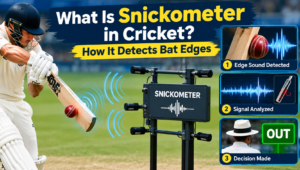

If you have ever watched a close cricket review where the ball seems to brush the bat, you may have noticed a small graph or sound-based spike on the screen. This is where the snickometer, commonly called Snicko or Snicko meter, becomes useful. It is a cricket technology system designed to help identify whether the ball made contact with the bat or glove, giving officials and viewers another piece of evidence during a review.
The snickometer in cricket is part of the wider use of technology in cricket, alongside ball tracking technology and the Decision Review System (DRS). While DRS technology gives umpires access to different forms of evidence, Snicko focuses mainly on detecting small sounds or signals around the moment the ball passes the bat. This umpiring technology has become an important part of cricket review technology, modern cricket, and broadcast technology, showing how technological innovation and match technology are changing the way decisions are examined on the field.
Table of Contents
How Snickometer in Cricket Works?
A Snickometer uses a stump microphone or sensitive microphone near the stumps to capture tiny sound waves when the ball passes the bat. The microphone converts the sound into an audio signal, which is processed through audio technology and displayed as a visual graph, waveform, or soundwave graph. During waveform analysis, officials look for a sound spike, sharp spike, or other changes in the audio trace that could indicate an impact sound.
The recorded signal is then matched with synchronized audio and video replay to check the exact timing of the possible contact. Acoustic detection, signal detection, and sound frequency analysis help separate a possible edge from other noises. The system can display electrical signals through an oscilloscope, while a flat line or weak signal may indicate little or no significant sound.

Detecting Bat-Ball Contact
Snickometer in cricket helps officials examine possible bat-ball contact by recording the sound created when the ball hits the bat. This can help identify an outside edge, inside edge, faint edge, thin edge, or small nick when the ball is nicking the bat. A clear snick may appear as a sound spike, helping with contact detection when the ball is passing the bat.
However, not every sound means there was bat contact. The system must distinguish an impact between bat and ball from bat-pad contact, glove contact, pad contact, or body contact. Sounds such as the ball hitting pad, ball hitting glove, or ball hitting equipment can also appear in the recording, so officials use the timing of the signal and video evidence to assess whether the sound came from genuine bat contact and make the correct edge detection decision.
Snickometer in Cricket DRS & Umpiring
During a DRS review, the third umpire, also known as the television umpire, can use Snickometer as part of the review process. When an on-field umpire makes a wicket decision or another disputed decision, Snickometer can provide audio evidence alongside video evidence. This is especially useful during a catch review for a possible caught behind, where officials need to determine whether there was a bat contact before the ball reached the wicketkeeper.
For an LBW review, Snickometer may help establish whether the ball made contact with the bat or pad first, supporting the LBW decision. The appeal, original umpire decision, and available evidence are considered during the decision review. Snickometer does not independently make the decision; instead, it provides umpire assistance and supports decision making as part of modern review technology. The final decision remains with the appropriate umpire after considering all relevant evidence.
Visit this: How Does DRS Work in Cricket? A Simple Guide to DRS Rules & Technology
Snickometer in Cricket Graph & Sound Patterns
- Snickometer graph: Shows changes in recorded sound as the ball approaches and passes the bat.
- Sound graph / waveform graph: Provides a graphical representation of the captured audio, making sudden changes easier to identify.
- Oscilloscope trace: Displays the electrical representation of the recorded sound and helps officials examine the audio trace.
- Audio spike: A noticeable rise in the graph can indicate a possible contact or impact.
- Sharp sound: A bat edge can sometimes create a short sharp spike rather than a long, continuous signal.
- Flat sound wave: A relatively flat pattern may suggest that no significant impact was detected at that moment.
- Sound pattern and sound signature: Officials consider the overall shape and timing of the signal rather than relying on one spike alone.
- Impact signature: A distinct change in the graph may correspond to the sound produced by contact.
- Graph interpretation: The graph must be assessed alongside other available evidence because different events can create similar audio signals.
- Synchronized replay: The graph is matched with slow motion footage and camera footage to establish the timing of a possible contact.
- High speed camera: Detailed footage can help officials compare the ball trajectory with the sound pattern as the ball passes the bat.

Uses of Snickometer in Cricket
| Snickometer Use | How It Helps |
|---|---|
| Detect edges | Helps officials identify possible edges when the ball passes the bat. |
| Detect faint edges | Can highlight a small sound from a thin or faint edge that may be difficult to hear naturally. |
| Confirm bat contact | Provides audio evidence that can support whether the ball touched the bat. |
| Identify bat-ball contact | Helps determine whether a sound occurred at the moment the ball passed the bat. |
| Distinguish bat and pad | Helps compare the timing of possible bat contact with pad contact during reviews. |
| Support LBW decisions | Can provide additional evidence during LBW decisions, particularly when checking whether the bat came before the pad. |
| Review caught-behind decisions | Helps officials examine possible edges in caught-behind decisions. |
| Analyze close calls | Adds another source of evidence when a decision is difficult to judge with the naked eye. |
| Assist match officials | Gives umpires additional information during the decision analysis process. |
| Television analysis | Helps broadcasters explain close incidents during television analysis and live cricket coverage. |
| Broadcast replay | Can be shown alongside broadcast replay to help viewers understand a disputed moment. |
| Cricket commentary | Provides useful information for cricket commentary when discussing possible edges and reviews. |
| Decision analysis | Supports a more detailed examination of disputed incidents using available audio and video evidence. |
| Controversial decisions | Can provide additional evidence when reviewing controversy |
History & Development of Snickometer in Cricket
The Snickometer was invented by Allan Plaskett, a British computer scientist and English inventor, during the mid-1990s. It emerged as part of the 1990s cricket technology movement, when broadcasters were looking for better ways to analyze close decisions. The early Snickometer used a sensitive microphone and oscilloscope to capture sound and display it alongside replay footage.
A major step in the development of Snicko came in 1999, when Channel 4 introduced it as part of its television broadcasting of international cricket. This made Snickometer an important cricket broadcast innovation and helped demonstrate how technology could improve match coverage and decision analysis. Since then, the evolution of cricket technology has produced more advanced systems, while the modern Snickometer continues to be used in some broadcasts and review systems.
Visit this also: Why Is a Good Economy Rate Important in Cricket? Bowling Impact, Strategy & T20 Explained
Accuracy & Limitations of Snickometer in Cricket
- Background noise: Crowd noise, player movement, and other sounds can affect the recording.
- Unwanted sound: Sounds such as the bat hitting pads or other equipment may create confusing signals.
- Bat-pad noise: Contact between the bat and pad can sometimes appear similar to a genuine edge.
- Bat hitting ground: A bat touching the ground may produce an audio signal that complicates analysis.
- Ball hitting pad: The sound of the ball hitting the pad can occur very close to a possible bat contact.
- Multiple sound sources: Several sounds may happen almost simultaneously, making the signal harder to isolate.
- Sound interference: Overlapping noises can affect the clarity of the recorded signal.
- False signals: Not every spike represents bat-ball contact, so a signal can sometimes be misleading.
- Unclear waveform: A weak or irregular waveform may make the possible contact difficult to identify.
- Difficult interpretation: Officials must consider the shape and timing of sound rather than relying on a single spike.
- Sound coincidence: A separate sound occurring at almost the same time as the ball passing the bat can create uncertainty.
- Visual confirmation: Snickometer is normally assessed alongside replay footage for additional confirmation.
- Human judgment: The final interpretation still requires trained officials to evaluate all available evidence.
- Technology limitations: These limitations of Snickometer mean it should be treated as supporting evidence rather than an infallible decision-making tool.
- Accuracy issues: The system can be highly useful, but accuracy issues may arise when sound quality, timing, or other conditions make the signal difficult to interpret.

Snickometer in Cricket vs Other Cricket Technologies
| Technology | How It Works | Main Purpose |
|---|---|---|
| Snickometer | Uses sound-based technology and stump mic technology to detect sounds from possible bat contact. | Audio-based detection and edge detection technology. |
| Hot Spot | Uses infrared cameras and thermal imaging to identify heat generated by contact. | Detects possible bat-ball impact visually through heat signatures. |
| UltraEdge / Ultra Edge | An advanced form of audio-based detection that combines sound signals with video timing. | Bat contact detection and edge detection during DRS reviews. |
| Hawkeye | Uses multiple cameras to track the ball and reconstruct its path. | Ball tracking, trajectory analysis, and LBW decisions. |
| DRS technologies | Combine systems such as ball tracking, UltraEdge, and other review tools. | Provide evidence for cricket review systems and umpiring decisions. |
The main difference in this technology comparison is that Snickometer and UltraEdge rely heavily on audio, while Hot Spot uses visual technology, infrared cameras, and thermal imaging. Hawkeye focuses on ball movement rather than sound. Together, these systems provide different forms of impact detection, making modern DRS more comprehensive than relying on a single technology.
Frequently Asked Questions About Snickometer in Cricket
What is Snickometer in cricket?
Snickometer is a cricket technology that uses sensitive microphones to detect sounds made when the ball may contact the bat. It is mainly used to help analyze possible edges during DRS reviews.
How does Snickometer work in cricket?
Snickometer captures sound through microphones near the stumps and displays the audio signal as a waveform or graph. Umpires compare the sound with video replay to determine whether bat-ball contact may have occurred.
Is Snickometer used in DRS?
Yes, Snickometer can be used as part of the Decision Review System to provide additional audio evidence during reviews, especially for caught-behind and other close bat-contact decisions.
What is the difference between Snickometer and UltraEdge?
Both technologies use sound to help detect possible bat contact, but UltraEdge is a more modern edge-detection system designed for DRS and synchronized with video replay. Snickometer is an earlier form of sound-based detection technology.
How accurate is Snickometer in cricket?
Snickometer can provide useful evidence, particularly for faint edges, but it is not perfect. Background noise, bat-pad contact, multiple sound sources, and timing issues can make signals difficult to interpret, so officials also consider video evidence and human judgment.


