
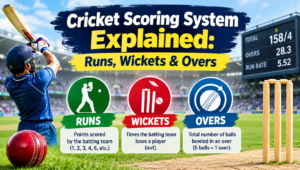

Imagine watching a close cricket match and seeing the scoreboard change after every ball. Understanding the cricket scoring system makes it much easier to follow what is happening on the field. Cricket scoring records the runs, wickets, overs, and innings to show how the batting team is performing against the fielding team. But how cricket scoring system works involves more than simply counting runs.
A cricket score usually includes the team total and the number of wickets lost, while each batter also has an individual score. The match score changes through boundaries, running between the wickets, extras, dismissals, and other events covered by the scoring rules. The cricket points system is different because points can determine standings in some competitions, whereas score calculation focuses on what happens during an innings. By understanding the basic scoring method, cricket rules, and how runs and wickets are recorded, anyone can quickly learn how cricket scoring system works.
Table of Contents
Runs and Ways to Score
In cricket, runs are the basic units used to build a team’s total. The most common method of scoring runs is running between wickets, where the two batters hit the ball and run to the opposite batting crease. Each time they safely complete a run by reaching the crease at the other end, it counts as a completed run. Batters can score a single, double, or three runs, depending on how many times they successfully change ends. These are known as completed runs, and quick running and good communication can help batters turn a short shot into multiple runs.
Batters can also score without running between wickets when the ball reaches or clears the boundary rope. A boundary is worth four runs when the ball reaches the boundary after touching the ground, while a six runs is awarded when the ball clears the boundary without bouncing. A four or six allows the batters to score without needing to complete physical runs, although the laws determine the exact scoring outcome in unusual situations. A maximum runs result from a single legal delivery is normally six for a clean hit over the boundary.

Wickets and Dismissals
A wicket can refer to the stumps and bails, but it also describes a dismissal when a batter is out. Each dismissal increases the wicket count and records the wickets lost. Common dismissal methods include being bowled, caught, run out, LBW, stumped, or hit wicket. A wicketkeeper is often involved in catches and stumpings behind the stumps.
When a team loses ten wickets, it is normally all out. The scorer records the dismissal method and the fall of wicket, showing the score at which each wicket fell. This helps readers understand how quickly a batting team lost wickets and how the innings developed.
Extras in Cricket
Extras are extra runs added to the batting team extras total without being credited to the batter’s individual score. They include wides, no-ball runs, byes, leg byes, and penalty runs. A wide ball or no-ball is an illegal delivery, so the batting side receives at least one run, with additional runs possible depending on what happens during the delivery.
The scorer records these as bowling extras or other appropriate extras, helping calculate the extras total and overall team score. For example, a wide can add a run immediately, while byes and leg byes are recorded separately because they are not credited to the batter.
Visit this: What Is Batting Average in Cricket? Formula, Calculation & Examples
Overs and Deliveries
An over consists of six legal balls delivered by one bowler from one end. Only a legal delivery counts toward the over count, so wides and no-balls do not count as one of the six balls. The number of balls bowled and overs completed helps scorers track the progress of the innings, while an incomplete over may occur when an innings ends before all six legal deliveries are bowled.
A maiden over is a bowling over in which the bowler concedes no runs. The scorer uses the bowling figures to record overs and other performance details. In limited overs cricket, the scoreboard also shows overs remaining and balls remaining, helping teams understand how much time they have left to score.
Cricket Scorecard
A cricket scorecard gives a complete summary of a match and makes reading a cricket scorecard much easier. The batting scorecard shows each batter’s runs scored, balls faced, fours, sixes, and dismissal details, while the team scorecard displays the total score and extras breakdown. It may also show partnerships and the fall of wickets to explain how the innings developed.
The bowling scorecard records overs bowled, maidens, runs conceded, wickets taken, and the bowler’s economy rate. Together with other player statistics, these details help readers quickly understand individual performances, scoring patterns, and the overall result of the match.

Cricket Match Formats
Cricket scoring system varies depending on the match format. Test cricket scoring system allows teams to bat for longer periods, while ODI scoring and T20 scoring are controlled by an overs limit. The table below explains the main differences:
| Match Format | Innings | Overs Limit | Key Scoring Features |
|---|---|---|---|
| Test Cricket | Two innings per team | No fixed limit | The Test match score can develop over several days. Teams may use declaration or face the follow-on depending on the match situation. |
| ODI (One Day International) | One innings per team | 50 overs | ODI scoring is based on a maximum of 50 overs per side, although a reduced overs match can have fewer overs. |
| T20 (Twenty20 Cricket) | One innings per team | 20 overs | T20 scoring is fast-paced, with each team normally limited to 20 overs in limited overs cricket. |
| Reduced-Overs Match | Usually one innings per team | Varies | Weather or other interruptions can create a reduced overs match, lowering the original overs limit. |
Run Rate and Match Progress
Run rate shows how quickly a team is scoring and is usually measured as runs per over. The current run rate reflects the team’s scoring rate during its innings, helping viewers understand innings progress and scoring momentum. In a chase, the chasing team also needs to consider the required run rate, which indicates how quickly it must score to reach the target score.
The required rate can change throughout the match situation. As the number of runs needed falls, the chasing team may adjust its approach based on the balls remaining and overs remaining. A strong current run rate can create pressure on the opposition, while a declining scoring rate may make the target increasingly difficult to achieve.
Scoreboard and Score Notation
A cricket scoreboard provides a quick score display of the match, showing the team total, wickets lost, and overs displayed. During a match, a live score or live cricket score allows fans to follow the current score and other important scoreboard information in real time. Modern grounds commonly use a digital scoreboard, while websites and apps provide similar information online.
The standard score notation is simple: a score such as 156/3 means the team has scored 156 runs and lost three wickets. Similarly, 23.4 overs means 23 complete overs plus four legal deliveries. The score format helps viewers quickly understand the current score, while the target and required score become especially important when a team is chasing a total.

Digital Cricket Scoring System
Digital tools have made cricket scoring system faster and easier to manage. Modern systems can record deliveries, update scores instantly, and maintain detailed match records. Common features include:
- Online cricket scoreboard – Displays the score, wickets, overs, and other match details online.
- Digital scoring – Records every delivery and scoring event electronically.
- Cricket scoring system app – Allows scorers to manage matches using a smartphone or tablet.
- Live scorekeeping – Provides continuous updates as the match progresses.
- Mobile scorekeeper – Lets an official record scores directly from a mobile device.
- Electronic scorecard – Stores batting, bowling, and match information digitally.
- Automated scoring – Can reduce manual work by connecting scoring systems with match data.
- Real-time score updates – Sends the latest information to websites, apps, and viewers.
- Online scoreboard – Shares match information with audiences watching remotely.
- Score display – Shows the current score, wickets, overs, and other key details.
- Streaming scoreboard – Integrates match information into live broadcasts.
- Scorebug – Displays essential match information as an on-screen graphic during a broadcast.
- Live statistics – Provides updated player and team performance data.
- Automatic run rate – Calculates the scoring rate as the innings progresses.
- Target calculation – Helps determine the target and required runs in a chase.
- Digital match record – Keeps a searchable electronic record of the complete match.
Visit this also: Finding Gaps in Cricket Field: Smart Batting Strategies
Advanced Cricket Scoring System
Advanced cricket scoring system becomes important when unusual match situations affect the innings total, required target, or final match result. In a rain affected match, the Duckworth Lewis Stern system, commonly called the DLS method, may be used to set a revised target after reduced overs. This makes accurate target calculation and chase calculation essential for determining how many runs the chasing team needs.
Other situations can also require careful scoring. A tie may lead to a super over in formats where this tiebreaker is used, while penalty runs can change the innings total and target. Scorers and officials must therefore track the net run rate, revised targets, and required target accurately so that the final score correctly reflects the match conditions.
FAQs About Cricket Scoring System
What is the cricket scoring system?
The cricket scoring system records runs, wickets, overs, extras, and other match events to calculate a team’s total score and track the progress of an innings.
How are runs scored in cricket?
Runs are scored by running between the wickets or hitting boundaries. A four is awarded when the ball reaches the boundary after bouncing, while a six is scored when the ball clears the boundary without bouncing.
How are wickets recorded on a cricket scoreboard?
Wickets are recorded alongside the team’s runs. For example, 150/4 means the team has scored 150 runs and lost four wickets.
What are extras in cricket scoring system?
Extras are runs not credited to the batter, including wides, no-balls, byes, leg byes, and penalty runs. They are added to the team total.
How does run rate work in cricket scoring?
Run rate measures the average number of runs scored per over. It helps teams and viewers understand scoring speed, match progress, and the required rate during a chase.


[…] Visit this: Cricket Scoring System Explained: Runs, Wickets & Overs […]
[…] Visit this: Cricket Scoring System Explained: Runs, Wickets & Overs […]