
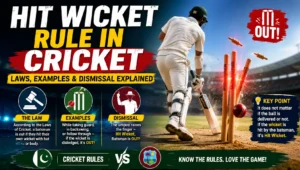

The hit wicket rule in cricket is a unique form of hit wicket dismissal covered under Law 35 of the Laws of Cricket. A batter can be given out when they accidentally break their own wicket while playing a shot or during the delivery. If the striker causes the stumps to be broken or a bail to fall in the circumstances defined by the law, it becomes a valid batter dismissal. The rule applies to the striker’s wicket while the ball is in play, subject to the relevant cricket rules and ICC playing conditions.
Unlike many other cricket dismissal types, hit wicket rule in cricket occurs because the batter causes the wicket to be put down. However, not every contact with the stumps results in a dismissal. The timing of the action, including the delivery stride and whether the ball is a legal delivery, can matter when deciding if the method of dismissal is valid. Understanding Law 35, the MCC Laws, and these conditions makes it easier to understand this unusual batting dismissal.
Table of Contents
How a Batter Gets Out Hit Wicket
A batter can be dismissed hit wicket by rule in cricket when they batter hits stumps or otherwise causes their wicket to be broken while preparing to receive the delivery, receiving the ball, or playing a shot. This can happen when the bat hits stumps, the bat dislodges bails, or the batter’s body hits stumps. Their clothing or equipment can also break the wicket, meaning the striker knocks off bails or causes the stumps removed in a way covered by the rule.
The dismissal can also occur when a batter is attempting to play the ball and losing balance causes contact with the wicket. A follow-through movement after a shot may break the wicket, and the same can apply when setting off for first run or making the first run after playing the ball. The key point is that the striker must have an opportunity to play the delivery; actions such as a second stroke or movements made while protecting the wicket can also be relevant under the law. The wicket does not necessarily need to be completely destroyed in every sense—the required wicket completely broken condition is determined by the specific requirements of the hit wicket rule in cricket.

Conditions for Hit Wicket Dismissal
- Bowler enters delivery stride: The relevant action must occur after the bowler enters delivery stride and during the period covered by the hit wicket rule in cricket.
- Ball is in play: The ball is in play when the striker causes the wicket to be broken in circumstances covered by the law.
- Striker’s wicket is broken: The striker’s wicket is broken by an action involving the batter or their equipment.
- Striker’s bat, person, clothing or equipment: The wicket may be broken by the striker’s bat, striker’s person, clothing or equipment, depending on the circumstances specified in the law.
- Wicket broken fairly: The wicket must be broken fairly, meaning the required conditions for putting down the wicket have been met.
- Bail completely removed: A bail completely removed from the top of the stumps can constitute the required breaking of the wicket.
- Stump removed from ground: A stump removed from ground can also mean the wicket has been broken according to the relevant cricket laws.
- Legal delivery: The circumstances of the delivery matter when determining whether the dismissal can be given on a legal delivery.
- Umpire decision: The umpire decision determines whether all conditions for hit wicket rule in crickett have been satisfied.
- Appeal for hit wicket: The fielding side can make an appeal for hit wicket when they believe the striker has broken their own wicket.
- Dismissal confirmed: After considering the circumstances and applicable laws, the dismissal confirmed decision is made by the umpire.
- Law 29 and Law 35.1: Law 29 explains when a wicket is considered broken, while Law 35.1 sets out the circumstances in which a batter can be dismissed hit wicket rule in cricket.
Visit this: Timed Out Rule in Cricket: When Is a Batsman Out?
Hit Wicket Rule in Cricket While Playing a Shot
A hit wicket rule in cricket while playing a shot can happen when a batter’s bat movement or body movement causes the stumps behind the batter to be broken during a batting action. For example, while playing a cricket shot, the batter may make a large backswing or downswing and accidentally hit the stumps. The same can happen during the follow-through, even after hitting the ball, if the movement causes the wicket to be put down under the applicable rule.
The dismissal may also occur while attempting a shot if the batter is losing balance and their body or equipment strikes the wicket. Even when recovering balance, the batter can accidentally make contact with the stumps. Such an accidental dismissal is commonly described as hitting own wicket. The important point is that the wicket broken during shot must meet the conditions of the hit wicket rule in cricket. A hit wicket rule in cricket after contact with the ball can therefore still be valid if the batter’s subsequent movement causes the wicket to be broken.
Hit Wicket Rule in Cricket While Running
A batter can be dismissed hit wicket while setting off for a run, including during the first run after hitting the ball. If the striker causes the wicket to be broken while running between wickets, the dismissal may apply when the action happens immediately after playing the ball. For example, while starting the first run, the striker leaving the crease might accidentally make the bat hitting stumps or body hitting stumps, causing the wicket to be broken.
The important factor is whether the circumstances meet the requirements of the hit wicket rule in cricket. An accidental wicket break can occur while running after delivery, and a hit wicket during first run is possible when the striker’s movement causes the wicket to be put down under the applicable conditions. Simply leaving the crease or running toward the other end does not automatically result in a dismissal; the required conditions must be satisfied.
When Hit Wicket Is Not Out
| Hit Wicket Rule in Cricket | Why the Batter Is Not Out |
|---|---|
| Wicket broken after completing the shot | If the wicket is broken after the completed batting action in circumstances covered by the law, the batter may remain not out hit wicket. |
| Running between wickets | Breaking the wicket during a later running between wickets movement does not automatically make the striker out hit wicket. |
| Avoiding run out | If the batter breaks the wicket while avoiding run out, the hit wicket rule in cricket must still be satisfied before a dismissal can be given. |
| Avoiding stumping | A wicket broken while avoiding stumping is not automatically a hit wicket dismissal. |
| Avoiding a throw | If the batter breaks the wicket while avoiding a throw, the specific hit wicket rule in cricket must apply. |
| Bowler does not deliver the ball | If the bowler does not deliver the ball, a hit wicket dismissal generally cannot be made under the normal delivery conditions. |
| Dead ball | When the dead ball situation applies, the relevant hit wicket rule in cricket may not be satisfied. |
| No ball | A batter is generally not dismissed hit wicket from a no ball, subject to the specific Laws of Cricket provisions. |
| Wicket broken before delivery stride | If the wicket is broken before delivery stride, the timing required for a hit wicket dismissal has not been met. |
| Subsequent running movement | A subsequent running movement after the relevant batting action does not automatically create a hit wicket dismissal. |

Runs and Scoring After Hit Wicket Rule in Cricket
When a batter is dismissed hit wicket, the runs scored from the delivery depend on the circumstances of the play and the applicable Laws of Cricket. Under Law 35.3, the dismissal itself does not necessarily mean that every possible run is cancelled. Completed runs and certain penalty runs may still be considered according to the law, while the dismissed batter does not receive batting runs for a scoring outcome that the laws do not allow.
- Hit wicket runs: Runs completed before the dismissal may count when permitted by the Laws of Cricket.
- Batting runs: Any runs credited to the batter depend on whether the ball was legally struck and the scoring action satisfies the applicable rules.
- Penalty runs: Separate penalty runs can still be awarded when the Laws provide for them.
- Wide penalty: A wide penalty is treated according to the laws governing wides rather than simply being cancelled because of a hit wicket rule in cricket.
- Five penalty runs: Five penalty runs may be awarded when a separate five-run penalty provision applies.
- No runs credited: In some circumstances, no runs credited to the batter may be recorded despite the ball being played.
- Scoring after dismissal: Once the hit wicket dismissal occurs, scoring after dismissal is governed by the relevant laws and the point at which the wicket was broken.
- Run penalty: A run penalty imposed under another law remains separate from the hit wicket dismissal.
The key point is that a hit wicket does not automatically erase all runs scored on the delivery. The umpire applies the relevant provisions, including Law 35.3, to determine which runs, if any, should be added to the team’s total.
Visit this also: How Does DRS Work in Cricket? A Simple Guide to DRS Rules & Technology
Umpire Decision and Appeal
A hit wicket appeal usually begins when the fielding team appeal after noticing that the wicket broken was caused by the striker. The on-field umpire is responsible for checking the wicket and determining whether the conditions for a striker dismissal have been met. The umpire decision is based on the relevant Laws of Cricket, including the timing of the delivery and how the wicket was broken.
If there is doubt, the third umpire or TV umpire may become involved when the competition’s playing conditions allow it. A replay review or DRS can help establish exactly when the wicket was broken and whether the batter caused it. Once the evidence has been assessed, the umpire gives the appropriate dismissal signal if the dismissal is confirmed. The exact appeal procedure and scope of video assistance depend on the competition, while umpire interpretation remains important when applying the Laws of Cricket.

Hit Wicket Rule in Cricket vs Other Dismissals
- Hit wicket vs bowled: In a hit wicket dismissal, the batter causes their own wicket to be broken under the relevant conditions. In bowled, the bowler’s delivery breaks the striker’s wicket. These are different methods of dismissal under the cricket wicket rules.
- Hit wicket vs run out: A hit wicket involves the striker breaking their own wicket, while a run out occurs when a batter is out of their ground and the wicket is fairly put down by the fielding side. Run out is covered by Law 38.
- Hit wicket vs stumped: A stumped dismissal normally occurs when the wicketkeeper puts down the striker’s wicket while the batter is out of their ground and not attempting a run. Stumping is covered by Law 39.
- Hit wicket vs caught: A caught dismissal happens when a fielder fairly catches the ball before it touches the ground after contact with the batter’s bat or hand holding the bat. Caught is covered by Law 33.
- Hit wicket vs LBW: In LBW, the batter can be dismissed when the ball hits their person rather than the bat and the conditions of the law are satisfied. LBW is covered by Law 36.
- Hit wicket vs obstructing the field: Obstructing the field involves a batter deliberately obstructing or distracting the opposition in circumstances defined by the law. It is covered by Law 37.
- Hit wicket vs hit the ball twice: Hit the ball twice concerns a batter making an impermissible second contact with the ball, subject to the exceptions in Law 34.
- Other batting dismissals: These different batting dismissals show why understanding each law matters. Law 32 covers caught, Law 33 covers caught, Law 34 covers hit the ball twice, Law 36 covers LBW, Law 37 covers obstructing the field, Law 38 covers run out, and Law 39 covers stumped. Hit wicket is governed separately by its own law.
Frequently Asked Questions About Hit Wicket Rule in Cricket
What is the hit wicket rule in cricket?
The hit wicket rule means a batter can be dismissed if they break their own wicket with their bat, body, clothing, or equipment while the ball is in play and the conditions of the law are met.
When is a batter out hit wicket?
A batter is out hit wicket when their action while receiving or playing the delivery causes the wicket to be broken. This can happen through a backswing, shot, follow-through, or certain movements while starting a run.
Can a batter be out hit wicket while running?
Yes, a batter can be dismissed hit wicket while setting off for a run if their bat, body, clothing, or equipment breaks the wicket under the conditions of the hit wicket law.
Is hit wicket possible on a no-ball?
Generally, a batter cannot be dismissed hit wicket from a no-ball, subject to the specific Laws of Cricket and applicable playing conditions.
What is the difference between hit wicket and bowled?
In a hit wicket dismissal, the batter causes their own wicket to be broken. In a bowled dismissal, the bowler’s delivery breaks the striker’s wicket. Both are different methods of dismissal under the Laws of Cricket.


[…] Visit this: Hit Wicket Rule in Cricket: Laws, Examples & Dismissal Explained […]
[…] Visit this: Hit Wicket Rule in Cricket: Laws, Examples & Dismissal Explained […]