
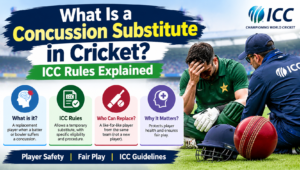

The concussion substitute in cricket is a player replacement system designed to protect cricketers after a serious head injury. Under the concussion substitute in cricke rule, an approved concussion replacement player can take the injured player’s place, subject to the ICC concussion replacement rule, medical assessment, and relevant ICC playing conditions.
Unlike a regular substitute player in cricket, a concussion replacement can fully participate according to the approved conditions. The cricket concussion rule is part of modern international cricket rules and cricket playing conditions, helping teams manage head injury substitute, injured player replacement, and other situations covered by the concussion protocol in cricket.
Table of Contents
ICC Concussion Replacement Rules
Under the ICC concussion regulations, a player who suffers a head and neck injury during play may be eligible for a concussion replacement if there is a suspected concussion or confirmed concussion following a proper medical assessment. The ICC rules for concussion substitute in cricket require the Team Medical Representative to assess the player and submit a concussion replacement request to the ICC Match Referee. The relevant ICC clause 1.2.7 also requires the replacement to be like-for-like, meaning the incoming player should perform a similar role to the injured player.
The ICC Match Referee has the authority to grant or refuse the replacement request in cricket and can impose conditions if the replacement would give the team an excessive advantage. The decision is final, with no right of appeal. These ICC concussion replacement regulations form an important part of the ICC’s concussion management, medical protocol, and player safety regulations, ensuring that player welfare remains a priority while maintaining competitive fairness.
Visit this: Retired Hurt in Cricket: Rules, Meaning & Comeback Explained
Like-for-Like Replacement Rule
The like-for-like replacement rule is designed to maintain team balance and competitive balance when a player is replaced because of concussion. The ICC Match Referee considers the likely role of the concussed player for the rest of the match and compares it with the normal role of the replacement. Therefore, a like-for-like player should have a reasonably similar playing role, rather than simply being the team’s strongest available player.
For example, a specialist batter replacement would generally be considered for a batter, while a specialist bowler replacement may be appropriate for a bowler. An all-rounder replacement, batting replacement, or bowling replacement is assessed according to the circumstances and the replacement player role. The key replacement eligibility and replacement conditions are intended to prevent an unfair advantage or excessive advantage. During the match referee assessment, the ICC Match Referee can impose conditions on the replacement’s involvement if needed to preserve the intended like-for-like balance.

How the Concussion Substitute in Cricket Works
The concussion replacement process generally follows these steps under the applicable ICC playing conditions:
- Concussion assessment: After a head or neck injury, the team doctor, team medical staff, or designated medical representative assesses the player for a concussion or suspected concussion.
- Player removed from match: If the medical assessment confirms or suspects concussion, the affected player can be removed from the match and cannot return once the replacement is approved.
- Replacement nomination: The team identifies a suitable nominated player who meets the replacement eligibility criteria and is considered a like-for-like option.
- Replacement request submission: The medical representative or Team Manager submits the official concussion replacement request, identifying the injured player, the incident, and the proposed replacement.
- Referee approval: The ICC Match Referee reviews the request and determines whether the proposed player meets the required replacement eligibility criteria and will not give the team an excessive advantage.
- Approved concussion substitute in cricket: Once referee approval is granted, the nominated player becomes the approved concussion substitute in cricket for the remainder of the match.
- Full participation: Unlike an ordinary substitute fielder, the approved replacement can take full participation in the match and replaces the injured player on the team’s nominated-player list.
- Replacement player enters match: After approval, the replacement player enters the match and serves as the playing XI replacement for the concussed player. The replacement is effectively a permanent replacement for that match, while the original player takes no further part.
Visit this also: How to Master the Cover Drive Technique in Cricket
What Can a Concussion Substitute in Cricket Do?
An approved concussion substitute in cricket can bat, bowl, and field, giving the player full participation in cricket rather than the limited role of an ordinary substitute fielder. The replacement receives batting rights and can score runs, while bowling rights allow them to bowl and take wickets, subject to the applicable playing conditions and any restrictions imposed by the Match Referee. They also have normal fielding rights and can take part in official match participation.
This is the main substitute fielder difference: a concussion replacement becomes a full replacement player with defined replacement player rights. Their performances can be reflected in cricket statistics and relevant match records under the applicable regulations, rather than being treated simply as a temporary fielder.

Concussion Substitute in Cricket vs Normal Substitute
The key concussion substitute difference is that a normal substitute or substitute fielder only replaces a fielder temporarily and is generally limited to fielding. An approved concussion replacement, under the applicable concussion replacement rules, replaces the injured player on the nominated list and can take a full part in the match, subject to any restrictions imposed by the Match Referee.
| Feature | Normal Substitute | concussion substitute in cricket |
|---|---|---|
| Role | Substitute fielder who temporarily replaces a fielder | Medical replacement for a player with concussion or suspected concussion |
| Purpose | Usually covers absence or injury | Provides an injury replacement while protecting player safety |
| Batting eligibility | Generally no | Yes, subject to the approved replacement conditions |
| Bowling eligibility | Generally no | Yes, subject to applicable restrictions |
| Fielding eligibility | Yes | Yes |
| Replacement status | Temporary substitute; does not replace the player on the nominated list | Permanent replacement for the remainder of the match |
| Match participation | Limited to fielding under substitute fielder rules | Full-match replacement with full participation |
| Approval | Governed by normal substitute procedures | Requires approval under the concussion replacement rules |
| Restrictions | Substitute player restrictions apply | Match Referee may impose specific conditions |
| Type of replacement | Regular substitute player | Approved concussion replacement, intended to be like-for-like |
| Tactical replacement | Not normally intended for tactical purposes | Not a tactical replacement; it must result from an eligible concussion situation |
ICC playing conditions specifically distinguish a substitute from a concussion replacement: a substitute’s activities are limited to fielding, while a concussion replacement takes the injured player’s place on the nominated list and can take a full part in the match.
Formats and Competitions
The concussion substitute in cricket system applies across major forms of international cricket, but the exact playing conditions can vary by format and competition. The ICC currently publishes separate Test match rules, One Day International rules, and T20 International rules, along with specific conditions for major ICC tournaments. Therefore, a Test cricket concussion substitute, ODI concussion substitute, or T20I concussion substitute is governed by the playing conditions applicable to that particular match.
- Test cricket: A Test cricket concussion substitute can be used when the requirements in the relevant Test playing conditions are met. The rules are particularly important in long-form first-class cricket, where player safety and medical assessment can affect several days of competition.
- ODI cricket: An ODI concussion substitute is governed by the ICC’s standard ODI playing conditions, including the requirements for medical diagnosis, replacement nomination, and Match Referee approval.
- T20I cricket: A T20I concussion substitute in cricket follows the applicable T20 International rules, with the same core focus on player welfare and a like-for-like replacement.
- ICC tournaments: Major ICC tournaments have their own competition-specific playing conditions, so teams must follow the regulations issued for that event.
- Domestic cricket: Domestic cricket may use different domestic cricket concussion rules. National cricket boards can establish playing conditions for their competitions, including cricket leagues and first-class cricket, so the international ICC process should not automatically be assumed to apply. ICC’s published documents also distinguish international playing conditions from domestic competition regulations.
Note: The exact rules can change between competitions and editions of the playing conditions. For this reason, teams and readers should check the relevant international playing conditions or competition regulations for the specific match rather than relying on a general concussion substitute in cricket rule.
Visit this also: Paddle Sweep in Cricket: How to Play This Shot Correctly
History and Important Examples of Concussion Substitute in Cricket
The concussion substitute introduced in 2019 marked an important step in the evolution of cricket rules. The ICC approved concussion replacements for international and First-Class cricket, creating a formal system to protect players after head injuries.
A landmark example came during the 2019 Ashes between England vs Australia, when Steve Smith concussion concerns followed a blow from Jofra Archer. Smith was unable to continue, and Marnus Labuschagne concussion substitute status was approved, making him the first concussion substitute in international cricket. This historic concussion replacement demonstrated how the ICC introduced concussion replacement to improve player safety while allowing the match to continue.

Player Safety and Concussion Awareness
Player safety in cricket has become a major priority because cricket head injuries, head trauma in cricket, and neck injury can lead to serious sports concussion and other forms of brain injury. The ICC uses medical protocols and concussion guidelines to support concussion management, while trained medical professionals assess players for concussion symptoms after a suspected head impact. A proper head injury assessment, neurological assessment, and medical examination help determine whether a player should be removed from play.
The concussion substitute in cricket system is therefore more than a replacement rule; it is part of wider brain injury prevention, injury prevention, and athlete safety efforts. ICC medical guidance emphasizes player welfare, while cricket safety rules provide medical protection when a player suffers a head or neck injury. The priority is a safe return to play, meaning a concussed player should not be rushed back into action simply because their team needs them. These measures reflect the growing role of sports medicine in protecting cricketers at every level.
Frequently Asked Questions About Concussion Substitute in Cricket
What is a concussion substitute in cricket?
A concussion substitute is a replacement player allowed when a cricketer suffers a concussion or suspected concussion from a head or neck injury during a match. The replacement generally needs to be a like-for-like player and must be approved by the ICC Match Referee.
Can a concussion substitute bat and bowl in cricket?
Yes. An approved concussion replacement can participate fully according to the conditions of the replacement. However, restrictions can apply, such as when the replaced player was already suspended from bowling.
Who approves a concussion substitute in cricket?
The ICC Match Referee approves the concussion replacement request. The Team Medical Representative or Team Manager submits the request after the player’s concussion or suspected concussion has been assessed.
What does “like-for-like” concussion replacement mean?
A like-for-like replacement means the substitute should have a similar playing role to the concussed player. The Match Referee considers the role the injured player was likely to perform and the normal role of the proposed replacement.
When was the concussion substitute rule introduced in cricket?
The ICC approved concussion player replacements for men’s and women’s international cricket and First-Class cricket in 2019, with the playing conditions taking effect from August 1, 2019. Marnus Labuschagne became the first concussion substitute in international cricket when he replaced Steve Smith during the 2019 Ashes.


[…] Visit this: What Is a Concussion Substitute in Cricket? ICC Rules Explained […]
[…] Visit this also: What Is a Concussion Substitute in Cricket? ICC Rules Explained […]