
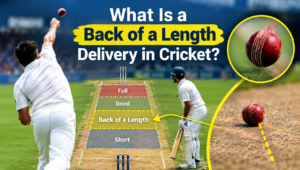

A back of a length delivery or back-of-a-length ball lands slightly shorter than a good length, often around the 7-8 metres or 8-9 metre length area. It sits between a short of a length delivery and a full-length ball, making the batter unsure whether to play forward or back.
The right bowling length depends on the pitch, pace, and batter, but the key is controlling the pitch location, bounce point, and landing zone. Bowlers use this shorter length alongside full length, half-volley, short ball, and bouncer to create effective length variations and attack the ideal target zone.
Table of Contents
Back of a Length Delivery vs Good Length
A good-length delivery generally lands in the 6-8 metre zone, while a back-of-a-length ball is slightly shorter and can fall closer to the 8-9 metre zone. The traditional good length is often considered an optimum length because it makes the batter decide whether to move forward or back. A back of a length vs good length comparison mainly comes down to bounce, movement, and how much time the batter has to play the shot.
For seam bowling length and fast bowling length, both can be a wicket-taking length when used with bowling accuracy, a consistent line and length, and strong length control. The best bowlers understand their natural length, adjust it to the conditions, and focus on hitting the right areas. A good-length ball can be an economical length that restricts scoring, while a back-of-length delivery can create awkward bounce and pressure the batter.

Bounce, Pace & Ball Movement
- Extra bounce — a back-of-a-length delivery can produce more steep bounce than a traditional good-length ball.
- Natural bounce — the pitch determines how high the ball rises, while variable bounce can make the batter’s reaction time unpredictable.
- Ball trajectory — the delivery’s trajectory and bounce height influence whether it reaches the batter at knee-height delivery or becomes a higher waist-height delivery.
- Bowling pace — fast bowling reduces batsman reaction time, especially when the ball maintains good pace off the pitch.
- Seam movement — seamers can create lateral movement, movement off the pitch, and seam deviation after the ball lands.
- Swing bowling — swing can change the ball deviation in the air before it reaches the bounce point.
- Pitch conditions — grass, moisture, hardness, and cracks can affect vertical bounce, seam movement, and the overall pace of the delivery.
Visit this: Retired Hurt in Cricket: Rules, Meaning & Comeback Explained
Bowlers Who Use Back of a Length Delivery
- Fast bowler — A fast bowler can use a back-of-a-length delivery to combine speed, bounce, and uncertainty, particularly when attacking the stumps or body.
- Pace bowler — A pace bowler often relies on pace and bounce to force the batter onto the back foot.
- Tall fast bowler — A tall fast bowler can generate a steeper bounce from a similar natural length, making the delivery more difficult to control.
- Quick bowler — A quick bowler can make short-of-a-length bowling threatening by reducing the batter’s reaction time.
- High-release bowler — A high-release bowler can create additional bounce through their bowling action and release point.
- Seam bowler — A seam bowler may combine back-of-length deliveries with seam movement to make the ball deviate after pitching.
- Hit-the-deck bowler — A hit-the-deck bowler deliberately attacks a hard natural length, using a strong bowling rhythm to generate bounce and pace.
- Bounce-focused bowler — A bounce-focused bowler uses this length to create pace and bounce while keeping the batter under pressure.
- Hostile bowling — Consistent back-of-length bowling can become a form of hostile bowling, especially when combined with accurate lines.
- Aggressive bowling — Bowlers can use this approach for aggressive bowling, targeting the batter’s body and limiting comfortable attacking shots.
- Intimidation — Repeated deliveries that rise sharply can create intimidation, forcing the batter to play cautiously or move deeper into the crease.
Back of a Length Delivery Bowling Strategy
A back-of-a-length bowling strategy is effective when bowlers combine different bowling tactics to keep the batter uncomfortable. It can be used as an attacking length to create wicket opportunities or a defensive length for pressure bowling and restricting scoring. By bowling to the batsman consistently, the bowler can keep creating pressure, building pressure, and testing the batsman until an opportunity develops.
This wicket-taking strategy works by forcing mistakes and inducing false shots through awkward bounce, movement, and accurate lines. Bowlers may focus on attacking the stumps, bowling outside off stump, or using body-line bowling depending on the batter and match situation. Changing lengths and using variation in length are equally important because predictable bowling allows the batter to settle and attack confidently.
Line, Length & Field Placement
A successful back of a length delivery depends on accurate line and length. Bowlers can use an off-stump line, fourth-stump line, or outside off stump to challenge the batter, while a body line or leg-side line can be used to attack different areas. The bowling corridor and channel outside off are particularly useful for creating edges when the ball rises from a difficult length.
Field placement should match the intended bowling line and strategy. An attacking field may include close catchers, slip fielders, a gully, point, and third slip for catching opportunities, while square leg can protect against shots toward the leg side. In a defensive field, bowlers can spread fielders into key catching positions and scoring areas to limit boundaries while maintaining pressure.

Advantages & Disadvantages of Back of a Length Delivery
| Advantages of Back of a Length | Disadvantages of Short Length |
|---|---|
| Back-of-a-length benefits include extra bounce and an uncomfortable batting height, making it harder for the batter to play freely. | The batsman attacking back foot can take advantage of the length if they read the delivery early. |
| It can create reduced reaction time, especially against fast bowling. | It can provide scoring opportunities for shots such as the cut shot and pull shot. |
| The delivery can be effective for forcing defensive shots and limiting attacking options. | If the line is predictable, the batter can comfortably attack from the back foot. |
| It is useful for inducing edges and creating false shots when combined with movement. | One of the main disadvantages of short length is the lack of stump threat compared with a fuller delivery. |
| Bowlers can use it for attacking the batsman and creating sustained pressure. | A poorly controlled short-length delivery may sit up and become easier to hit. |
| It helps with restricting boundaries by making clean front-foot drives more difficult. | If there is little bounce or movement, the batter may have more time to play attacking shots. |
Conditions & Pitch Behaviour
Pitch conditions have a major impact on how a back of a length delivery behaves. On a fresh pitch, hard pitch, or grassy pitch, the ball can generate useful bounce from the surface and lateral movement, particularly during seaming conditions and seam-friendly conditions. A helpful pitch with moisture or grass can provide greater pitch assistance, while a dry pitch may produce different bounce and movement as the match progresses.
The new ball can be particularly effective in seaming conditions or swinging conditions, while an old ball may offer less conventional movement but can still be dangerous when the surface provides bounce. On a flat pitch, bowlers may receive less natural assistance and need to rely more on accuracy and pace. Atmospheric conditions, including humidity, can also influence movement through the air, while the surface of the cricket pitch determines how much bounce and seam the delivery receives.
Visit this also: Back-Foot Batting Technique In Cricket: Improve Footwork, Timing & Shot Control
Back of a Length Delivery in Test Cricket
In Test cricket, a back-of-a-length delivery is a valuable weapon, especially for fast bowling in Tests. During Test match bowling, pacers can use this length against top-order batsmen to create pressure over long spells. It is particularly effective during new-ball bowling, an opening spell, and the first session, when the pitch and ball may offer movement.
Bowlers can assess their bowling performance using statistics such as bowling average, economy rate, strike rate, wickets per over, and wickets per runs. Modern ball tracking, including Hawk-Eye data, allows teams to study pitching areas, bounce, and movement through detailed statistical analysis. On the first morning, consistently hitting a challenging back-of-length area can test batsmen repeatedly and increase the chances of mistakes and wickets.

Back of a Length Delivery Bowling Accuracy
Bowling accuracy is essential for making a back-of-a-length delivery effective. Line and length accuracy improves when the bowler focuses on hitting the pitch in the same target area repeatedly. Consistent bowling requires a repeatable action, controlled run-up, stable release point, and reliable bowling rhythm.
Bowlers should maintain seam position and wrist position at release while completing a balanced follow-through. Regular target practice helps develop bowling control, pace control, and length control. With practice, the bowler can improve the ability to keep the ball landing consistently, making the back-of-a-length delivery more difficult for the batter to attack.
Frequently Asked Questions About Back of a Length Delivery
What is a back of a length delivery in cricket?
A back of a length delivery is a ball that pitches slightly shorter than a traditional good-length delivery, often creating extra bounce and making the batter uncertain whether to play forward or backward.
What is the ideal length for a back of a length delivery?
The ideal length varies with the bowler, pitch, and batter, but it commonly lands around 7–8 metres or slightly farther from the stumps, depending on conditions and bowling pace.
Why is a back of a length delivery effective?
A back of a length delivery can produce extra bounce, reduce the batter’s reaction time, restrict scoring options, and induce edges or false shots when bowled with good accuracy.
What is the difference between a good length and a back of a length delivery?
A good-length delivery pitches farther forward and encourages the batter to decide between front- and back-foot play. A back-of-length delivery lands slightly shorter and generally encourages more back-foot responses.
How can bowlers improve their back of a length delivery?
Bowlers can improve by practicing consistent line and length, maintaining a repeatable bowling action, controlling the release point, working on seam and wrist position, and repeatedly targeting the same landing area.


