
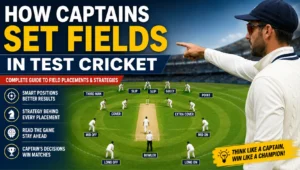

Test cricket field settings showcase a captain’s strategy, awareness, and ability to read the game. In long-format cricket, captains use fielding positions, bowling plans, and tactical captaincy to respond to match situations, pitch conditions, and batsman weakness. Every decision reflects careful field placement planning aimed at creating pressure and finding wickets.
A captain’s role involves balancing an attacking mindset with a defensive strategy while providing bowler support through smart strategic decisions. By using wicket-taking strategy and understanding the strengths of both bowlers and batters, captains create plans that can change the outcome of a Test match.
Table of Contents
Defensive Field Settings in Test Cricket
Defensive fields play an important role in Test cricket when captains want to slow down the opposition’s progress and control the flow of runs. A run-saving strategy focuses on boundary protection by placing deep fielders in key areas for saving fours and reducing scoring opportunities. These placements help in controlling scoring rate while maintaining pressure on the batting side.
Through defensive captaincy, leaders often use pressure tactics and a containment approach to frustrate batters, especially when facing a settled batsman strategy. Negative fields may be used in certain situations to prevent easy runs, create scoreboard pressure, and force batsmen to make mistakes.A captain uses a wide field spread for singles prevention and focuses on protecting runs during crucial phases of a match.

Attacking Field Settings in Test Cricket
- Attacking fields are designed to create wicket-taking opportunities by placing more close catchers around the batsman and increasing pressure. Captains use an attacking mindset to focus on creating chances rather than only saving runs.
- Aggressive captaincy often involves setting wicket-taking fields with a strong slip cordon, including multiple slips, a gully position, short leg, silly point, and sometimes leg slip depending on the bowler and batsman’s weakness.
- Captains use these catching positions for edge hunting, especially when fast bowlers are using swing bowling fields and seam bowling tactics to find movement outside the off stump. These setups help create pressure and increase the chances of early breakthroughs.
- Against spin bowling, captains build spin bowling traps by placing fielders close to the bat and waiting for mistakes. Positions like short leg and silly point are used to force batters into risky shots and create wicket opportunities.
- These attacking setups are especially effective when a new batsman arrives at the crease. By applying new batsman pressure through aggressive bowling plans and smart field placements, captains aim to force mistakes and break partnerships.
Visit this: How Teams Chase Targets in T20 Cricket: Complete Run Chase Strategy
Fast Bowling Field Placements
Fast bowling field placements are designed to support fast bowlers by creating maximum wicket-taking opportunities, especially during new ball bowling. In swing conditions and green pitch conditions, captains focus on using slip fielders, a gully fielder, and positions like third slip to take advantage of seam movement and the moving ball.
During the early stages of a Test match, the pace attack relies on accurate bowling line and length around the off-stump channel to create chances through the outside edge and caught behind dismissals. The wicketkeeper position becomes crucial, while fielders at short cover, mid-off placement, and mid-on placement provide support and prevent scoring options.
Captains also use a bouncer strategy to challenge batsmen with short deliveries and adjust fields according to the situation. The first session strategy often focuses on attacking the top order by combining smart field placements with disciplined fast bowling.
Spin Bowling Field Placements
Spin bowling field placements require smart planning because spinners rely on accuracy, variation, and pressure-building. Captains use spin bowling tactics on a turning pitch and spin-friendly conditions by creating attacking setups around the batsman. For an off-spinner field or leg-spinner field, positions like silly point, short leg, forward short leg, leg slip, and a slip for spinners are used to target bat-pad catches and build catching traps.
These close-in fielders help create pressure on batsmen by challenging their ability to play defensive strokes and control the sweep shot. With flight and turn, captains look for mistakes, create stumping chances, and force batters into risky shots that can lead to crucial wickets.
Common Test Cricket Field Positions
In Test cricket, captains use different field positions based on the bowler’s plan, batsman’s weakness, and match situation. Each position has a specific role, from taking catches near the bat to stopping boundaries. Common Test cricket field positions include:
- Slip: A key catching position placed beside the wicketkeeper, mainly used for fast bowlers to catch edges. Captains may set a first slip, second slip, or third slip depending on the number of chances expected.
- Gully: A catching position between slip and point, often used when bowlers target the outside edge with movement.
- Point: Positioned square on the off side to stop cuts and quick singles.
- Cover: A fielding position used to protect drives, while extra cover provides additional protection against attacking shots.
- Mid-off: Placed on the off side near the bowler to stop straight drives and support attacking plans.
- Mid-on: Located on the leg side near the bowler, helping prevent runs from straight shots.
- Mid-wicket: A valuable position for stopping shots played through the leg side.
- Square leg: Used to cover shots behind square and assist against pull or sweep attempts.
- Fine leg: Positioned near the boundary behind the batsman to stop deflections and glances.
- Backward point: Protects the area behind point and targets risky cut shots.
- Deep cover: A boundary position used to stop powerful drives and save runs.
- Long-off: Placed near the boundary on the off side to prevent lofted shots.
- Long-on: Covers the boundary on the leg side against attacking strokes.
- Deep mid-wicket: A key boundary position against big hits through the leg side.
- Wicketkeeper: The player behind the stumps who plays a vital role in catches, stumpings, and supporting the bowler.
- Close catching positions: Includes areas near the bat where fielders wait for edges, bat-pad chances, and defensive mistakes.
- Boundary riders: Deep fielders placed near the rope to protect runs and control scoring in defensive situations.

Field Settings Based on Batsman Weakness
Captains use batsman analysis and opposition analysis to study a player’s batting technique, habits, and weaknesses before creating a strategy. Through weakness identification, captains examine scoring areas, shot selection, and preferred shots to design a personalized field placement that limits scoring opportunities and creates wicket chances.
By reading batting patterns, captains can target a batsman’s specific problems, such as a cover drive weakness, pull shot weakness, or sweep shot weakness. They adjust attacking angles, set fields for trapping batsmen, and focus on forcing risky shots while bowling according to plan. This smart approach helps bowlers exploit technical flaws and build pressure during crucial phases of a Test match.
Visit this also: What Happens When a Cricket Match Is Tied? Rules, Super Over, ODI, T20 & Test
Captaincy Tactics and Match Scenarios in Test Cricket
| Match Scenario | Captaincy Tactics and Fielding Approach |
|---|---|
| Early Match Phase | In Test match captaincy, leaders focus on session planning, studying conditions, and making field changes based on the batsman’s response. Proactive captaincy helps create early opportunities through smart positioning. |
| After Taking Wickets | Captains use an attacking after wickets approach by bringing in close catchers and making tactical adjustments to maintain pressure on new batters. |
| Against Strong Partnerships | During long partnerships, captains shift to defensive after partnerships strategies while using partnership breaking fields to create mistakes and regain control. |
| Pressure Situations | In pressure situations, captains rely on reading the game and adjusting fields according to the match flow, batsman confidence, and scoring rate. |
| Supporting Declaration Strategy | A captain may use declaration strategy support by setting attacking fields, creating wicket chances quickly, and forcing the opposition into difficult decisions. |
| Facing New Batsmen | New batsman strategy involves aggressive fields, close catching positions, and pressure bowling to prevent the batter from settling. |
| Against Experienced Batsmen | An experienced batsman plan focuses on patience, changing angles, and creating specific traps based on batting habits. |
| Bowling to Tailenders | Tailender tactics include attacking fields with catching positions to finish the innings quickly and avoid unnecessary runs. |
| Final Stages of Test Match | Final day tactics and fourth innings strategy require careful field placements, defensive options, and smart risk-taking to chase victory or defend a target. |

Field Placement According to Pitch Conditions
Captains study pitch behavior carefully before deciding field placements because every surface creates different challenges. On a green pitch, fast bowlers can benefit from seam movement, while a dry pitch or turning track allows spinners to create chances. A flat wicket may require defensive fields to control runs, whereas a surface with uneven bounce demands careful bounce assessment and smart positioning.
Successful captains focus on reading conditions and adjusting their plans through match preparation. They consider weather conditions, ball movement, and whether the pitch is a fast pitch, slow surface, or offers reverse swing conditions. By adapting field positions and changing tactics throughout the match, captains create effective strategies that match the behavior of the pitch and support their bowlers.
Frequently Asked Questions About Set Fields in Test Cricket
How do captains decide field placements in Test cricket?
Captains decide field placements by analyzing the batsman’s weakness, pitch conditions, bowler’s strengths, match situation, and scoring patterns. They use strategic positions to create wicket chances and control runs.
What is the purpose of attacking fields in Test cricket?
Attacking fields are used to create wicket-taking opportunities by placing close catchers, slips, and other aggressive positions. Captains use these fields to build pressure and force batsmen into mistakes.
How do pitch conditions affect Test cricket field settings?
Pitch conditions play a major role in field settings. Green pitches support swing and seam bowling with slip cordons, while turning tracks require close-in fielders for spin bowling opportunities.
Why do captains use defensive field settings in Test matches?
Captains use defensive field settings to control scoring, protect boundaries, and build pressure on batsmen. These tactics are common when defending totals or stopping strong partnerships.
How do captains set fields against different types of batsmen?
Captains study batting techniques, preferred shots, and weaknesses to create personalized field placements. They set traps for specific shots like cover drives, pulls, or sweeps to increase wicket chances.
Advanced Test Cricket Fielding Concepts
Modern Test cricket fielding requires smart planning beyond traditional setups. Captains use strategic positioning, innovative captaincy, and a mix of orthodox fields and unconventional fields to challenge batsmen. An in-out field provides defensive balance, while funky fields, baiting batsmen, and leaving gaps intentionally help create opportunities.
By creating false confidence, attacking vacant areas, and setting clever field traps, captains apply psychological pressure on opponents. Understanding and reading batsman mindset allows leaders to make quick adjustments, force mistakes, and use advanced fielding strategies to influence the outcome of a Test match.


[…] Test cricket is the longest format, with a five day Test allowing up to five days of play. A Test match has two innings per team and is divided into Test match sessions, so the Test match duration can vary depending on wickets, declarations, weather, and other conditions. In comparison, a One Day International (ODI) is limited overs cricket with 50 overs per team. An ODI match duration is usually several hours, including the break between the first and second innings. […]