
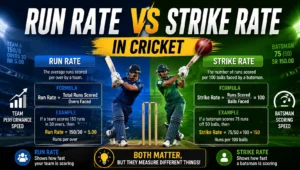

Understanding run rate vs strike rate in cricket helps fans interpret cricket statistics and batting statistics more accurately. Run rate measures the team scoring rate, usually expressed as runs per over, while strike rate measures an individual batter’s scoring pace, based on runs per 100 balls.
Both are important cricket metrics and performance indicators for evaluating batting performance, batting efficiency, and scoring efficiency. In cricket analysis, run rate shows how quickly a team is scoring, whereas strike rate reveals how quickly an individual batter scores, making both useful match statistics.
Table of Contents
Run Rate Terms
Run rate in cricket refers to the number of runs a team scores per over and is a key measure of team scoring pace. The run rate meaning becomes clear when looking at total runs scored and overs faced or overs completed. The basic run rate calculation uses the run rate formula: total runs ÷ overs faced. For example, if the batting side scores 60 runs in 10 overs, its cricket run rate is 6 runs per over.
Several terms are used when discussing run rate. Current run rate (CRR) shows the scoring rate at a particular point in an innings, while required run rate (RRR) indicates the target pace needed to reach a target during a chase. Net run rate (NRR) is mainly used in tournaments to compare teams based on their scoring and conceding rates. These figures help assess innings scoring pace, scoring tempo, team run rate, and chase rate throughout a match.
Visit this: How Net Run Rate Works in Cricket? Formula, All-Out Rules, T20 & ODI Examples
Strike Rate Terms
Strike rate in cricket measures a batter’s scoring speed and shows how many runs per 100 balls they would score at their current rate. The strike rate meaning is simple: runs scored ÷ balls faced × 100. This strike rate formula is used for strike rate calculation, making batting strike rate an important measure of batting speed, scoring efficiency, and overall batting impact.
A high strike rate often indicates quick or explosive batting, while a low strike rate can reflect a more controlled approach. The cricket strike rate varies by format, so T20 strike rate, ODI strike rate, and Test match strike rate can have very different interpretations. In particular, aggressive batting and high scoring speed are highly valued in limited-overs batting, where batters often need to score quickly without facing too many balls.

Formulas and Calculations of Run Rate vs Strike Rate in Cricket
- Run rate formula: Run Rate = Total Runs ÷ Overs Faced. This gives the runs per over calculation and shows the team’s scoring rate.
- Example: If a team scores 150 runs in 20 completed overs, the calculation is 150 ÷ 20 = 7.5 runs per over.
- Strike rate formula: Strike Rate = (Runs Scored ÷ Balls Faced) × 100. It measures how quickly an individual batter scores.
- Example: If a batter scores 75 runs from 50 balls, the calculation is (75 ÷ 50) × 100 = 150 strike rate.
- Important distinction: Run rate uses total runs and overs, while strike rate uses runs scored and balls faced. Overs bowled can also be relevant when analyzing a team’s overall performance.
- Run rate vs strike rate in cricket formulas make scoring rate calculation and batting rate calculation simple and useful for statistical comparison. Both are straightforward cricket formulas that help explain scoring performance.
Run Rate vs Strike Rate Comparison
| Feature of Run Rate vs Strike Rate in Cricket | Run Rate | Strike Rate |
|---|---|---|
| Meaning of run rate vs strike rate in cricket | Measures the team’s scoring pace | Measures an individual batter’s scoring speed |
| Calculation of run rate vs strike rate in cricket | Total runs ÷ overs | (Runs scored ÷ balls faced) × 100 |
| Measurement of run rate vs strike rate in cricket | Runs per over | Runs per 100 balls |
| Main Focus of run rate vs strike rate in cricket | Team scoring tempo | Individual batting pace |
| Statistic Type of run rate vs strike rate in cricket | Team statistic | Individual statistic |
| Example of run rate vs strike rate in cricket | 8 runs per over | 150 strike rate |
| Performance of run rate vs strike rate in cricket | Shows overall innings performance | Shows individual player performance |
| Best Used For of run rate vs strike rate in cricket | Evaluating team scoring rate | Evaluating individual scoring contribution |
| Match Context of run rate vs strike rate in cricket | Useful for understanding the team’s progress in a match situation | Useful for judging how quickly a batter is scoring |
| Key Comparison of run rate vs strike rate in cricket | Team run rate vs batting strike rate | Batting strike rate vs team run rate |
The difference between run rate and strike rate is mainly what they measure: run rate evaluates the team, while strike rate evaluates an individual batter. This run rate vs strike rate comparison is useful for understanding scoring speed, batting pace, and overall innings performance in cricket statistics comparison.

T20 Cricket About Run Rate vs Strike Rate in Cricket
T20 cricket is built around speed, making T20 batting, T20 run rate, and T20 strike rate especially important. Teams aim for a strong T20 scoring rate by combining aggressive batting, boundary hitting, six hitting, and quick singles and doubles. During the powerplay scoring phase, batters often attack the fielding restrictions to build batting momentum and create a foundation for a high scoring innings.
The approach can change during the middle overs, while the death overs usually bring another burst of fast scoring and quick runs. A batter’s T20 strike rate shows individual scoring speed, whereas the T20 run rate reflects the team’s overall scoring tempo. When a team is chasing, the required run rate becomes crucial because increasing chase pressure can force more attacking shots. These factors make run rate and strike rate valuable measures in limited-overs cricket.
Visit this also: How Does DRS Work in Cricket? A Simple Guide to DRS Rules & Technology
ODI Cricket About Run Rate vs Strike Rate in Cricket
ODI cricket, also known as one-day cricket or 50-over cricket, requires a balance between controlled scoring and timely batting acceleration. In ODI batting, the ODI run rate shows the team’s overall scoring pace, while the ODI strike rate indicates how quickly an individual batter scores. The powerplay overs often provide opportunities for boundary scoring, while the middle overs usually focus more on strike rotation and building the innings tempo.
During the death overs, batters generally increase their scoring pace through attacking shots and calculated risks. A successful batting strategy changes according to the match situation, especially during a run chase. For target setting, teams try to maintain a strong ODI run rate, while chasing sides monitor the required scoring rate to stay on track. This makes both run rate and strike rate useful for understanding scoring patterns and performance in ODI cricket.
Test Cricket About Run Rate vs Strike Rate in Cricket
Test cricket has a very different scoring pattern from limited-overs formats, so Test batting often depends on patience, conditions, and the match situation. The Test run rate shows how quickly a team accumulates runs, while the Test strike rate measures an individual batter’s scoring speed. A batter may use cautious batting or defensive batting early in an innings before shifting toward attacking batting when conditions become easier.
The session scoring rate can help explain innings progression and the pace of run accumulation throughout a Test match. Factors such as pitch conditions, wickets, opposition bowling, and the required batting approach can all influence scoring tempo. Therefore, Test run rate and Test strike rate should be interpreted differently from their T20 or ODI equivalents, making them useful format-specific statistics for understanding Test batting performance.
Current, Required and Net Run Rate
- Current Run Rate (CRR): Shows how quickly a team is scoring at a particular stage of an innings. It is calculated from runs scored and overs completed and helps assess the current scoring pace.
- Required Run Rate (RRR): Indicates the scoring rate needed to reach the target score. It considers the runs required and overs remaining, helping a chasing team understand its scoring requirement.
- Chase Equation: The RRR changes as the innings progresses. A team with more wickets in hand may be better positioned to increase its scoring rate when the required rate rises.
- Net Run Rate (NRR): Used mainly in a limited-overs league to compare teams in tournament standings and the points table. It is based on the difference between the team’s scoring rate and the rate at which opponents score.
- Net Scoring Rate: NRR considers runs scored and runs conceded across relevant matches, providing a broader measure of team performance than CRR or RRR.

Batting Performance and Match Impact
A batter’s batting performance cannot be judged by runs alone. Batting impact also depends on individual contribution, scoring consistency, and how a player uses their balls faced to produce runs scored. An aggressive approach can increase the boundary percentage, while controlled aggression, singles and doubles, and effective strike rotation help maintain pressure without taking unnecessary risks. Limiting dot balls is also important when a team needs to maintain scoring momentum.
The role and batting position can significantly influence a player’s impact. An opener may build an innings and provide a strong start, a middle-order batter may stabilize or accelerate the scoring, while a finisher is often expected to score quickly at the end. When these contributions change the course of a match, they can create a momentum shift and produce a match-winning innings, showing why strike rate and run rate should always be considered alongside the wider context of batting performance.
Frequently Asked Questions About Run Rate vs Strike Rate in Cricket
What is the difference between run rate and strike rate in cricket?
Run rate measures how many runs a team scores per over, while strike rate measures how quickly an individual batter scores based on runs per 100 balls faced.
How is run rate calculated in cricket?
Run rate is calculated by dividing the total runs scored by the number of overs completed. For example, 120 runs in 20 overs gives a run rate of 6 runs per over.
How is strike rate calculated in cricket?
Strike rate is calculated using the formula (runs scored ÷ balls faced) × 100. A batter scoring 60 runs from 40 balls has a strike rate of 150.
Is strike rate more important than run rate in T20 cricket?
Both are important, but strike rate is especially valuable for judging individual batting speed in T20 cricket, while run rate shows the overall scoring pace of the team.
Why are run rate and strike rate important in cricket?
Run rate and strike rate help evaluate team scoring pace and individual batting performance. Together, they provide a clearer picture of scoring efficiency, batting impact, and match situation.


[…] Visit this: Run Rate vs Strike Rate in Cricket: Formula, Meaning & Examples […]