AI Jobs Replacing Humans in 2026,I got a text from my old coworker Priya in March that just said, “well, it finally happened to me.”She’d worked in customer support for a mid-size software company for six years. Good reviews, fast ticket resolution, the whole thing. Her team of fourteen got cut down to three people and an AI agent that now handles the rest of the workload.She wasn’t laid off because she was bad at her job. She was laid off because the AI got good enough, fast enough, that her company decided it didn’t need fourteen people to do what it used to.I’ve spent the last few years testing AI tools and writing about tech for a living, and 2026 is the first year this stopped feeling like a “someday” problem. It turned into a “this month” problem. I’ve watched it happen to friends, to clients, and honestly, to parts of my own freelance work.
So this isn’t a doom post, and it’s not hype either. It’s what I’ve actually seen happen, what the data backs up, what doesn’t hold up under scrutiny, and what you can realistically do about it.
Table of Contents
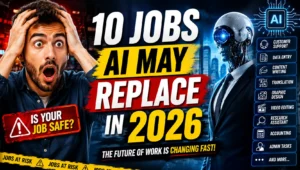
Jobs Most Likely to Be Replaced by AI in 2026
1. Customer Support Representatives
This is probably one of the biggest areas being disrupted.
Companies are increasingly using:
ChatGPT-powered chatbots
Intercom AI
Zendesk AI
Freshdesk AI
Most customer questions are repetitive:
“Where is my order?”
“How can I reset my password?”
“What are your prices?”
AI handles these questions 24/7 without taking breaks.
I recently visited several eCommerce websites and honestly couldn’t tell whether I was talking to a human or an AI assistant.
Does this mean all support jobs disappear?
No.
But companies may need fewer agents, keeping only senior staff for complex issues.
2. Data Entry Jobs
Years ago, data entry was considered a stable remote job.
Now AI can:
Read invoices
Extract information from PDFs
Fill spreadsheets automatically
Organize databases
3. Basic Content Writers
This topic often creates controversy because I also write content myself.
The truth is simple:
AI is not replacing great writers.
It is replacing average, repetitive writing.
For example:
Product descriptions
Basic news summaries
Generic blog posts
Simple SEO articles
Many website owners now use AI to create first drafts and then have one editor improve them.
I’ve tested this myself.
4. Translation Jobs
AI translation has improved dramatically.
Google Translate used to produce awkward sentences.
Now tools like:
ChatGPT
DeepL
Gemini
can create surprisingly natural translations.
Simple translation projects are becoming harder to find because businesses can automate much of the work.
Human translators will still be needed for:
Legal documents
Medical reports
Creative writing
Cultural adaptation
But routine translation work is already shrinking.
5. Junior Graphic Designers
This one surprised me personally.
I started experimenting with AI image generators mainly for website thumbnails.
Tools like:
Midjourney
DALL·E
Adobe Firefly
Canva AI
can now create professional-looking graphics within minutes.
Many small businesses no longer hire designers for simple tasks like:
Social media posts
Blog thumbnails
Basic advertisements
Experienced designers are still valuable, but entry-level work is definitely changing.
6. Simple Video Editing Jobs
Platforms such as:
CapCut AI
Descript
Runway
Canva Video
can automatically:
Remove silence
Add subtitles
Generate voiceovers
Create short clips
Some YouTube creators now produce multiple videos every week with very small teams.Tasks that once required professional editors are becoming increasingly automated.
7. Research Assistants
Today, AI tools can summarize huge amounts of information within minutes.
Platforms like Perplexity and ChatGPT Deep Research are changing how researchers work.
Instead of replacing researchers entirely, AI is reducing the amount of junior-level research work available.losing the job. Whether AI technically replaced you or just made your headcount look expendable on a spreadsheet, the outcome is identical.
Where I’ve Actually Seen AI Jobs Replacing Humans in 2026 Hit Hardest
Not every job is equally exposed. Here’s what I’ve noticed firsthand, from friends’ experiences and from testing this stuff myself.
Customer support and call centers. This is the one people describe least accurately. The old “chatbot replaces human” idea isn’t really what’s happening anymore. Modern support tools, built on models like GPT-4o and Claude, don’t just answer FAQs. They can log into a CRM, process a refund, reschedule an appointment, and remember your last three contacts with the company. Platforms built on Salesforce, Zendesk, and HubSpot have rolled this kind of agent into their products over the last year, and a lot of routine tickets now get resolved without a human ever touching them.
Entry-level content work, data entry, and QA testing. These got hit early and hit hard. If a job was mostly “look at this, categorize it, type a standard response,” AI does it faster and doesn’t need a paycheck or a lunch break.
Coding, but not quite in the way people expected. I use Cursor and Claude Code almost every day on my own projects, and a couple of developer friends lean on GitHub Copilot for daily autocomplete. Here’s the honest truth: none of these have replaced experienced developers on the teams I know. What they’ve replaced is the need for as many junior developers doing repetitive grunt work. Multi-file refactors, boilerplate, first-draft debugging, writing test cases, that stuff is genuinely faster with an AI agent handling the first pass. Senior engineers who know how to direct these tools well are more valuable than ever. Junior engineers who only knew how to do the repetitive parts are the ones getting squeezed out of hiring pipelines.
Medical billing, transcription, and healthcare back-office work. Hospitals using AI transcription tools are reporting documentation cost drops of 70 to 90%. Doctors and nurses aren’t going anywhere, since licensing and the need for human presence protect those roles, but the paperwork jobs sitting behind the scenes are shrinking noticeably.
The Time I Tried to Replace My Own Workflow With AI (and Got Humbled)
Back in February, half out of curiosity and half out of financial anxiety, I ran an experiment on myself.I run a small freelance content operation on the side, a handful of writers producing blog posts for clients. I wanted to know: could I just… not need them anymore?I fed one client’s brief into an AI writing tool, generated a full draft, lightly edited it, and sent it over.The client caught it within a day. Not because the writing was bad exactly, but because it didn’t sound like anyone specific. No real opinions, no concrete detail, nothing like “I tried this myself and here’s what actually went wrong.” It read like it had been assembled from a dozen other articles on the same topic, because functionally, it had been.
The client didn’t leave, but they did ask for a call, which is never a great sign. I learned two things from that. First, AI is genuinely excellent at structure, research summarizing, and fast first drafts. Second, the moment I stripped out human judgment and lived experience, the value of the piece dropped off a cliff, and clients noticed faster than I expected them to.
Step-by-Step: What I’d Actually Do If I Were Worried About My Job Right Now
If you’ve got that low hum of anxiety about your own role, here’s the practical version of what I’ve told friends who’ve asked me directly.
1. Separate the “pattern matching” parts of your job from the “judgment” parts. Be honest with yourself here. If your day is mostly repeating the same categorization, lookup, or standard response, that part is exposed. If it’s mostly judgment calls, relationship-building, or handling situations that don’t follow a script, that part is safer, for now.
2. Actually use the tools your industry is adopting, before you’re forced to. If you’re in support, spend a weekend testing an AI agent tool and see what it genuinely handles well. If you write for a living, draft with Claude or ChatGPT and then rewrite it in your own voice so you understand exactly where the gap is. If you code, put in real hours with Cursor or Claude Code instead of five minutes of skepticism.
3. Move toward the parts of your job that carry accountability. Someone still has to be responsible when an AI agent messes up a customer’s refund, a patient’s chart, or a company’s codebase. That accountability layer is where humans are staying employed.
4. Get specific on your resume, not generic. “Familiar with AI tools” means almost nothing now. “Supervised an AI agent handling 200 support tickets a day and cut backlog by half” means something concrete.
5. Don’t treat layoffs at your own company as background noise. If your company just cut a department by 10% and mentioned AI investment in the same earnings call, that’s not a coincidence you can afford to shrug off.
What’s Actually Growing Right Now
It’s not all bad news, and I don’t want to pretend it is. New roles are opening up around exactly this shift: people who supervise AI agents, people who audit AI output for accuracy, people who configure these tools for a specific business’s workflow, and people who handle the judgment-heavy escalations AI still can’t touch.
I’ve watched titles like “AI operations specialist” and “AI quality reviewer” show up at companies that had nothing like them eighteen months ago. Nobody’s fully staffed those teams yet. That gap is where a lot of the near-term opportunity actually sits.
Which jobs are most likely to be replaced by AI in 2026?
Customer support, data entry, basic content writing, translation, and repetitive administrative jobs are among the most vulnerable.
Will AI replace all human jobs?
No. AI is more likely to automate repetitive tasks while humans will still be needed for creativity, leadership, emotional intelligence, and complex decision-making.
Which jobs are safest from AI?
Healthcare professionals, skilled trades, managers, engineers, and jobs requiring human interaction are relatively safer.
How can workers prepare for AI in 2026?
Learning AI tools, improving soft skills, and continuously updating professional skills can help workers stay competitive.
Is AI creating new job opportunities?
Yes. AI is creating demand for AI specialists, automation consultants, prompt engineers, AI trainers, and technology managers.
Bilal Ahmad
Bilal Ahmad is the Founder and Editor of GlobalNewsHubz. He writes about technology, world news, government schemes, and digital trends. His goal is to provide readers with accurate, well-researched, and easy-to-understand information using trusted and official sources.