Europe’s Rare Solar Eclipse 2026, my uncle saw the 1999 eclipse from a field in Cornwall. He’s told the story so many times over the years that I could probably recite it word for word the birds going silent, the temperature dropping, a couple standing near him bursting into tears for no reason they could explain. Every time he tells it, he ends with the same line “You’ll understand when you see one.”
I always nodded along, half believing him and half-thinking he was exaggerating for effect. Then I found out that on August 12, 2026, Europe gets its next total solar eclipse the first one to actually reach the mainland since the one my uncle saw and something in me shifted. I wasn’t going to be the guy who heard about this secondhand thirty years from now. I wanted to actually understand what he meant.
So I spent the last few months doing something I don’t normally do real research, real trip planning, actual money set aside for it. Not because someone told me to, but because I kept running into the same realization over and over this isn’t a “check the sky at lunch” kind of event. It’s a “get on a plane or you’ll miss it” kind of event. And once that sank in, everything else followed.
Europe’s Rare Solar Eclipse 2026 Isn’t Just Another Eclipse
Here’s the thing that took me a while to actually get my head around, eclipses happen fairly often somewhere on Earth, but “somewhere” is usually the middle of the Pacific Ocean or a stretch of Antarctic ice nobody’s driving to on a weekend. Total eclipses over populated, reachable land are rare enough that people build entire trips, sometimes entire hobbies, around chasing them.
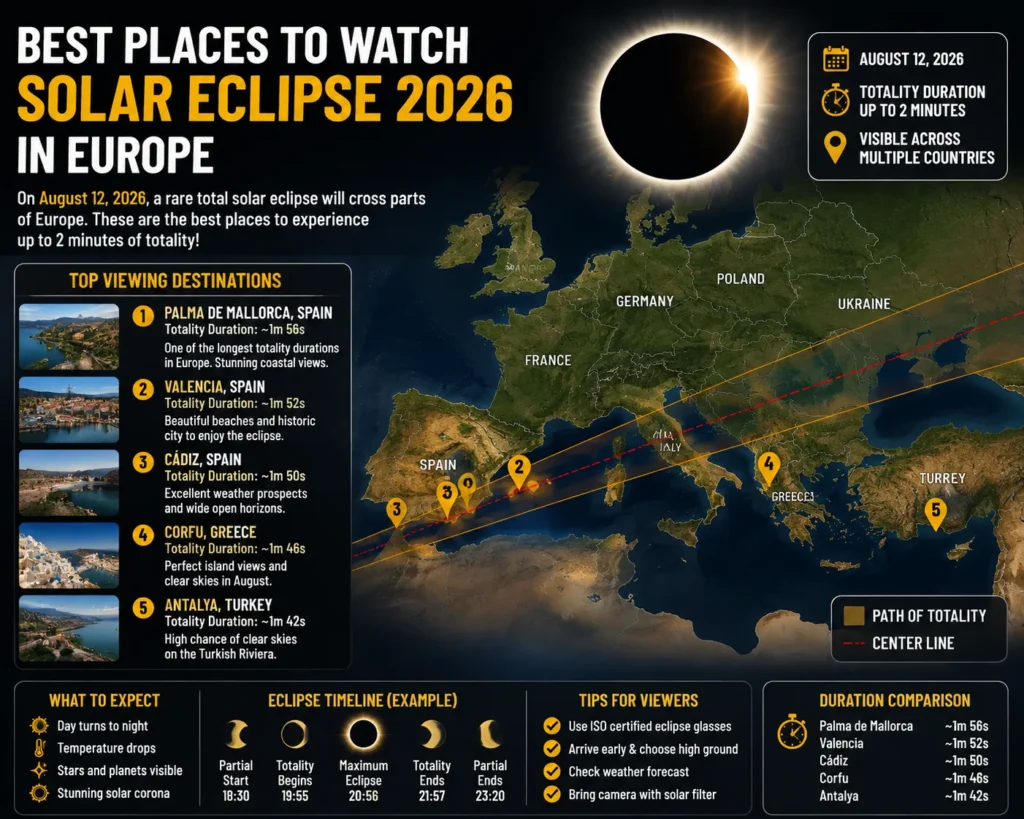
Europe hasn’t had one on the mainland since 1999. That’s not a small gap. That’s an entire generation of people who’ve grown up hearing about totality without ever standing under it. The path this time cuts across the western edge of Iceland, crosses a long stretch of open Atlantic, and then comes down over northern Spain, covering somewhere around 40% of the country, before brushing the Balearic Islands and a small corner of northeastern Portugal. Everywhere else in Europe the UK, Ireland, most of the continent gets a partial eclipse. A good one, sure. But partial and total are not cousins. They’re barely in the same family.
I say that because I made the mistake of treating them as basically the same thing back in 2024, watching a partial eclipse from my own backyard with a pair of cardboard glasses. It was fine. It was also completely forgettable. The sun got a little dimmer, I looked up a few times, and by evening I did basically stopped thinking about it. That memory is honestly what convinced me not to half ass this one.
The Decision Nobody Warns You About – Iceland or Spain
Iceland gets totality at around 5:44pm local time, and depending on exactly where you stand, you can get up to roughly 2 minutes and 13 seconds of darkness close to the longest totality anywhere along the entire path, which tops out at 2 minutes 18 seconds. There’s a spot out in the Westfjords, right at the western tip near a lighthouse and some seabird cliffs, that apparently gets about as close to maximum as you can. It sounds incredible on paper.But I’ve been to Iceland twice, and both times, the weather did whatever it wanted regardless of what the forecast said. Clouds roll in fast there. You could plan a trip around this exact event and still end up staring at a gray sky for the two minutes that matter most. That’s the gamble.
Spain is the one I eventually committed to, and the reason is almost embarrassingly simple: timing. The eclipse hits Spain right before sunset in the middle of August, so instead of the sun disappearing somewhere overhead in a bright afternoon sky, you get this low, golden hour eclipse where the sky is already turning orange and the sun is sinking toward the horizon at the same time it’s being covered. People who study this stuff for a living are calling it one of the more visually dramatic eclipses in recent memory because of that low angle. That sold me. I didn’t want astronomy I wanted a scene.
The tradeoff is real, though. Because the sun will only be a few degrees above the horizon, anything blocking your western view a hill, a building, even a line of trees can ruin it. You can’t just show up anywhere in the path and assume you’re set.
I want to be honest about the parts I got wrong, because I think they’re more useful than anything I got right.
I almost booked a hotel in a city center. My logic was simple bigger city, more to do, easier logistics. Except cities come with buildings blocking horizon views, more light interference, and worse, some “eclipse zone” cities are only partially inside the actual path of totality depending on which side of town you’re on. I didn’t realize this until I actually pulled up an interactive path map and typed in the hotel’s coordinates. It was outside the line. Cancelled it immediately.
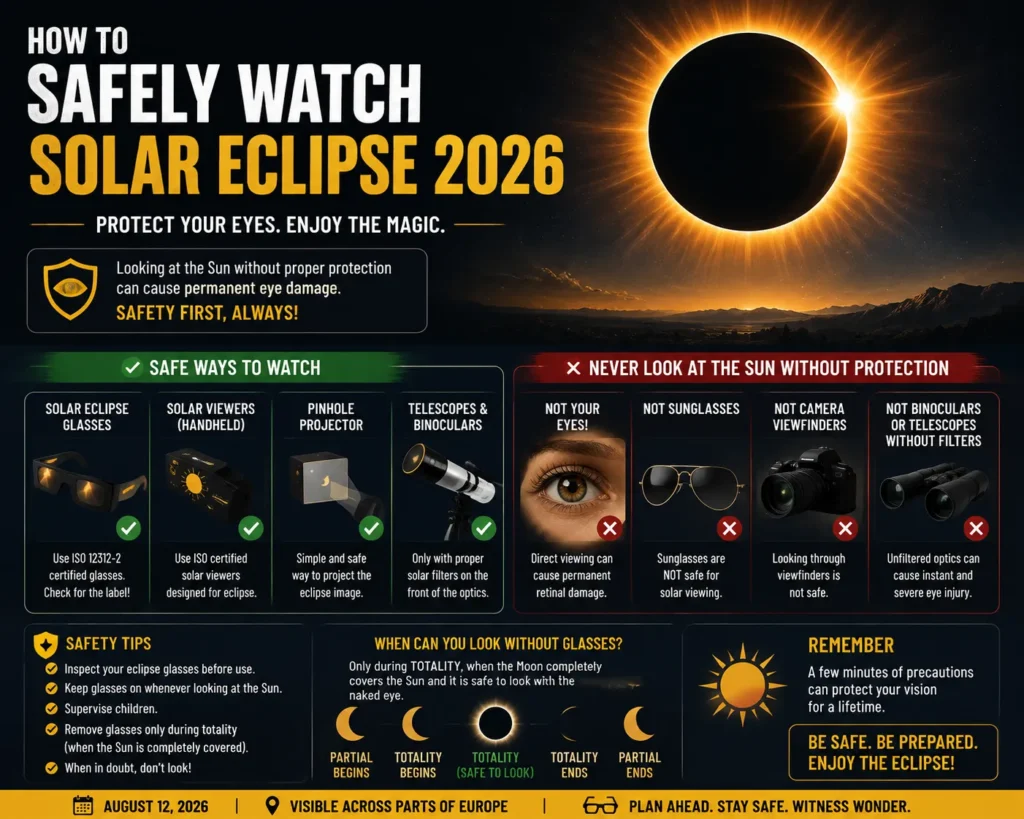
I trusted eclipse glasses that turned out to be sketchy. There’s a certification standard ISO 12312-2 that legitimate solar viewing glasses need to meet, and it should be printed directly on the glasses themselves, not just on the box they came in. I’d already added a cheap multipack to my cart before noticing the certification marking was only on the cardboard sleeve, nowhere on the actual lenses. That’s a classic sign of counterfeit stock flooding in ahead of a big eclipse date. I returned them and bought from a supplier that had the marking stamped right on the frame.
I didn’t understand the “safe to look” window at first. This one genuinely confused me until I read it a few times. You need certified eclipse glasses on during every partial phase, both before and after totality, no exceptions. The only time it’s actually safe to look with your bare eyes is during totality itself, when the sun’s disc is completely blocked. The moment the first bit of sun peeks back out, glasses go back on immediately. People apparently get so caught up in the moment that they forget this exact transition, which is the riskiest part of the whole thing.
I hadn’t practiced with my camera at all. I do a decent amount of phone photography, but I’d never tried shooting into direct sun with a filter attachment before. So I ran a test during a regular sunset just to get a feel for exposure settings, because totality lasts around two minutes at best, and there’s no reshoot.
Look up your exact location on an interactive path map not just the general region. Sites built specifically for this eclipse let you enter a town or even a street and tell you if you’re inside totality or just outside it in the partial zone.
Book somewhere close to the centerline of the path. The nearer you are to that line, the longer totality lasts. Drift too far to either edge and you might get totality that lasts only seconds, or none at all.
Buy certified glasses now, not in July 2026. Prices spike and counterfeit sellers multiply as the date gets closer.
Physically check your sightline, especially in Spain, since the sun will be low. Stand where you plan to watch from and look west. If there’s a building or hill in the way, find a new spot.
Pick a backup location with different weather odds, ideally 30 to 60 minutes away, in case clouds roll in over your first choice.
Set an alarm before predicted totality. The partial phases stretch out over an hour or more, and it’s easy to lose track of exactly when the main event starts.
Plan to put the camera down for at least part of totality. I have heard this advice from more experienced eclipse-watchers than I can count people who spent their entire first eclipse fumbling with settings and later admitted they barely looked up.
What I’m Actually Expecting to See
I have not lived through totality myself, so I’m not going to pretend I have some poetic firsthand description ready. But from what people who’ve chased these before describe consistently: the temperature drops noticeably in the minutes leading up to it, birds and animals start acting like it’s dusk, and right before the sun fully disappears there’s often a bright flash on one edge called the “diamond ring” effect. Then, for those brief couple of minutes, you can actually see the sun’s outer atmosphere the corona glowing around the blacked-out disc. It’s something that doesn’t show up the same way in photos or through any filtered viewing on a regular day.
Don’t rely purely on phone signal for navigation if you’re heading somewhere remote download offline maps beforehand, especially in rural Iceland or inland Spain. Don’t underestimate how backed up small roads into centerline towns could get in the final hours before the event. Don’t skip water and sun protection if you’re in Spain in August, since you’ll likely be sitting outside waiting for a while. And don’t assume your regular sunglasses, no matter how dark, are any kind of substitute for certified eclipse glasses. They’re not, and it’s not close. How to safely watch a solar eclipse?
Final Thoughts
I keep coming back to my uncle’s line “you’ll understand when you see one.” I used to think that was just something people said to sound profound about a natural event. Now, after months of reading flight paths, path of totality maps, and stories from people who’ve done this before, I think I get what he meant. It’s not really about the astronomy. It’s about being one of a relatively small number of people standing in exactly the right spot on exactly the right day, watching something the sky only offers up once in a very long while.
Whether that ends up being a windswept cliff in the Westfjords or a hillside in northern Spain with the sun sinking low, I’d rather be there and get rained out than not go at all. If you’re on the fence, my honest advice is to stop sitting on it. Check the map, get real glasses, and go stand under it.
When is the solar eclipse in Europe 2026?
The 2026 solar eclipse will be visible from parts of Europe, with some regions experiencing a total solar eclipse.
Where is the best place to watch the 2026 solar eclipse?
The best locations are areas inside the eclipse path where viewers can experience totality with clearer skies.
Can a phone camera capture the solar eclipse?
Yes, but proper solar filters and safe photography methods are recommended for better results.
Is the August 2026 solar eclipse visible from Pakistan or India?
No, The eclipse’s visibility zone covers Europe, Greenland, parts of North Africa, and the edges of North America. South Asia falls outside that zone entirely, so a livestream is the only realistic way to watch it from there.
When’s the next total solar eclipse in Europe after 2026?
The next one is August 2, 2027, visible from Spain, northern Africa, and parts of the Middle East. After that, an annular eclipse crosses Portugal and Spain again on January 26, 2028.
Bilal Ahmad
Bilal Ahmad is the Founder and Editor of GlobalNewsHubz. He writes about technology, world news, government schemes, and digital trends. His goal is to provide readers with accurate, well-researched, and easy-to-understand information using trusted and official sources.