Freelancing in Pakistan 2026, A few years back, I remember sitting in a cafe in a small town, watching my electricity bill pile up while I waited for a Fiverr message to come through. That “ting” notification sound? I used to get genuinely excited over it, because back then, one $30 order felt like a small miracle.
Fast forward to now, and freelancing in Pakistan isn’t some side hustle secret anymore everyone’s cousin, neighbour, or college batchmate is “doing something online.” But here’s the thing nobody tells you clearly not every skill pays the same, and picking the wrong one can waste six months of your life before you even land your first real client.
So let’s talk honestly about what’s actually working in 2026, what I wish someone had told me earlier, and how you can avoid the mistakes that cost me time and money.
Why Pakistan Is Actually a Good Place to Freelance Right Now
I know it sounds like a line from a motivational Linkedin post, but the numbers genuinely back it up this time. Pakistani freelancers pulled in $557 million in foreign exchange in just the first half of FY2026 that’s a 58% jump year on year. IT exports overall crossed $2.97 billion in the same stretch. This isn’t a hype cycle; it’s a real, growing pipeline of dollars coming into the country through people sitting at home with a laptop and decent internet.
None of this matters if you pick the wrong skill though. I’ve seen too many beginners jump into things like basic data entry or “like and subscribe” type gigs that pay peanuts and go nowhere. So let’s break down what’s actually worth your time.
The Skills That Are Genuinely Paying Off in 2026
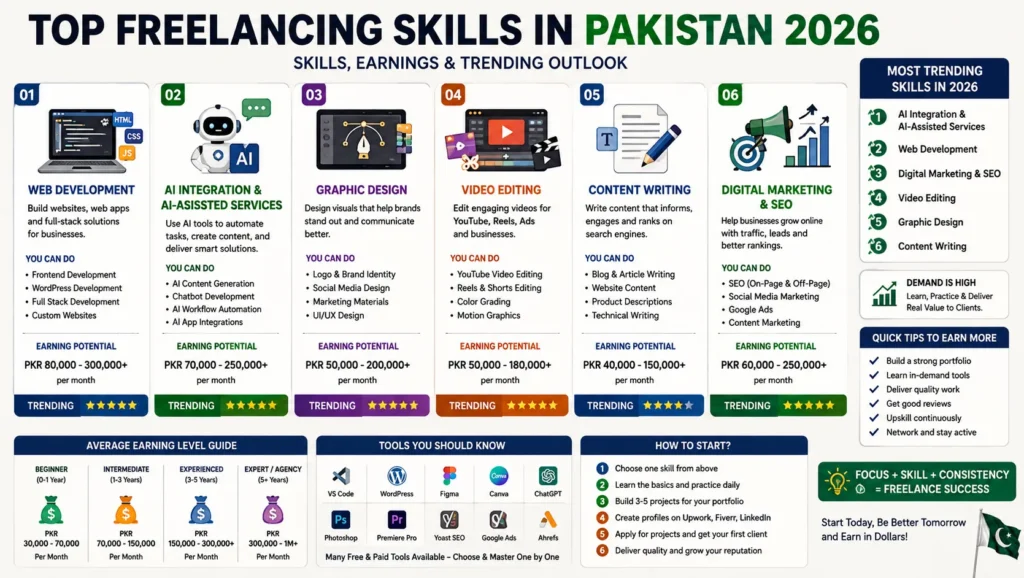
1. Web Development (Still King, Not Dying Anytime Soon)
I get asked constantly if web development is “saturated.” Short answer: the basic stuff is, the good stuff isn’t. Every business on the planet still needs a website that actually works, loads fast, and doesn’t look like it was built in 2012.
What’s working right now:
Flutter for cross-platform apps clients love it because one codebase covers both Android and iOS, which saves them money. That “saves them money” part is exactly why it’s blown up as a freelance skill.
Laravel and basic PHP are still bread and butter for small business sites.
WordPress customization is unglamorous but pays consistently small business owners will pay $150-$400 just to get their site looking clean and working properly.
My honest advice don’t try to learn everything at once. I made that mistake jumped between React, then Vue, then back to plain JavaScript because some YouTube video told me it was “better.” Pick one stack, build three real projects (not tutorials actual things you’d show a client), then start applying.
2. AI Integration and AI-Assisted Services
This is the one that genuinely surprised me. Two years ago, “AI skills” meant knowing how to write a decent ChatGPT prompt. Now clients are specifically asking for people who can wire up AI tools into their actual business think chatbots connected to a business’s own data, automation workflows using tools like Zapier or Make, or AI-powered content pipelines.
You don’t need a computer science degree for this. A lot of freelancers I know started by:
Learning how APIs work (even at a basic level)
Getting comfortable with no-code automation tools
Building small demo projects like an AI chatbot for a local restaurant’s Facebook page just to have something to show
This category has probably the highest ceiling of anything on this list right now, but also the steepest learning curve if you’re starting from zero.
3. Graphic Design (Boring but Reliable)
Everyone rolls their eyes at graphic design because “everyone can use Canva now.” True, but there’s a difference between someone who can use Canva and someone who understands actual design principles spacing, color theory, brand consistency.
I’ve watched friends build stable $500-800/month incomes just doing:
Instagram post templates for small brands
Logo design (still one of the most searched Fiverr categories)
Menu design for restaurants (there are literally millions of restaurants worldwide that market never dries up)
Tools worth learning:Photoshop and Illustrator if you want to go pro, but honestly Canva Pro gets you 80% of the way for a fraction of the learning time.
If I had to recommend one skill for someone who wants results fast, it’s this. Video editing has one of the quickest paths from “I just learned this” to “someone paid me for it,” mainly because demand from YouTubers, TikTok creators, and small businesses making Reels is honestly endless right now.
Learn Premiere Pro or DaVinci Resolve (free, and genuinely powerful don’t let anyone tell you that you need to pirate Premiere to start). Start by editing free stock footage just to build a demo reel, then approach small YouTube channels directly cold outreach works way better here than waiting for Fiverr orders.
5. Content Writing (But With an AI-Era Twist)
Content writing isn’t dead, but the game changed. Clients don’t just want “someone who can write English well” anymore that’s assumed. What separates people who get repeat clients from people who get ghosted is understanding how content needs to work now for both humans and AI-driven search (things like Google’s AI Overviews and ChatGPT answers pulling from web content). This is sometimes called GEO (Generative Engine Optimization) alongside traditional SEO.
If you’re starting out, don’t chase generic “blog writer” gigs. Niche down. I’ve seen way better luck with writers who pick a lane SaaS product writing, health content, finance explainers because clients pay more for someone who “gets” their industry.
6. Digital Marketing & SEO
Businesses will always need eyes on their stuff. SEO specifically is shifting technical SEO and content structuring for AI-generated answers is becoming its own specialty. If you’re technical-minded, this pairs really well with content writing skills.
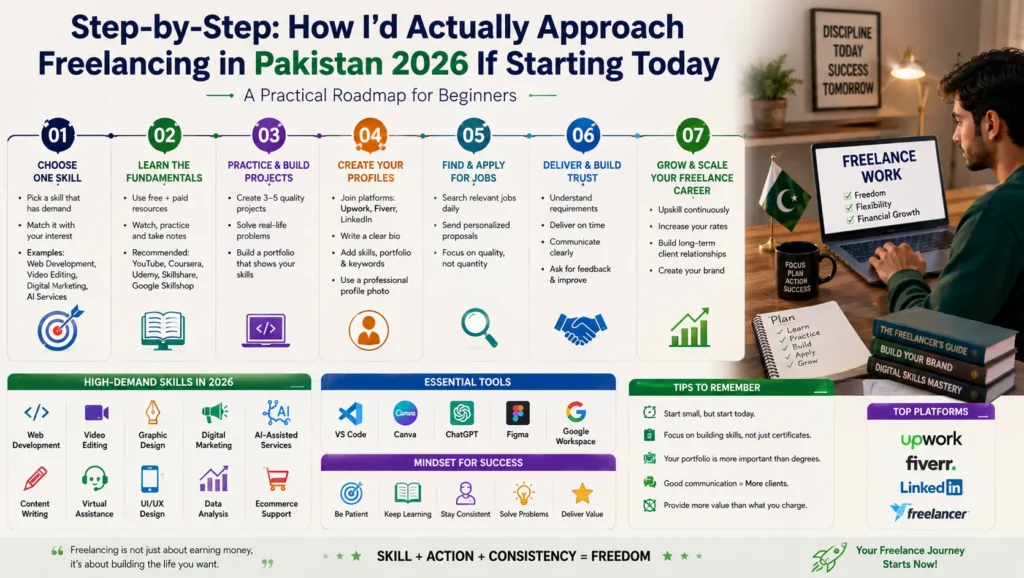
Step-by-Step: How I’d Actually Approach Freelancing in Pakistan 2026 If Starting Today
Pick ONE skill, not three. I wasted months trying to be a “jack of all trades” freelancer. Clients don’t hire generalists, they hire specialists.
Learn from free resources firstDigiskills.pk (a genuinely underrated government backed platform), YouTube, and Udemy courses (wait for the $10-12 sales, never pay full price).
Build 3-5 real portfolio pieces before you even think about applying for paid work.
Get your payment method sorted early. Payoneer is still the most widely used option and works directly with Fiverr and Upwork withdrawals. Bank Alfalah also has a dedicated freelancer account that’s worth looking into.
Register for an NTN through FBR’s IRIS portal once you start earning consistently it’s a simple process (Form 181 plus your CNIC), and if your annual income crosses PKR 600,000, filing returns becomes mandatory anyway, so it’s better to be ahead of it than scrambling later.
Apply, don’t wait. I spent way too long “perfecting” my profile before applying to a single gig. Your first few proposals will probably get ignored that’s normal, not a sign you’re bad at this.
Underpricing myself for too long. I stayed at $5/hour rates way past the point where my work justified more, purely out of fear that raising prices would scare clients off. It didn’t better clients actually take you more seriously at slightly higher rates.
Ignoring communication skills. Technical skill gets you noticed, but clear, professional communication is what gets you repeat clients. A lot of freelancers lose good clients simply by being slow or vague in replies.
Learning too many tools instead of finishing projects. Tutorials feel productive but they’re not the same as shipping actual work.
Not diversifying platforms. I relied on Fiverr alone for over a year. When my account got a temporary review hold, I had zero backup income. Having a presence on Upwork or even direct outreach via LinkedIn saves you from that kind of scare.
Final Thoughts
There’s no single “best” skill that works for everyone it depends on how much time you can put in, whether you enjoy creative work or technical problem solving, and honestly, how patient you are with the slow first few months. What I can tell you from actually going through it is that consistency beats talent almost every time in this game. The people who stuck around, kept showing up, and slowly got better at one thing are the ones earning real money now not the ones who jumped between five different “trending” skills every other month.
Pick something. Give it three real months of focused effort before judging whether it’s “working.” Then decide from there.
Which skill is best for freelancing in Pakistan in 2026?
Web development, AI integration, graphic design, video editing, and content writing are currently the highest demand skills. Web development still pays the most consistently, while AI integration has the fastest growing ceiling for those willing to learn it.
Can a complete beginner start freelancing in Pakistan without any experience?
Yes, skills like graphic design (using Canva), content writing, and video editing have a short learning curve and don’t require a technical background.
How much can a beginner freelancer earn per month in Pakistan?
Most beginners earn somewhere between PKR 20,000 and 80,000 per month within their first 3–6 months of consistent work. Experienced freelancers with in demand skills often cross PKR 100,000 to 500,000+ monthly, depending on niche and platform.
Is web development still worth learning in 2026, or is it saturated?
Basic, low effort web development is saturated but skilled developers, especially those working with Flutter, Laravel, or clean WordPress customization, are still in strong demand because businesses consistently need functional, well built websites.
Is AI replacing freelancers in Pakistan, or creating more opportunities?
Right now, it’s creating more opportunities. Clients are increasingly looking for freelancers who can integrate AI tools into their business (chatbots, automation, AI assisted content), which has become one of the highest paying emerging niches rather than threat.
Bilal Ahmad
Bilal Ahmad is the Founder and Editor of GlobalNewsHubz. He writes about technology, world news, government schemes, and digital trends. His goal is to provide readers with accurate, well-researched, and easy-to-understand information using trusted and official sources.