SpaceX’s First Earnings Report, I put a small chunk of money into SPCX shares back in June, right after the IPO. Not a huge amount enough that I’d actually pay attention, not enough to lose sleep over. Or so I thought.Fast forward to now, and my stock app notification is basically a second heartbeat. Green one week, red the next, red again, red again. If you own even a few shares of SpaceX right now, you know exactly what I’m talking about.
Tomorrow (August 4) is a big one. SpaceX reports its first-ever quarterly earnings as a public company, and honestly, this is the moment that decides whether the last two months of chaos was just IPO growing pains or the start of something uglier.
SpaceX priced its IPO at $135 a share on June 11, and started trading on the Nasdaq under the ticker SPCX on June 12. It raised roughly $75 billion, and once the underwriters exercised their overallotment option, that climbed to $85.7 billion officially the biggest IPO in history, blowing past Saudi Aramco’s old record from 2019.
What made it different from most IPOs is that regular people actually got a real shot at shares. Around 30% of the offering was set aside for retail investors, distributed through brokerages like Schwab, Fidelity, Robinhood, SoFi, and E*TRADE. That’s a much bigger slice than retail usually gets in a mega IPO, and it’s a big part of why this stock has so many everyday investors (like me) glued to it.
The stock then did exactly what hyped up debuts tend to do. It shot up to an intraday high of $225.64 on June 16, before gravity took over. As of this week, it’s trading in the $107–$113 range below the original $135 IPO price, and less than half of that June peak.
Why tomorrow’s SpaceX’s First Earnings Report is such a big deal?
Normally a company’s second quarterly report isn’t dramatic. This one is, for two reasons.
First, this is literally the first time outsiders get to see SpaceX’s real numbers on a recurring, audited, public basis. Before the IPO, everything was estimates, leaked filings, and secondhand reports. Now it’s official.
Second and this is the part a lot of casual investors don’t realize this earnings release triggers the first stage of SpaceX’s insider lock-up expiration. Employees and early investors have been sitting on restricted shares since the IPO, and this report opens the door for them to start selling. Starting August 6 (two trading days after earnings), insiders can offload up to 20% of their locked-up shares, which works out to roughly 911.5 million shares. There’s also a clause that could unlock an extra 10% if the stock had closed 30% above the IPO price on enough sessions beforehand but given where the stock actually is right now, that particular trigger isn’t happening.
So you’ve got a first ever earnings report and a wave of potential insider selling landing basically back to back. That’s why the mood around this stock feels tense rather than routine.
What Wall Street is actually expecting
To be clear none of this has happened yet as I’m writing this. These are analyst estimates, not results. Here’s the shape of what people are looking for:
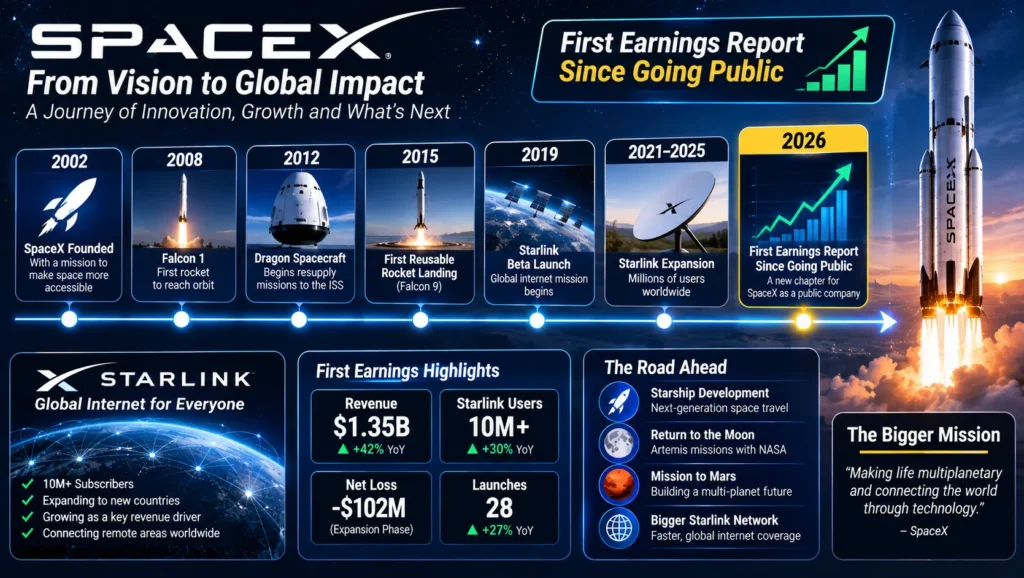
Revenue: Consensus is sitting around $6.8–6.9 billion for the quarter, up from $4.7 billion in Q1 2026.
Loss per share: Analysts are penciling in a loss of roughly $0.25–$0.26 per share.
Adjusted EBITDA: Estimated around $2 billion.
Capital spending: This is the scary one. Estimates put 2026 capex around $48.7 billion, potentially climbing toward $118 billion by 2028. Debt is projected to grow from around $41.7 billion this year to over $218 billion by 2028.
The three businesses you actually need to understand
SpaceX reports results across three segments, and each one tells a different story.
Space: This is the classic rocket launch business people picture when they hear “SpaceX.” Falcon 9, Falcon Heavy, and eventually Starship. It’s the most mature part of the business but not necessarily the biggest revenue driver anymore.
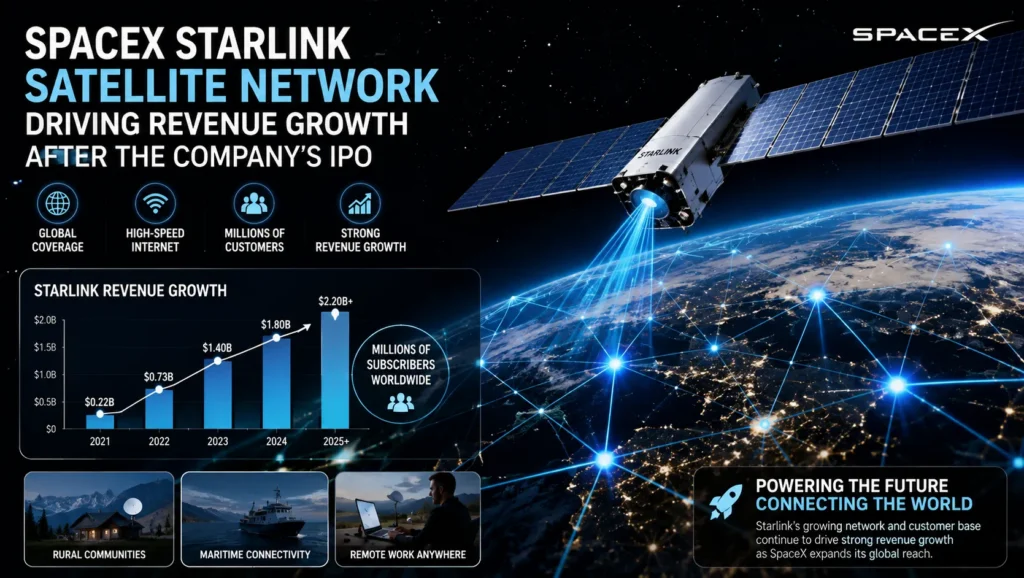
Connectivity (Starlink): This is the real engine right now. As of March 31, 2026, Starlink had crossed 10.3 million subscribers across more than 160 countries, roughly double what it had a year earlier. Starlink alone brought in $11.4 billion in 2025, about 61% of total company revenue. The number to watch here isn’t just subscriber count it’s average revenue per user and whether margins are actually expanding as the network scales.
AI: This is the newest and most controversial piece. SpaceX completed its acquisition of Elon Musk’s xAI in February 2026, folding in the Grok chatbot, and also picked up the AI coding startup Cursor. The AI segment pulled in $818 million in Q1 alone, and there’s a headline grabbing deal with Google Cloud worth $920 million a month in compute capacity. This is also the segment fueling the most skepticism, because AI infrastructure eats capital fast, and it’s not obvious yet how quickly it turns into profit.
Musk himself has talked about SpaceX hitting something like $1 trillion in revenue by 2030 up from $18.7 billion last year. I’ll be honest, when I read that number I did a double take. That’s not impossible territory for SpaceX given how fast Starlink scaled, but it’s the kind of number that needs actual quarters of evidence behind it, not just a post on X.
How to actually watch this yourself (step by step)
If you want to follow along live instead of just reading recaps after the fact, here’s exactly how I’m doing it:
Mark the time. SpaceX releases results after market close on August 4, with the earnings call starting at 4:30 p.m. ET / 3:30 p.m. CT.
Find the webcast. It’s audio only, no video, hosted at ir.spacex.com. Pre-registration and replays are usually available there too.
Pull up your brokerage app in real time. Whether you use Robinhood, Fidelity, Schwab, or something else, after-hours price action tends to move fast and hard on earnings nights. Don’t be shocked by wild swings in the first 15–20 minutes.
Read the shareholder letter, not just headlines. The actual filing usually has more nuance than any single news alert. Look specifically at segment level numbers, not just the overall revenue and loss figures.
Wait for the dust to settle before reacting. More on this below this is the step I personally learned the hard way.
Chasing the June 16 spike. I watched the stock hit $225 and genuinely considered buying more right at the top out of pure FOMO. I didn’t, mostly out of laziness, not wisdom and I’m glad, because it’s down more than 45% from there since.
Panic-selling on red days. A friend of mine dumped shares the day it first dipped below the $135 IPO price, only to watch it bounce slightly the next session. Volatility right after an IPO, especially one this size, is normal not necessarily a signal.
Ignoring the lock-up calendar. A lot of retail investors don’t even realize insider lock up expirations exist, let alone that this specific one is tied directly to the earnings date. That’s a real supply side pressure on the stock that has nothing to do with the actual business performance.
Treating hype numbers as guarantees. Big, bold statements about trillion-dollar revenue in 2030 make headlines, but they’re projections, not commitments. Judge the company on the quarters it actually reports.
For me, it’s less about the exact revenue beat or miss and more about direction and honesty in guidance. Is Starlink’s margin actually improving as it scales, or just growing in raw dollars? Is the AI segment showing real traction beyond one headline grabbing Google deal? And does management give a straight answer on how they’ll fund a capex plan that’s ballooning into the hundreds of billions, without endlessly diluting shareholders or piling on debt?
I’m also keeping half an eye on Starship. SpaceX is gearing up for Flight 14, aiming for its first attempt at catching the upper stage itself using the Mechazilla tower arms at Starbase something they’ve only done with the booster so far. It’s not technically part of the earnings report, but Musk tends to bring it up on these calls, and it matters for the long-term Starship dependent parts of the valuation story.
When does SpaceX report its Q2 2026 earnings?
After market close on August 4, 2026, with an earnings call starting at 4:30 p.m. ET.
Why has SpaceX stock dropped so much since the IPO?
It priced at $135, spiked to an intraday high of $225.64 on June 16, then fell back trading in the $107–$113 range in early August, below its IPO price. Early enthusiasm cooling off, profit-taking, and reassessment of the valuation all played a role.
What is the SpaceX lock-up expiration, and why does it matter?
It’s the point where employees and early investors are first allowed to sell restricted shares. The first tranche opens starting August 6, right after this earnings report, and could add significant selling pressure to the stock.
Is SpaceX profitable?
Not yet as a whole company. It posted a $4.9 billion net loss in 2025 and a $4.28 billion loss in Q1 2026, even though Starlink itself is considered profitable. The Space and AI segments are still weighing on overall results.
Is Starlink actually making money?
Starlink is generally viewed as the profitable core of the business, generating $11.4 billion in 2025 revenue and over 10 million subscribers. It’s effectively subsidizing the more capital hungry Space and AI segments right now.
Bilal Ahmad
Bilal Ahmad is the Founder and Editor of GlobalNewsHubz. He writes about technology, world news, government schemes, and digital trends. His goal is to provide readers with accurate, well-researched, and easy-to-understand information using trusted and official sources.