What Caused the Japan Earthquake, I was scrolling through my phone at 2 AM when a push notification lit up my screen: earthquake alert, Japan, magnitude 6.8. My first thought wasn’t even about the science it was about a friend of mine who lives in Fukuoka. I messaged her immediately. She was fine, a little shaken (literally), but her neighbour’s shop wall had come down and a nearby mall was dealing with people trapped inside.That’s usually how these things hit us, right? Not as a headline, but as a “wait, isn’t my friend/cousin/that YouTuber I follow living there?” moment. And once the initial worry passes, the next question is almost always the same one people type into Google at 2 AM. why does this keep happening in Japan?
I’ve spent way too many hours over the years reading up on this partly because I visited Japan once and the hotel had laminated earthquake instructions taped right next to the TV remote, which honestly rattled me more than any news article ever did. So here’s what I’ve learned, broken down the way I wish someone had explained it to me the first time.
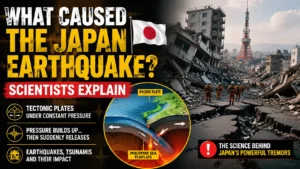
Japan sits in one of the most geologically busy spots on the planet. Four tectonic plates the Pacific, Philippine Sea, Eurasian, and North American all meet or brush up against each other right around the Japanese archipelago. Nowhere else on Earth do quite so many plates crowd into such a small area.
Think of tectonic plates like giant rafts floating on a slow moving ocean of hot rock underneath them. They’re not floating gently, though. They’re constantly grinding, pushing, and occasionally slipping past one another. Japan just happens to be sitting exactly where several of these rafts bump into each other.
The Recent Kumamoto Quake — A Real, Fresh Example
I want to use a real, recent case instead of just talking in the abstract, because I think it actually makes the concept click.
On July 28, 2026, a magnitude 6.8 earthquake struck just south of Kumamoto city on Kyushu, one of Japan’s southern islands. It cracked roads, brought down walls, and rescue crews had to pull people out from under a collapsed mall.
Here’s the part that actually surprised me when I looked into it: this wasn’t one of those deep, offshore “the whole ocean floor just moved” earthquakes. It happened on a strike slip fault basically a crack in the Earth’s crust where two blocks of rock slide sideways past each other, like two hands pressed together and dragged in opposite directions. This particular stretch of crust sits where the Philippine Sea Plate is slowly grinding against the Eurasian Plate, at a pace of roughly 58 millimeters a year.
Fifty eight millimeters doesn’t sound like much. That’s less than the length of your thumb, per year. But that stress doesn’t just disappear it builds up along the fault for years, decades, sometimes centuries, until the rock finally can’t hold the tension anymore and it snaps. That snap is the earthquake.
This is the bit that finally made things click for me, because I used to lump all Japanese earthquakes into one mental category. Turns out there are really two different flavors.
1. Subduction zone earthquakes These happen offshore, where a massive plate physically dives underneath Japan. Picture one plate acting like a ramp, sliding beneath the other. These zones are enormous, which means the earthquakes they produce can get seriously massive the 2011 Tohoku Oki earthquake, a magnitude 9.1, was this type. Because that energy is released offshore and underwater, these quakes are also the ones capable of generating massive tsunamis, since they physically shove huge volumes of ocean water when the seafloor lurches.
2. Shallow crustal earthquakes These happen on land, closer to the surface, on faults within the plate itself rather than at the boundary where one plate dives under another. The July 2026 Kumamoto quake falls into this bucket. Because they’re shallower and closer to where people actually live, the shaking can feel intense even at a “smaller” magnitude compared to a deep offshore mega-quake.
If you want to understand why Japan takes earthquake prep so seriously, you have to talk about March 2011. A magnitude 9.1 earthquake off the coast triggered a tsunami that killed tens of thousands of people and caused the Fukushima Daiichi nuclear disaster.For over a decade, scientists genuinely didn’t fully understand why that particular fault ruptured so violently and slipped so far. Then, researchers drilled into the seafloor at the Japan Trench aboard a science vessel called the Chikyu, going down nearly 8,000 meters a record for scientific ocean drilling. What they found was kind of wild a thin slippery layer of ancient clay-rich mud buried in the rock beneath the seafloor, formed from sediment that had been settling there for over 130 million years.
That clay layer acted almost like a lubricant. Instead of the fault gripping and grinding in smaller increments, the slippery clay let it slide much farther in one go, which is part of why the seafloor rose so dramatically and produced a tsunami far bigger than anyone expected for that region.
Common Mistakes People Make When Reading What Caused the Japan Earthquake
I’ve made a few of these myself, so consider this the “learn from my confusion” section.
Assuming magnitude alone tells you the danger. A shallow 6.8 near a city can do more visible damage than a 7.5 that happens deep underwater far from shore. Depth and location matter as much as the number.
Thinking a big quake “uses up” the risk. Actually, after a major earthquake, agencies like the Japan Meteorological Agency (JMA) sometimes warn that the risk of another large quake is temporarily elevated, not lowered. That happened after the magnitude 7.7 quake off northeastern Honshu back in April 2026 JMA flagged an increased chance of a bigger “mega quake” in the following days.
Ignoring earthquake swarms. Places like the Tokara Islands have had long stretches of repeated smaller quakes (a “swarm”). It’s tempting to assume a swarm means a huge one is coming, but researchers who’ve studied these patterns statistically have found the swarms often resemble past ones that didn’t lead to anything catastrophic. Doesn’t mean zero risk just means don’t panic from a headline alone.
Forgetting the Nankai Trough conversation. Japan has an ongoing, long term watch on the Nankai Trough, a subduction zone scientists believe is overdue for a major rupture based on historical patterns. It’s a slow moving, decades scale concern, not breaking news, but it’s part of why Japan invests so heavily in building codes and early warning systems.
What Actually Helped Me Understand This (Tools & Resources)
If you want to follow this stuff yourself instead of just reacting to alerts:
USGS Earthquake Hazards site gives you the technical breakdown (fault type, plate boundary, depth) usually within an hour of a quake.
Japan Meteorological Agency (JMA) the primary source for tsunami warnings and official magnitude readings for events inside Japan; their numbers sometimes differ slightly from USGS because of different measurement methods.
NHK World Japan’s public broadcaster, and honestly the fastest source for live footage and evacuation updates if something is unfolding in real time.
A basic earthquake alert app on your phone (many Android phones have this built in now, and iPhones get emergency alerts too) genuinely useful if you have friends, family, or business ties in Japan.
The honest truth is that no one not the JMA, not the USGS, not any seismologist can predict exactly when or where the next one hits. What they can do is explain, after the fact, which fault moved, why, and what kind of quake it was. That’s still incredibly valuable, because it’s how building codes get updated, how tsunami warning systems get calibrated, and how cities like Kumamoto figure out what needs reinforcing before the next one.
If there’s one thing my friend in Fukuoka told me that stuck with me, it’s this: she said the shaking itself lasted less than a minute, but the checking in on each other afterward is what actually matters. The science explains the “why.” The rest of us just try to be ready and look out for each other when it happens.
Why does Japan have so many earthquakes?
Japan sits right where four tectonic plates the Pacific, Philippine Sea, Eurasian, and North American meet or grind against each other. That’s not common anywhere else on Earth, which is why Japan experiences frequent seismic activity as a permanent feature of its geography, not bad luck.
What caused the July 2026 Kumamoto earthquake?
The magnitude 6.8 quake that hit just south of Kumamoto on July 28, 2026 happened along a strike slip fault, where the Philippine Sea Plate and Eurasian Plate are sliding past each other at about 58 millimeters a year. That slow buildup of stress over years eventually released all at once, causing the quake.
What’s the difference between a subduction zone earthquake and a shallow crustal earthquake?
Subduction zone quakes happen offshore where one plate dives beneath another they can reach massive magnitudes and trigger big tsunamis, like the 2011 Tohoku quake. Shallow crustal quakes happen on land, closer to the surface, and while often lower magnitude, they can still cause serious local damage since they’re closer to where people live.
Can scientists predict when the next big earthquake will hit Japan?
Not precisely, Seismologists can identify high-risk zones (like the Nankai Trough) and explain why a quake happened after it occurs, but pinpointing an exact date or location beforehand still isn’t possible with current science.
Does a big earthquake reduce the risk of another one happening soon?
Not necessarily sometimes it’s the opposite. After Japan’s magnitude 7.7 quake off Honshu in April 2026, the Japan Meteorological Agency actually warned that the odds of another large earthquake were temporarily higher than normal, not lower.
Bilal Ahmad
Bilal Ahmad is the Founder and Editor of GlobalNewsHubz. He writes about technology, world news, government schemes, and digital trends. His goal is to provide readers with accurate, well-researched, and easy-to-understand information using trusted and official sources.