E-commerce Growth in 2026, I still remember the exact night my store’s server hiccuped during a flash sale. Orders were coming in, my phone wouldn’t stop buzzing, and for about twenty minutes I genuinely thought I was watching the best day of my business turn into the worst one. Turns out, half those “orders” were people abandoning carts because my checkout page was timing out under traffic it had never seen before.
That night taught me something nobody tells you when you start selling online growth isn’t the finish line. It’s the thing that exposes every weak spot in your setup. More traffic, more orders, more attention it all sounds great until it finds the cracks you didn’t know were there.
I have been running (and occasionally rescuing) small online stores for a few years now, on Shopify, on WooCommerce, and briefly on a janky custom build I do not recommend to anyone. What follows isn’t theory. It’s what actually worked, what wasted my money, and what I’d tell a friend who just launched their first store and is wondering why sales aren’t taking off.
When people say “grow my e-commerce business,” they usually mean “get more sales.” But sales come from only four places, and most stores are only pulling on one of them:
More people visiting your store (traffic)
More of those people buying (conversion rate)
Bigger average orders (AOV)
People coming back to buy again (retention)
I spent almost a full year obsessed with traffic running ads, chasing Instagram followers, doing giveaways while my conversion rate sat at an embarrassing 0.7%. I was pouring water into a bucket with a hole in the bottom. Fixing the bucket (my product pages, my checkout, my trust signals) did more for revenue in six weeks than the previous eight months of ad spend.
That’s the biggest mindset shift I can hand you: before you spend another rupee or dollar on ads, look at what happens to the people who are already showing up.
Step 1: Fix What’s Leaking Before You Add More Traffic
If checkout abandonment is high, it’s rarely about price. It’s usually one of these:
Shipping cost shown too late (surprise fees at the last step kill trust instantly)
Too many form fields
No guest checkout option
Payment methods people don’t recognize or trust
I added Apple Pay and Google Pay as checkout options on a client’s store and abandonment dropped almost 18% within a month. No ad spend, no new traffic just removing friction for people who already wanted to buy.
Step 2: Make Your Product Pages Do the Selling For You
A product page has one job: answer every question a buyer would ask a salesperson if they were standing in a physical shop.
Things that actually moved sales for me:
Real photos from real angles, including close-ups of texture, fabric, or material stock style images convert worse than slightly imperfect real ones
Short videos, even filmed on a phone, showing the product in use
Specific descriptions instead of vague adjectives (“holds 500ml, keeps drinks cold for 12 hours” beats “premium quality bottle”)
Reviews with photos, not just star ratings I use Judge.me for this, though Yotpo and Loox work well too
One thing I learned the hard way don’t hide your shipping time. I used to leave it vague because slower shipping embarrassed me. Customers trusted the store more once I just wrote “ships in 3-5 business days” plainly at the top of the page. Certainty beats optimism every time.
Step 3: Treat Retention Like It’s Free Money (Because It Basically Is)
Getting a new customer through ads can cost anywhere from a few dollars to 30+ dollars depending on your niche. Getting an existing customer to buy again costs almost nothing.
Here’s what actually worked for me:
Abandoned cart emails set up through Klaviyo, sent 1 hour and 24 hours after someone leaves items in cart. This alone recovered close to 8% of “lost” sales for one store.
Post-purchase email flow a simple “here’s how to use your product” email a few days after delivery, followed by a review request a week later.
A small loyalty program even something basic like “spend $50, get $5 off next order” through an app like Smile.io kept repeat customers coming back.
None of this is glamorous. It’s not the exciting part of e-commerce. But it’s the part that keeps a store alive during slow months.
Step 4: Traffic That Actually Converts (Not Just Traffic)
Once the leaks are fixed, traffic becomes worth paying for. A few channels I’ve actually gotten results from:
Meta Ads (Facebook/Instagram) — still solid for visual products, especially with retargeting ads aimed at people who visited but didn’t buy
TikTok Shop and short-form video — genuinely surprised me. A 20-second unscripted video of a product being used outperformed a polished ad I paid a freelancer for
Google Shopping ads — better for products people are actively searching for (like “stainless steel water bottle”) rather than impulse-buy items
Email marketing — the most underrated channel, full stop. A simple weekly email to your existing list, even a plain-text one, often outperforms a paid ad in terms of return
I wasted real money on influencer shoutouts early on, picking people based on follower count instead of actual engagement. A “micro-influencer” with 8,000 highly engaged followers in my niche sold more units than one with 200,000 followers who mostly posted travel content.
How Small Businesses Can Benefit
One lesson stands out.
You don’t need a giant warehouse anymore.
Many successful stores begin with only a handful of products.
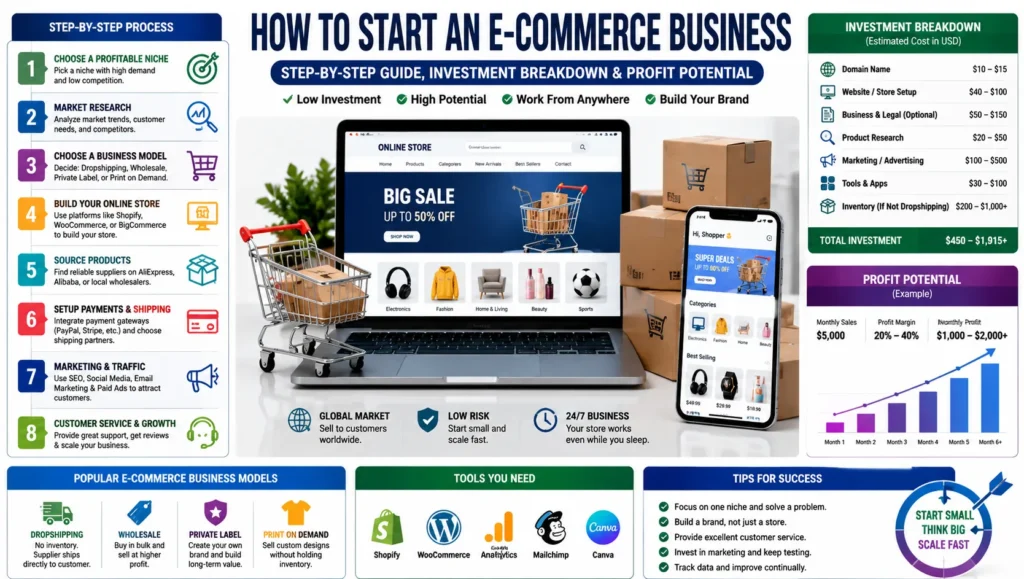
Some even use dropshipping, where suppliers ship products directly to customers.
Others use print-on-demand services for custom clothing or accessories.
This dramatically lowers startup costs.
Common Mistakes I See (and Made Myself)
Chasing every new marketing trend instead of doubling down on the one channel that’s already working
Ignoring mobile experience over 70% of my traffic came from phones, yet I originally designed everything checking only the desktop view
Discounting too aggressively, training customers to wait for sales instead of buying at full price
Not tracking customer acquisition cost (CAC) against lifetime value growth that costs more than it earns isn’t really growth
Launching too many products at once, spreading marketing budget thin instead of making one or two products genuinely well-known first
What E-commerce Growth in 2026 Actually Feels Like
It’s not a hockey stick graph overnight. For most of the stores I’ve worked on, it looked like small, boring improvements stacking on top of each other a slightly better product photo here, a faster checkout there, one more email flow turned on. None of it felt dramatic in the moment.Then one day you check the dashboard and the numbers just look different than they did three months ago.
If you’re starting out, don’t try to fix everything at once. Pick the leakiest part of your funnel, fix that first, and let the data tell you where to look next.
What’s the fastest way to grow an e-commerce store with a small budget?
Focus on fixing conversion rate and setting up abandoned cart emails before spending on ads. Fixing what you already have is usually cheaper and faster than acquiring new traffic.
How much should I spend on ads when starting out?
There’s no universal number, but many stores test with $10-20/day per ad set to gather data before scaling. Watch your CAC against your average order value, not just total spend.
Is email marketing still worth it in 2026?
Yes, it remains one of the highest-ROI channels for e-commerce because you own the list, unlike social platforms where algorithms decide your reach.
Shopify or WooCommerce for a new store?
Shopify is easier to set up and maintain with less technical hassle. WooCommerce gives more control and can be cheaper long term, but requires more hands on management (hosting, plugins, updates).
How do I reduce cart abandonment?
Show shipping costs early, offer guest checkout, add trusted payment options like Apple Pay or Google Pay, and follow up with an abandoned cart email within an hour of the visitor leaving.
Bilal Ahmad
Bilal Ahmad is the Founder and Editor of GlobalNewsHubz. He writes about technology, world news, government schemes, and digital trends. His goal is to provide readers with accurate, well-researched, and easy-to-understand information using trusted and official sources.