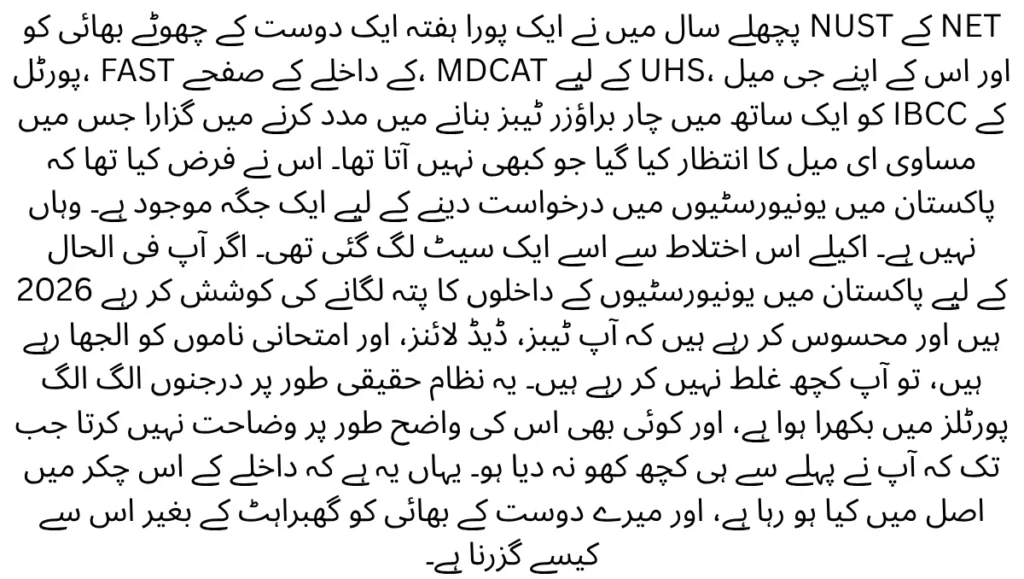
University Admissions 2026 in Pakistan, Last year I spent an entire week helping a friend’s younger brother juggle four browser tabs at once NUST’s NET portal, FAST’s admission page, UHS for MDCAT, and his own Gmail waiting for an IBCC equivalence email that never seemed to arrive. He’d assumed there was one place to apply to universities in Pakistan. There isn’t. That mix-up alone almost cost him a seat.
If you’re currently trying to figure out university admissions in Pakistan for 2026 and feel like you’re drowning in tabs, deadlines, and confusing test names, you’re not doing anything wrong. The system is genuinely scattered across dozens of separate portals, and nobody explains that clearly until you’ve already missed something.
Here’s what’s actually going on this admission cycle, and how to get through it without the panic my friend’s brother went through.
Table of Contents
The First Thing to Understand: There’s No Single Portal for University Admissions 2026 in Pakistan
This trips up more students than anything else. Unlike some countries with one centralized university application system, Pakistan doesn’t have a single government-run portal that covers every university’s deadlines in one place. HEC (Higher Education Commission) does maintain its own test calendar for tests like USAT, HAT, LAT, and GAT, but that only covers HEC’s own tests not NUST’s NET, not FAST’s entry test, not the medical college tests, and not UET’s ECAT.
That means each university you’re interested in needs to be checked individually, on its own website, on its own schedule.
Since dates shift constantly, here’s a snapshot of real, currently confirmed activity across a few major tracks, just so you know what “normal” looks like this time of year:
FAST-NUCES announced its Fall 2026 merit list for July 22, with the exact time posted on their own admissions schedule page. Their aggregate is calculated as NET score (50%) plus FSc percentage (40%) plus Matric percentage (10%) a formula worth knowing before you assume your NET score alone decides anything.
Punjab University ran its second admission test in mid-July, with online registration having closed about two weeks before the test date. PU calculates its own aggregate differently Matric counts for 25%, Intermediate for 50%, and their own admission test for the remaining 25%.
NUMS (National University of Medical Sciences) MDCAT is scheduled for late September 2026, while UHS (University of Health Sciences) MDCAT, the one that feeds Punjab’s public medical and dental colleges, is scheduled for late October 2026. These are two separate tests, run by two separate bodies, with separate registration windows which is exactly where a lot of medical aspirants get confused.
UET’s ECAT (for Punjab’s engineering universities) had its second round of results released recently, with the fuller merit list typically following in August.
Smaller public universities, like Bahauddin Zakariya University in Multan, publish their own detailed merit list schedules some programs get their merit lists in mid-July, others closer to late July, with classes generally starting mid-August.
None of these line up with each other. That’s the whole point of understanding this system early you’re not managing one deadline, you’re managing several running in parallel.
Step-by-Step: How to Actually Get Through This Without Missing a Deadline
Figure out which track you’re actually applying to first: medical, engineering, computer science/general BS, or business. Each track has different entry tests, and mixing them up wastes time.
List your target universities individually, and go to each one’s own official admissions page. Don’t rely on a single article or aggregator site to give you every date bookmark the actual university domains (things like nu.edu.pk for FAST, uhs.edu.pk, nums.edu.pk, uet.edu.pk, pu.edu.pk, or hec.gov.pk for HEC’s own test calendar).
If you’re an O-Level or A-Level student, start your IBCC equivalence certificate early. This is the single most common cause of missed registrations. Without an IBCC equivalence certificate, you often can’t even register for tests like NUST’s NET, let alone apply. Processing generally takes a few weeks, not a few days, so this needs to happen well before your target test’s registration deadline not the week of it.
Register for entry tests as soon as registration opens, not close to the deadline. Servers slow down and payment portals get flooded in the final 48 hours before any registration closes.
Calculate your own aggregate using each university’s specific formula once you have your test score. Don’t assume your NET score or MDCAT score is “the whole picture” every university weighs it differently against your FSc and Matric percentages.
Watch for merit list dates specifically for your program and campus, not just the university in general bigger universities often release merit lists at different times for different programs.
Have your fee ready before the merit list drops. Most universities give you a short window often just 48 to 72 hours to pay your dues and confirm your seat after appearing on a merit list. Miss that window, and your seat can go to the next name in line.
Know that program or campus change requests are usually possible, but only within a short window right after a merit list is published, so don’t wait to think it over for a week.
Assuming one national exam covers everything. It doesn’t. A student aiming for both medical and engineering programs needs to register for MDCAT and ECAT (or NET) separately, on separate calendars.
Confusing NUMS and UHS. Both run MDCAT-style tests for medical admission, but they’re different institutions with different registration timelines and different colleges attached to each. Applying to the wrong one, or assuming one score works for both, causes real problems.
Starting the IBCC equivalence process too late. I’ve seen students miss an entire NET series because their equivalence certificate hadn’t come through yet, and testing bodies won’t budge on that requirement.
Not having funds ready when a merit list is published. A short payment window catches people off guard every year, especially when the merit list lands on a weekend or a public holiday and banks are slower to process things.
Trusting unofficial “expected merit percentage” numbers as guarantees. A lot of sites publish estimated closing aggregates based on previous years. They’re useful as a rough guide, but merit shifts a bit every year depending on how many people apply and how the test went overall treat those numbers as a planning range, not a promise.
Ignoring backup options. Applying to only one university, in only one program, with no second or third option, turns a single missed merit list into a full year lost.
Keep a simple spreadsheet even a basic one in Google Sheets works fine with columns for each university, the entry test required, registration deadline, expected result date, and expected merit list date. It sounds basic, but it’s the single thing that keeps four or five parallel admission processes from colliding into each other.
If you’re applying to programs with provincial quotas (common in medical and some engineering programs), also make sure your domicile certificate and other quota-related documents are sorted well in advance these aren’t something you can arrange the night before a merit list deadline.Whichever track you’re on this year, the honest truth is that nobody manages this system perfectly on the first try. Keep your documents ready, track each deadline separately, and don’t wait until the last 48 hours for anything that involves a payment portal or a certificate you don’t already have in hand.
Is there one website where I can apply to all Pakistani universities at once?
No. Each university manages its own admissions portal and its own deadlines. HEC’s test calendar only covers HEC’s own tests, not university-specific ones like NET, ECAT, or MDCAT.
What’s the difference between NUMS MDCAT and UHS MDCAT?
They’re separate tests run by separate bodies for different sets of medical and dental colleges. NUMS generally covers army-affiliated medical colleges, while UHS covers Punjab’s public medical and dental colleges. Check registration deadlines for both separately if you’re eligible and interested in either.
Do O-Level and A-Level students need anything extra
Yes — an IBCC equivalence certificate, which converts your grades into an equivalent Matric/FSc percentage. Without it, you typically can’t register for most entry tests or apply to most universities. Start this early.
Should I trust websites that publish “expected” merit list percentages?
Treat them as a rough planning guide based on past years, not a guarantee. Actual closing merit depends on that year’s applicant pool and test difficulty, and can shift from what’s estimated.
Bilal Ahmad
Bilal Ahmad is the Founder and Editor of GlobalNewsHubz. He writes about technology, world news, government schemes, and digital trends. His goal is to provide readers with accurate, well-researched, and easy-to-understand information using trusted and official sources.