China’s Economic Slowdown 2026, A few months back, I was chatting with a friend who imports electronics parts from Shenzhen for a small assembly business here. He mentioned, almost in passing, that his supplier had cut prices twice in one quarter without him even asking. That’s when it clicked for me something bigger was happening behind the scenes, and it wasn’t just one supplier being generous. It was the whole Chinese economy quietly grinding into a lower gear.
I started digging into this properly after that conversation, reading through official data releases, talking to a couple of people who track trade numbers for a living, and honestly just paying closer attention to the headlines I used to scroll past. What I found was more interesting and more layered than the usual “China is slowing down” headline suggests.
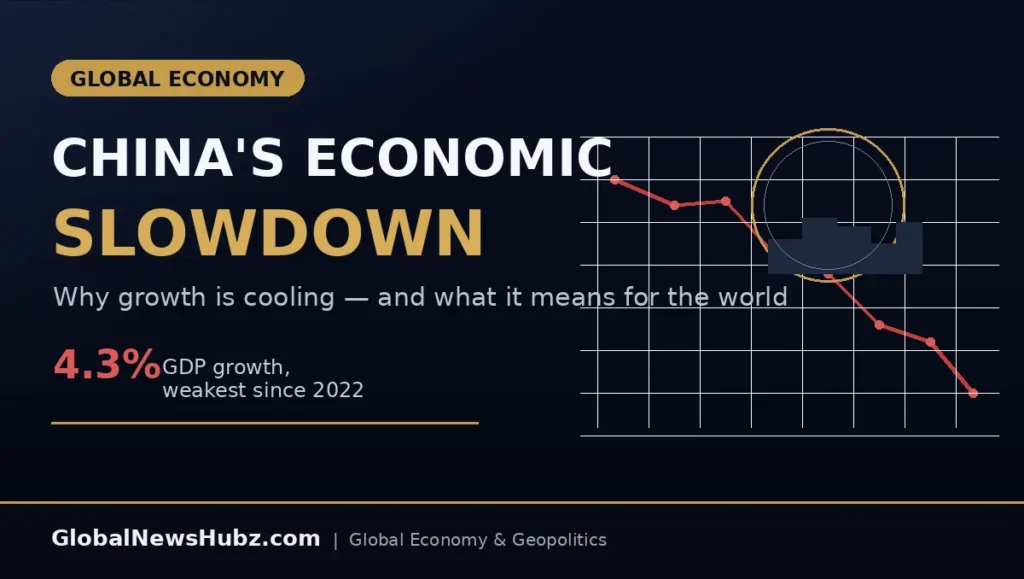
Let’s start with what’s actually on the record. China’s National Bureau of Statistics reported that GDP grew 4.3% year on year in the second quarter of 2026. That’s the weakest quarterly reading since late 2022, back when the country was still dealing with the tail end of COVID lock downs. It’s also below the 4.5% most analysts were expecting, and it came down from 5.0% growth in the first quarter of the same year.For the whole of 2026, Beijing had already lowered its own growth target to a range of 4.5% to 5%. That’s the lowest official target China has set since it started publishing these numbers back in 1991. So even before the disappointing Q2 print, the writing was already on the wall the government itself was quietly preparing people for slower growth.
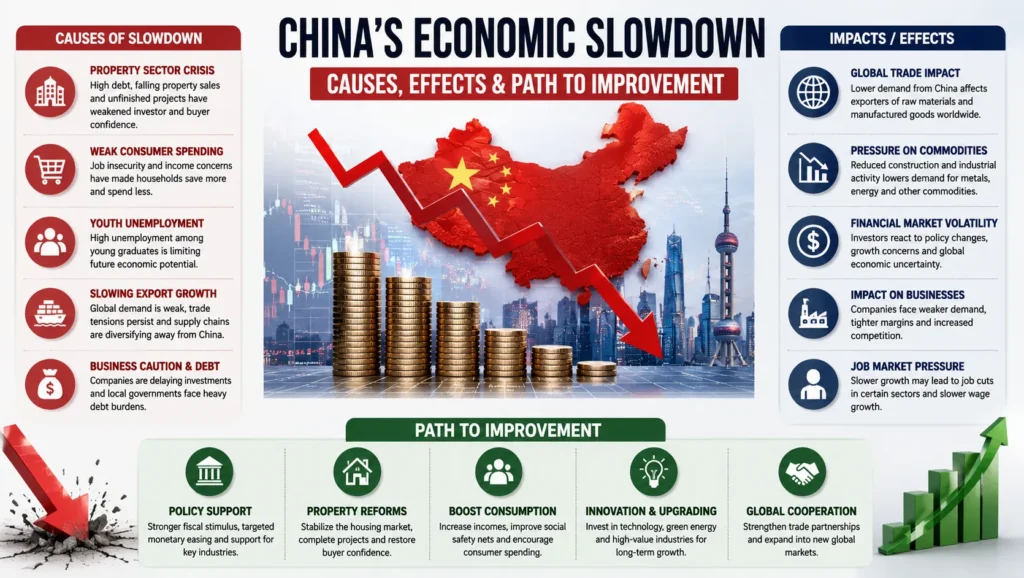
What struck me most wasn’t the headline number though. It was the split underneath it. Exports actually did really well they jumped over 17% in the first half of the year, with June alone seeing a 27% year on year surge, largely on the back of AI related hardware and electric vehicles. But domestic demand the stuff regular Chinese households are buying stayed weak. Real estate investment fell about 18% in the first half of the year, and new home prices kept sliding.
So you’ve got factories humming along shipping goods overseas, while at home, people are holding back on spending. That imbalance is really the whole story in a nutshell.
Why This Isn’t Just “China’s Problem”
I used to think of China’s economy as something that mostly affected, well, China. That assumption didn’t survive contact with reality once I started looking at how this connects to everyday things.Take commodity prices. China buys enormous quantities of raw materials iron ore, copper, oil to feed its factories and construction projects. When Chinese demand softens, commodity exporters from Australia to Brazil feel it in their own economies. I noticed this myself when a relative who works in shipping mentioned freight rates on certain bulk routes had softened noticeably.
Then there’s the “China Plus One” trend companies diversifying manufacturing away from China into places like Vietnam, India, and Mexico. I’ve seen this play out with a couple of small businesses I know that source products. One friend who used to order exclusively from Guangzhou factories has now split his orders between China and a supplier in Ho Chi Minh City, partly for cost reasons and partly just to hedge his bets.
And if you’re someone who invests, even casually, through an index fund or an ETF with emerging market exposure, you’re probably more exposed to this than you realize. A lot of emerging market funds carry heavy weightings toward Chinese equities or currencies of countries that trade heavily with China.
The Property Sector: The Part That Doesn’t Get Better on Its Own
If there’s one thing I’d tell anyone trying to understand this slowdown, it’s this: keep an eye on real estate. It sounds boring compared to talk of AI exports and trade wars, but property and related industries have historically made up roughly a quarter to nearly a third of China’s entire GDP when you count everything connected to it construction, materials, home furnishings, local government land sales, all of it.
That sector has been in a slump for years now, going back to the Evergrande crisis that made global headlines. New home prices were still falling as of June 2026, just at a slightly slower pace than the month before. That’s not a recovery that’s a slower decline. There’s a difference, and it matters.
Here’s the part that surprised me when I first learned it a huge chunk of local government revenue in China comes from selling land to developers. When developers stop buying land because nobody’s buying new apartments, local governments lose a major funding source. That’s part of why you’re hearing more about local government debt problems it’s not a separate issue, it’s downstream of the same property slowdown.
Mistakes People Make When Reading This China’s Economic Slowdown 2026
I made a couple of these myself early on, so I’ll flag them.
Mistake one: treating the headline GDP number as the whole picture. China’s official growth figures get a lot of skepticism from independent economists, some of whom think actual growth could be running well below the official number. I’m not in a position to verify that claim either way, but it’s worth knowing that reasonable people question the headline figure, and you shouldn’t treat 4.3% as gospel.
Mistake two: assuming exports and domestic weakness cancel each other out into some average “meh” economy. They don’t work like that in practice. Export heavy growth benefits specific regions and industries coastal manufacturing hubs, EV and battery makers, chip adjacent supply chains while leaving other parts of the country, especially inland regions dependent on construction and consumer spending, worse off. It’s an uneven economy, not a flat one.
Mistake three: assuming this is a short-term blip that stimulus will quickly fix. Chinese Premier Li Qiang has called for stronger counter cyclical measures, and there’s been talk of a late July Politburo meeting to address this. But most economists I read expect only modest fiscal stimulus unless things get noticeably worse. Beijing has been fairly cautious about large scale stimulus compared to, say, its response after the 2008 financial crisis.
What I’d Actually Watch Going Forward
If you want to keep tabs on this without becoming a full-time China economy watcher, here’s what I personally track now:
Quarterly GDP releases from the National Bureau of Statistics: usually mid-quarter, and worth comparing against the Reuters poll of analyst expectations to see if China is beating or missing forecasts.
Monthly retail sales figures: this tells you about actual household spending, not just industrial output.
New home price data: even a small monthly change tells you whether the property sector is stabilizing or still sliding.
Export growth numbers: especially in EVs, batteries, and AI linked hardware this is currently the strongest pillar holding up the whole economy.
IMF and major bank forecasts: the IMF recently nudged its 2026 forecast for China up slightly to 4.6%, while expecting a further slowdown to around 4.1% in 2027. Watching whether these get revised up or down over time tells you which way sentiment is shifting.
None of this requires specialized tools a lot of it is available through free sources like Trading Economics, Reuters, or even just following a couple of good economics reporters on social media.
Where This Leaves Things
I don’t think China’s economy is collapsing, and I’d push back on anyone who frames it that way for clicks. But I also don’t think it’s some temporary dip that bounces back next quarter. What I’ve come to understand after following this for a while is that China is going through a genuine structural shift moving away from property and construction as growth engines, toward exports and high tech manufacturing, while domestic consumers stay cautious for reasons tied to job security, wages, and years of economic uncertainty.
If you’re running a business that touches Chinese suppliers, investing in anything with emerging market exposure, or just trying to make sense of global headlines that keep mentioning tariffs and trade imbalances, this is one of those stories worth actually understanding rather than skimming past. It’s shaping a lot more than it gets credit for.
What was China’s GDP growth rate in 2026?
China’s economy grew 4.3% year on year in the second quarter of 2026, down from 5.0% in the first quarter. That’s the slowest quarterly pace since late 2022. Full-year growth is expected to land somewhere around 4.5% to 4.6%, based on current forecasts.
Is China’s economic slowdown as bad as a recession?
No, not by the official numbers China is still growing, just at a slower rate than it used to. That said, some independent economists question whether the real growth rate is meaningfully lower than what’s officially reported, so there’s genuine debate about how strong the underlying economy actually is.
How does China’s slowdown affect the rest of the world?
China buys huge amounts of raw materials like oil, copper, and iron ore, so weaker Chinese demand tends to soften commodity prices globally. It’s also accelerating the “China Plus One” trend, where companies diversify manufacturing into countries like Vietnam, India, and Mexico instead of relying solely on China.
What sectors are still doing well despite the slowdown?
Exports of electric vehicles, batteries, semiconductors, and AI-related hardware have held up strongly, with export growth surging well into double digits in the first half of 2026. These sectors are currently the main pillar keeping overall growth from falling further.
Should investors be worried about China exposure in their portfolios?
It depends on how much exposure you actually have. Many emerging market index funds carry significant weightings toward Chinese equities, so it’s worth checking your fund’s holdings rather than assuming you have no exposure at all.
Bilal Ahmad
Bilal Ahmad is the Founder and Editor of GlobalNewsHubz. He writes about technology, world news, government schemes, and digital trends. His goal is to provide readers with accurate, well-researched, and easy-to-understand information using trusted and official sources.