Meta vs Microsoft Earnings Shock, I had my earnings tracker app open on Wednesday night, half watching a movie, half refreshing the screen. Both Meta and Microsoft were reporting the same evening, right after the closing bell. I figured I did see the usual a small pop, a small dip, nothing dramatic.That is not what happened.
Within minutes of the numbers dropping, Meta was down nearly 10% in after hours trading. Microsoft, reporting the exact same night, was climbing. Same AI boom, same quarter, same “we’re spending billions on data centers” story from both companies and Wall Street treated them like they were on completely different planets.
Let’s start with the basics, because the headlines alone don’t tell you much.
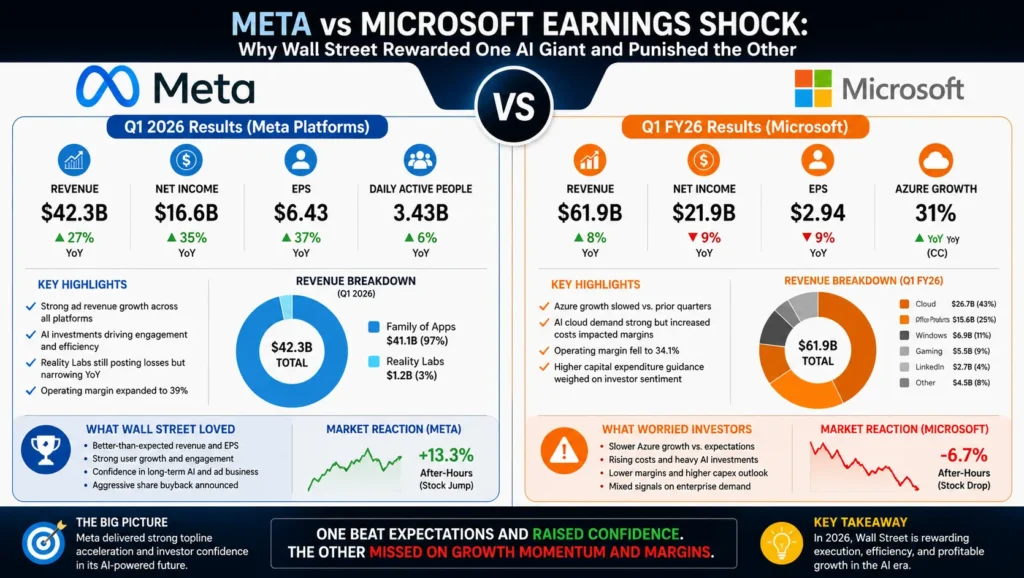
Meta reported revenue of $60.8 billion for the quarter, up 28% from a year earlier. That’s genuinely strong. But earnings per share came in at $6.18, way below what analysts were expecting (somewhere around $7.14 to $7.22). Shares fell close to 8-10% after hours.
Microsoft, reporting the same night for its fiscal fourth quarter, posted $90 billion in revenue, up almost 18%, and beat on earnings too helped in part by a gain tied to its investment in Anthropic. Shares moved higher in extended trading.
Two companies. Same night. Same AI arms race. Opposite reactions. That’s the part that actually made me sit up and start digging into the details.
What Actually Went Wrong for Meta vs Microsoft Earnings Shock
Here’s the thing that a lot of headlines glossed over: Meta’s revenue was fine. It beat estimates. The advertising business, which is still the heart of the company, brought in $59.36 billion, up 27% year over year, with more ad impressions and higher prices per ad.So why the stock crash?
Two words: costs and guidance.
Meta’s total expenses jumped 55% year over year, and a big chunk of that came from two things that aren’t part of normal operations $2.4 billion in legal charges and roughly $1.2 billion in severance costs tied to the layoffs Meta made back in May 2026 (around 8,000 roles). Strip those one time hits out, and Meta would have actually beaten earnings estimates instead of missing them.But the market doesn’t always give you credit for “well, if you ignore the bad stuff, it looks fine.” The headline number is the headline number.Then there’s Reality Labs Meta’s VR/AR/smart glasses division. It brought in just $431 million in revenue and lost about $4.6 billion for the quarter. That gap has been going on for years now, and investors are clearly running out of patience.
On top of that, Meta’s guidance for next quarter came in a bit soft ($61–64 billion versus the roughly $63 billion Wall Street wanted), and the company raised its full year spending plans, pushing 2026 capital expenditure guidance up to a $135–145 billion range. The low end of that range jumped by $10 billion in a single quarter. That’s the kind of move that makes investors nervous when there isn’t an obvious payoff attached to it yet.
Worth mentioning too: Meta’s stock had already dropped for nine straight sessions heading into earnings, its worst losing streak on record. It went into this report already bruised.
Here’s what clicked for me after reading through both reports back to back: both companies are spending an enormous amount of money on AI infrastructure. Neither one is being shy about it. But Wall Street isn’t just grading “are you spending on AI.” It’s grading “can we actually see where the money from that spending is coming back to you.”
Microsoft has a very direct answer: Azure. Copilot subscriptions. Cloud contracts with big businesses. Investors can point at a line item and say “that’s the AI payoff, right there.”
Meta’s answer is fuzzier. Its AI spending mostly goes into things like improving its ad-targeting algorithms (which is working, to be fair ad revenue is genuinely strong) and long term bets like AI glasses and the metaverse, which still aren’t making real money. There isn’t a clean “Azure-style” product where Meta can say “look, businesses are paying us directly for this AI thing.”
That difference a visible, monetizing AI product versus a promise that the AI spending will pay off eventually seems to be exactly what separated an 8% stock drop from a same night rally.
I’ll be honest about something I got wrong in the moment. When Meta’s revenue beat came through first, my gut reaction was “oh, this should be a relief rally, especially after that ugly losing streak.” I’ve made that assumption before with other earnings reports too revenue beat equals stock goes up.
That is not how it works, and this was a good reminder. The market cares much more about earnings per share versus expectations, and even more about guidance for the next quarter, than it does about the current quarter’s top-line revenue number. A revenue beat with a profit miss and soft guidance is often treated as bad news, not good news. I’ve been burned assuming otherwise, and this quarter was a textbook example of it happening again to someone else’s stock.
How to Actually Read One of These Earnings Reports (Without Panicking)
If you are new to following stocks or you just want to understand these headlines without getting whiplash every quarter, here’s the mental checklist I now run through every time:
Check revenue vs. estimate first. This tells you if the core business is actually growing.
Check EPS (earnings per share) vs. estimate separately. A company can beat on revenue and still miss on EPS if costs went up faster than sales exactly what happened with Meta.
Look for one time charges. Legal settlements, severance costs, and write-downs can distort a single quarter. Good financial news sites and the company’s own press release usually call these out explicitly.
Read the guidance for next quarter, not just this quarter’s results. Markets are forward looking. Weak guidance can sink a stock even after a strong quarter.
Look at capital spending (capex) commentary. Rising capex isn’t automatically bad, but rising capex with no clear revenue story attached to it makes investors twitchy.
Check where the money is actually coming from. Segment breakdowns (like Microsoft’s Intelligent Cloud vs. Meta’s Family of Apps vs. Reality Labs) tell you a lot more than the total revenue number alone.
I usually pull this info straight from the company’s investor relations page (both Meta and Microsoft post the full press release there within minutes of reporting), plus a quick check on a financial site like Yahoo Finance or CNBC’s live earnings blog for the analyst reaction.
Common Mistakes to Avoid
Don’t assume “revenue beat” automatically means the stock goes up. As Meta just proved, it doesn’t.
Don’t treat after-hours price moves as final. They’re often exaggerated and can shift by the time regular trading opens the next day.
Don’t ignore the difference between GAAP and non-GAAP earnings. Microsoft’s non-GAAP number excluded certain investment related swings knowing which number you’re looking at matters.
Don’t confuse “spending a lot on AI” with “AI spending is a problem.” The real question is always whether that spending is showing up anywhere in actual revenue yet.
Don’t make investment decisions off a single quarter. One rough report doesn’t undo years of ad or cloud growth, and one great report doesn’t guarantee the next one looks the same.
What struck me most about this whole night wasn’t really about Meta orMicrosoft individually it was what it says about where we are in this AI spending cycle generally. Companies are pouring unprecedented money into data centers and chips, and for the first time in a while, investors are actually splitting hairs over who’s turning that spending into real, visible income versus who’s asking for more patience.
Meta’s ad business is still healthy, and to be fair, a lot of this quarter’s miss came down to one time legal and severance costs rather than the core business falling apart. Microsoft, meanwhile, gets to point at Azure crossing $100 billion and say “see, this is working.” Whether that gap closes by next quarter is honestly the thing I’ll be watching for when both companies report again in a few months.
Why did Meta’s stock fall even though revenue beat estimates?
Because earnings per share missed badly (largely due to $2.4 billion in legal charges and $1.2 billion in severance costs), and Meta’s guidance for the next quarter and raised capital spending plans made investors nervous, even though the underlying ad business grew.
Why did Microsoft’s stock rise after its earnings report?
Microsoft beat on both revenue and earnings, and Azure its cloud computing business crossed $100 billion in annual revenue for the first time while growing 43% in the quarter, giving investors a clear, monetizing AI story to point to.
Does this mean Meta’s AI strategy is failing?
Not necessarily, Meta’s advertising business, which already uses AI heavily for targeting, grew nearly 27%. The bigger concern investors have is Reality Labs’ ongoing losses and the lack of a clear near term revenue stream from Meta’s broader AI infrastructure spending, unlike Microsoft’s Azure.
Should I panic if I own Meta or Microsoft stock?
One earnings report is rarely a reason to make snap decisions. It’s usually more useful to look at the trend across several quarters revenue growth, guidance patterns, and whether spending eventually shows up as revenue rather than reacting to a single night’s price swing.
What is Azure, and why does it matter so much to Microsoft’s stock?
Azure is Microsoft’s cloud computing platform, used by businesses to run software, store data, and increasingly to build and run AI applications. Its growth is one of the clearest signs investors have that Microsoft’s AI spending is translating into paying customers.
Bilal Ahmad
Bilal Ahmad is the Founder and Editor of GlobalNewsHubz. He writes about technology, world news, government schemes, and digital trends. His goal is to provide readers with accurate, well-researched, and easy-to-understand information using trusted and official sources.