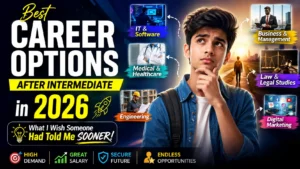
Best Career Options After Intermediate in 2026, I still remember my cousin sitting on the floor of her room, result card in hand, absolutely refusing to talk to anyone. Not because she’d failed she’d actually done okay in her Intermediate exams. She was stuck because for the first time in her life, nobody was telling her what to do next. School had a fixed path. College didn’t.That confusion is normal. Almost everyone I know went through some version of it staring at a result card and realizing the next decision is actually yours to make, and it feels way bigger than it should.
So I’m not going to give you a “top 10 careers” list copy pasted from some career counseling brochure. I want to walk you through the actual options, the trade offs nobody mentions upfront, and a few mistakes I’ve watched people make (including myself) so you don’t repeat them.
One thing that messed with my head early on was thinking Intermediate is where you pick your entire life’s direction. It’s not. It’s where you pick your next 2-4 years. People switch fields all the time from pre-engineering to design, from medical to business, from IT back to teaching. The goal right now isn’t to find your “destiny.” It’s to pick a direction that keeps enough doors open while you figure things out.
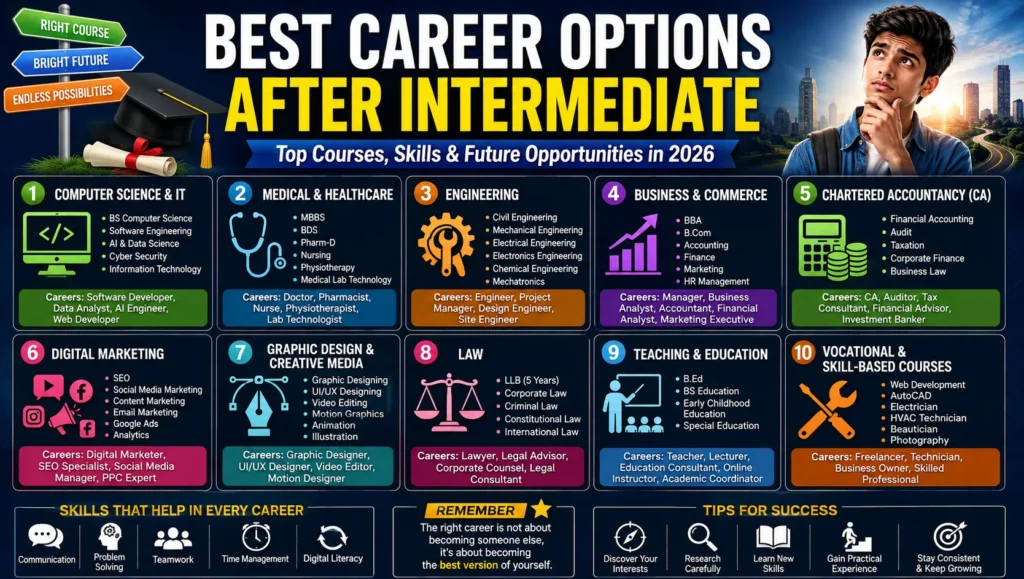
With that out of the way, here’s a realistic breakdown of where people usually go after Intermediate, and what it actually looks like once you’re in it.
1. Engineering (if you took Pre-Engineering)
This is the classic route, and for good reason it’s structured, respected, and there’s real demand for civil, electrical, mechanical, and software engineers.
But here’s what people don’t tell you: entry tests matter more than your Intermediate percentage in most cases. ECAT, NET (NUST), and similar tests are a different beast from board exams. I’ve seen students with 90%+ marks completely bomb ECAT because they never practiced the test format, just their regular coursework.
Practical tip: start entry test prep at least 6 months before the exam, not 6 weeks. Platforms like KIPS, Sir Syed Kazim’s YouTube resources, or even free past papers on university websites are enough you don’t need to spend a fortune on an academy if you’re disciplined.
2. Medical (MBBS/BDS route)
If you’re on Pre-Medical, MDCAT is your gatekeeper. It’s tough, and the honest truth is that government medical college seats are limited, while private medical colleges can be extremely expensive we’re talking lakhs of rupees per year in some cases.
I know a few people who got into private medical colleges without really calculating the total cost over 5 years, and it caused real financial stress on their families later. If medicine is genuinely your passion, go for it just have an honest conversation at home about the government-vs-private cost gap before you commit.
3. Computer Science / IT
This is the one I have the most hands-on experience with, and it’s genuinely one of the most flexible paths right now.
You don’t need pre-engineering to get into a BSCS or BSIT program many universities accept ICS or even FA/FSc students. What actually matters more than your background is whether you enjoy problem-solving and don’t mind sitting in front of a screen debugging something for three hours straight (because that happens a lot).
Real tools people in this field actually use day to day: VS Code for coding, GitHub for hosting projects, freeCodeCamp and Coursera for learning outside class, and Stack Overflow (or honestly ChatGPT/Claude now) when you’re stuck at 2am on an assignment.
Mistake I made: I picked a specialization (mobile app development) way too early without exploring web development, data, or design first. Spend your first year exploring broadly before narrowing down.
4. Business, Commerce, and Finance
If you did ICom or FA with economics, routes like BBA, ACCA, or CA are worth looking at. ACCA in particular has become popular because it’s internationally recognized and you can start it right after Intermediate without waiting for a full bachelor’s degree first.
A friend of mine started ACCA at 19, and by the time his batchmates were graduating with a regular bachelor’s, he already had a professional qualification and was working part time at an audit firm. It’s not an easy road the exams are genuinely hard and require consistent study but the ROI is solid if you stick with it.
5. Skill-based and freelancing careers
This one barely existed as a “real” option a decade ago, and now it’s one of the most practical paths for students who don’t want to (or can’t afford to) go the traditional 4-year degree route immediately.
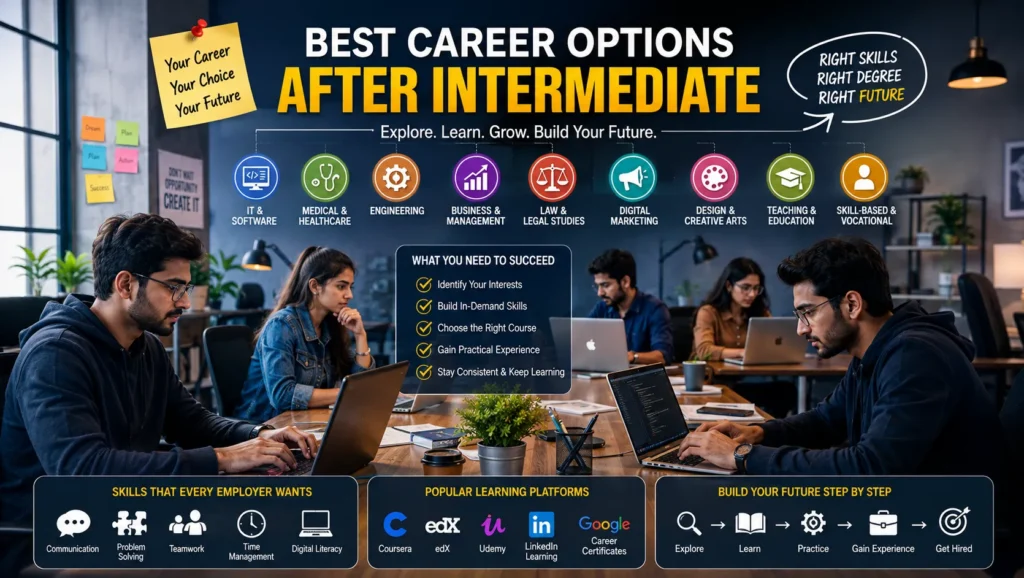
Graphic design, video editing, digital marketing, content writing, and web development are all skills you can genuinely learn through free or low cost resources Google Digital Garage, YouTube tutorials, Coursera, or HubSpot Academy and start earning through platforms like Fiverr, linkedin or Upwork within a few months of consistent practice.
I want to be upfront here though: the “make money online in 30 days” claims you see on YouTube thumbnails are mostly exaggerated. It took me around 4 months of daily practice before I landed my first small freelance gig, and even longer before it became consistent income. It works, but it’s not instant.
6. Government jobs and competitive exam prep
You technically need a bachelor’s degree for most competitive exams like CSS or PMS, but Intermediate is the right time to start building your general knowledge, English writing, and current affairs base if that’s a direction you’re eyeing long-term. Reading newspapers daily (Dawn is a common choice) and following basic GK apps can build a habit that pays off years later.
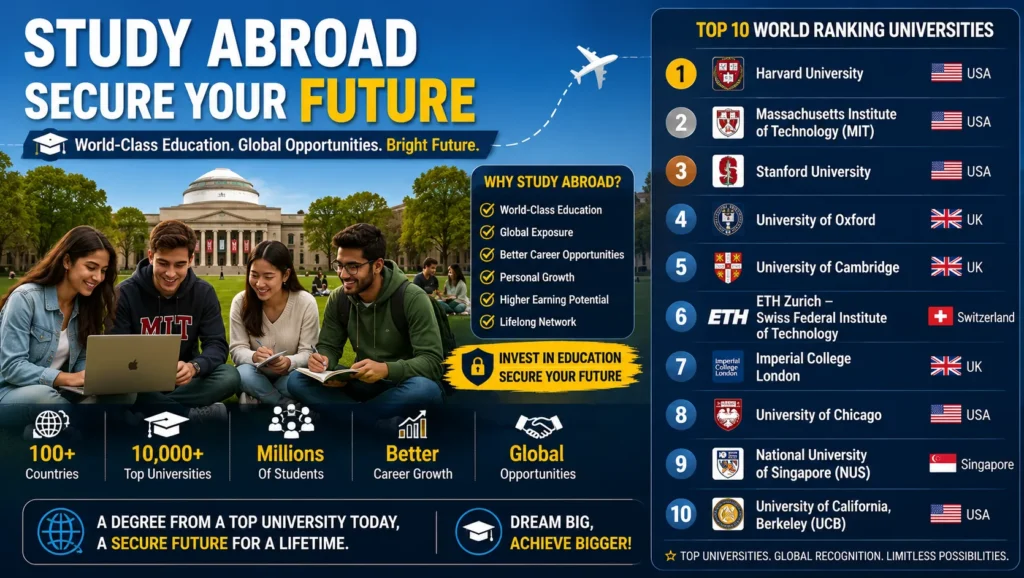
If your grades are strong and you’re willing to put in the work on IELTS/TOEFL prep, HEC and various foreign university scholarships (Turkiye Burslari, Chinese Government Scholarship, and others) are realistic options not just for the ultra privileged. The application process is paperwork heavy and deadlines are strict, so start researching at least a year in advance.
Following your friend’s choice instead of your own interest. I’ve seen entire friend groups pick the same field just to “stay together,” and half of them switched out within a year.
Ignoring the financial side until it’s too late. Ask about total program cost upfront, not after you’ve already enrolled.
Not researching entry tests early enough. Whether it’s ECAT, MDCAT, or a university’s own admission test, the format matters as much as your subject knowledge.
Treating the first choice as permanent. Changing direction after a semester or two isn’t failure it’s normal course correction.
Is it necessary to choose a career immediately after Intermediate?
No, It’s smart to have a direction, but plenty of successful professionals switched fields in their first year or two of university.
Can I do BSCS without a Pre-Engineering background?
Yes, most universities accept ICS, and many even accept FA/FSc students for BSIT or BSCS programs check specific university requirements though, as they do vary.
Is freelancing a stable career option right after Intermediate?
It can become stable, but it usually takes a few months of consistent skill building and practice before the income becomes reliable. Treat it as a skill investment, not a quick fix.
What if I don’t get into my first-choice field?
It happens to a lot of people, and it’s rarely the end of the story. Many strong professionals today started in a “backup” field and either grew to love it or transitioned later with added experience.
Can I start earning while studying after Intermediate?
Yes, Many students earn through freelancing, internships, tutoring, content writing, graphic design, web development, and digital marketing while completing their studies.
Bilal Ahmad
Bilal Ahmad is the Founder and Editor of GlobalNewsHubz. He writes about technology, world news, government schemes, and digital trends. His goal is to provide readers with accurate, well-researched, and easy-to-understand information using trusted and official sources.