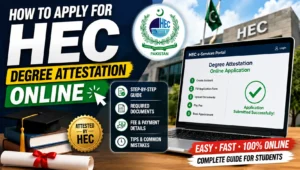
HEC Degree Attestation Online 2026, A couple of months back I was sitting in the waiting area of an HEC regional office, clutching a plastic folder full of photocopies, absolutely convinced I’d walk out an hour later with my degree stamped. I didn’t. I walked out three hours later with a token number, a confused look on my face, and instructions to “check the portal for updates.”That was basically my introduction to degree attestation. If you’ve never had to do this before, it sounds like a boring formality get a stamp on your degree, done. In practice it’s one of those things nobody explains properly until you’re already stuck in it, usually with a visa deadline breathing down your neck.
The good news is that things genuinely changed this year. HEC rolled out a fully online, paperless attestation system on May 11, 2026, and it’s a completely different experience from what I went through before. No more sitting in waiting rooms, no more physical stamps pasted on the back of your degree. I went through the new system myself recently (for a transcript I needed re-verified), and I want to walk you through exactly how it works, where people trip up, and what I’d do differently.
Table of Contents
Quick Refresher: What HEC Degree Attestation Online 2026 Actually Does
Before jumping into steps, here’s the plain-language version for anyone who’s fuzzy on this.
HEC (Higher Education Commission) is the government body that checks whether your Pakistani university degree is genuine and whether your university is actually recognized. Once they confirm it, they attach their official verification to your degree historically a physical stamp and signature, now a digital certificate.
Without this, foreign embassies, employers, and organizations like WES (World Education Services, which evaluates degrees for Canada immigration) generally won’t accept your degree as valid. It’s usually the very first link in a longer chain HEC first, then MOFA (Ministry of Foreign Affairs), then whichever embassy you’re dealing with.
One thing that confuses a lot of people: HEC only handles Bachelor’s, Master’s, and higher degrees from HEC-recognized universities. Your Matric or Intermediate certificates go through IBCC (Inter Board Committee of Chairmen) instead totally separate portal, separate office. I’ve seen people waste weeks applying to the wrong body because nobody told them this.
Here’s the difference, because if you’re reading old blog posts or YouTube videos about this, a lot of them describe a process that no longer exists.
Before: You’d apply online, wait for verification, then get an SMS or email to book an appointment at a regional center (Islamabad, Karachi, Lahore, and a few others). You’d show up with your original documents, hand them over, and eventually get a physical attestation ticket pasted onto your degree. Multiple visits weren’t unusual if anything was flagged.
Now: Everything happens through the portal. You upload scans, your university verifies your record digitally, HEC does its own check, and if everything matches, you get a blockchain-secured e-Attestation Certificate you can download. No office visit, no handing over your original degree, no courier.
If you’d already started an application under the old system and paid your fee before mid-May, HEC kept processing those the old way for a short grace period that ended June 30, 2026. That window’s closed now, so if you’re starting today, you’re doing the whole thing on the new online portal regardless.
Step-by-Step: How the Application Actually Works
This is the part people actually want, so here’s the walkthrough based on what I did.
Step 1: Confirm your university is HEC-recognized. Before touching the portal, search “HEC recognized universities list” and check your institution is on it. If you graduated from a lesser-known private institute, this step matters more than people think I’ve heard of applications sitting stuck for weeks because someone assumed recognition instead of checking.
Step 2: Create your account. Go to the official HEC e-services portal and register using your CNIC number and an email address you actually check regularly. Every update verification status, requests for corrections, your final certificate comes through that email plus SMS, so don’t use some old address you forgot the password to.
Step 3: Fill out your personal and education profile. This is where most small errors happen. You’ll enter your full education history starting from Matric degree titles, university names, session/years, roll numbers. Every single field needs to match your actual documents exactly. A typo here causes headaches later.
Step 4: Scan your documents properly. You’ll need clear scans of your final degree (or provisional certificate if the actual degree hasn’t been issued yet), your official transcript, and your CNIC (front and back). Formats accepted are typically PDF and JPEG.
Don’t just snap a photo with your phone at an angle on your desk that was my first mistake, more on that below. Use an actual scanner if you have access to one, or a scanning app like Adobe Scan or CamScanner on your phone, which flatten and sharpen the image properly.
Step 5: Submit and wait for verification. Your university’s records office gets pinged to confirm your degree details digitally, and HEC runs its own check in parallel. This is genuinely the slowest part of the whole process, and it has nothing to do with HEC’s speed it depends entirely on how fast your specific university responds.
Step 6: Track your status through the dashboard. Log back in periodically. If something’s wrong a mismatch, a missing document you’ll get a notification, but honestly the wording in these emails can be vague. If you get one, log into the dashboard directly and check the specific application status rather than trying to decode the email.
Step 7: Pay the attestation fee online. Once your documents are verified, you pay through the portal options usually include 1-Link, debit/credit card, or mobile wallet. As of this year the fee has been around Rs. 3,000 per document, but fees do get revised, so check the current rate on the portal before you pay rather than trusting any blog post’s number, including this one.
Step 8: Download your e-Attestation Certificate. Once everything clears, you get a downloadable, blockchain-secured certificate. This can be verified online by any employer, embassy, or organization instantly no physical stamp needed, and honestly it’s harder to fake than the old paper version.
Cost-wise, budget around Rs. 3,000 per document under the current fee structure that covers degrees, transcripts, provisional certificates, and equivalence letters separately, so if you’re getting multiple documents attested, the cost adds up fast.
Timeline is the trickier part to promise. On paper, the online scrutiny is supposed to move quickly. In reality, I’ve seen cases resolve in under two weeks, and I’ve also seen people wait over a month, mostly because their university’s records department was slow to confirm details. The bottleneck is very rarely HEC itself it’s whoever holds your original academic records.
My honest advice: start this at least 4 to 6 weeks before you actually need the certificate. If you’re applying for a visa or a job deadline, do not assume this will be a same-week thing.
My cousin got a job offer in Saudi Arabia last year and had three weeks to submit an attested degree. He applied on a Tuesday, uploaded what he thought were fine scans, and got flagged four days later for “unclear document quality” his transcript photo had a shadow across one corner from his desk lamp.
He redid it at a small photocopy shop that had a flatbed scanner, for the cost of a cup of tea, basically. That version went through fine. But the university verification step still took another two and a half weeks, which nearly blew his deadline. He made it, barely, by emailing his university’s exam department directly and asking them to expedite their end.
The lesson here isn’t really about HEC’s system it’s that the human bottleneck (your own university’s paperwork speed) matters more than anything you do on the portal.
Common Mistakes to Avoid
Blurry or angled phone photos. This is still the single biggest reason for rejection under the new system. Sharp, flat, fully visible, properly cropped that’s the bar.
Name mismatches. If your CNIC says “Mohammad” and your degree says “Muhammad,” or your name changed after marriage, this will get flagged. You’ll need supporting documents typically a Nikkahnama or an affidavit, sometimes along with a newspaper notice confirming the name change. Sort this out before you apply, not after rejection.
Applying to the wrong body. HEC does not attest Matric or Intermediate certificates that’s IBCC’s job. Don’t waste time uploading school-level documents to the HEC portal.
Skipping the Equivalence Certificate for foreign degrees. If your degree is from outside Pakistan, HEC needs an Equivalence Certificate first before it’ll even consider attestation.
Waiting until the last minute. Because the real delay usually sits with your university, not HEC, starting early is the single biggest thing you control.
Assuming this is still the old office-visit process. A lot of guides and videos floating around online describe appointments and physical visits. That’s outdated as of May 2026 don’t plan around information that no longer applies.
Quick Tips Before You Start
Double-check your name spelling matches across your CNIC, NADRA record, and degree before you even open the portal.
Keep a folder with all your scanned documents organized by name, so you’re not scrambling mid-application.
If you’re doing this for WES (Canada) or an embassy submission, confirm exactly which documents they need attested sometimes it’s just the final degree, sometimes the transcript too.
Check your spam folder for HEC emails. More than one person I know missed a status update because it landed there.
If your application is stuck for an unusually long time, contacting your university’s exam or records office directly (not just HEC) often moves things faster than waiting on the portal alone.
Final Thoughts
Honestly, the new online system is a genuine improvement. I say that as someone who sat through the old waiting-room version and know exactly what it used to feel like. But “online” doesn’t mean “instant,” and the biggest source of delay these days is rarely the technology itself. It’s scans that aren’t sharp enough, names that don’t quite match across documents, or a university records office that takes its time.
If you’re about to start this process, give yourself more time than you think you need, get your documents scanned properly the first time, and keep an eye on your email. That’s really most of the battle.
What is the official HEC attestation portal?
Applications go through HEC’s e-services portal. Always use the official HEC website link rather than third-party sites claiming to be the portal, since attestation-related scams and lookalike sites do exist.
How much does HEC attestation cost in 2026?
The current fee is around Rs. 3,000 per document, though this has changed before and can change again — confirm the exact amount on the portal before paying.
Do I need HEC attestation if my degree is from a foreign university?
You’ll need an Equivalence Certificate from HEC first, since HEC directly attests only degrees from HEC-recognized Pakistani institutions.
How long does HEC attestation take?
It varies a lot. Some applications clear in under two weeks; others take over a month, mainly depending on how quickly your university confirms your records. Start at least 4 to 6 weeks before any deadline.
What if my name doesn’t match across my CNIC and degree?
You’ll need supporting proof of the name difference — commonly a Nikkahnama or a legal affidavit, sometimes with a newspaper confirmation. Resolve this before applying to avoid a rejection cycle.
Bilal Ahmad
Bilal Ahmad is the Founder and Editor of GlobalNewsHubz. He writes about technology, world news, government schemes, and digital trends. His goal is to provide readers with accurate, well-researched, and easy-to-understand information using trusted and official sources.