Fully Funded Scholarships for Pakistani Students 2026, A few years back, a friend of mine sent me a screenshot at 9 AM. It was a Facebook post claiming some random university in Europe was giving “100% fully funded scholarships, no IELTS, no GRE, guaranteed selection.” She was ready to pay a “processing fee” to some agent to lock her spot.I told her to close that tab immediately.That night turned into a three hour phone call where we actually went through real scholarship portals together USEFP, Chevening, HEC’s website, DAAD one by one. She ended up applying to two of them properly. She didn’t get in on the first try, actually. But the second year, she did.
That’s the thing about fully funded scholarships. They’re real, they’re out there, and Pakistani students win them every single year. But the process is slower, more paperwork heavy, and less glamorous than the Instagram reels make it look. So let’s go through the ones that are actually worth your time, based on what I’ve seen work (and not work) for people around me.
Table of Contents
Quick reality check before the list
“Fully funded” gets thrown around loosely online. A real fully funded scholarship should cover tuition, a monthly living stipend, health insurance, and usually your flight. If a program only waives tuition and expects you to figure out rent and food in a foreign country on your own, that’s a partial scholarship, not a fully funded one. Read the benefits section on the official page every single time don’t trust a blog’s summary (including this one) as the final word.
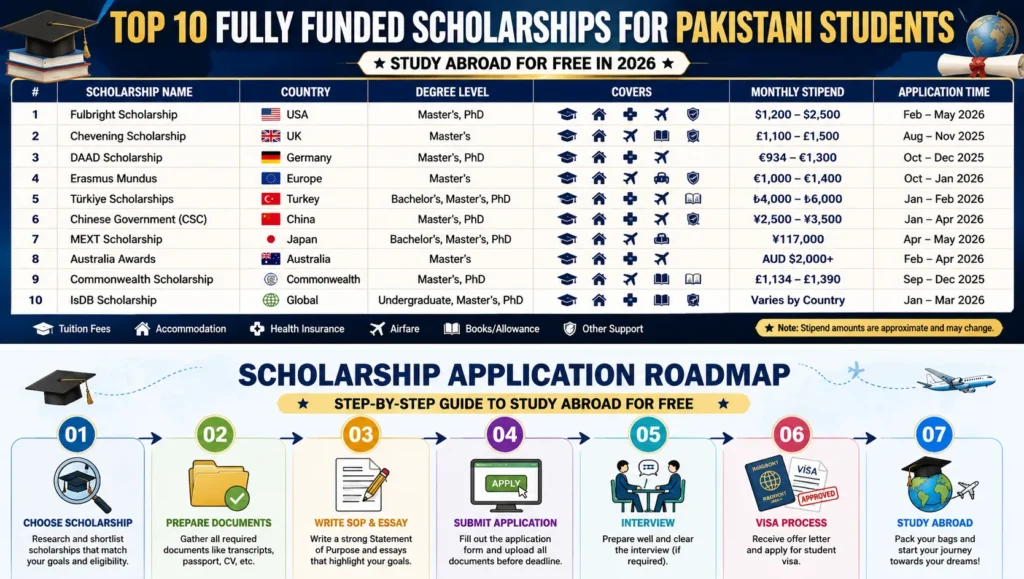
This is the one almost everyone in Pakistan has heard of, and for good reason. It’s run locally by USEFP (United States Educational Foundation in Pakistan), and it covers tuition, a living stipend, airfare, health insurance, and even a laptop allowance for Master’s and PhD study in the US.
A few things people get wrong about Fulbright:
It does not fund undergraduate study Master’s and PhD only.
It does not cover clinical medicine, so MBBS holders usually pivot toward public health or research based fields instead.
There’s a return to Pakistan requirement after your degree, with a bond for PhD scholars specifically.
The application usually opens in the fall and closes around April 1 for the following year’s intake this year’s round already closed on April 1, 2026, so if you missed it, start prepping now for the next cycle instead of waiting till the last month. You’ll need a GRE score, IELTS or TOEFL, three references, and a Statement of Purpose that doesn’t read like a template (more on that below).
2. Chevening Scholarship (UK)
Chevening funds a one year Master’s in the UK and honestly it’s one of the more realistic ones for people who don’t have a research background, since it’s more about leadership potential than pure academic scores.
Here’s something worth knowing right now, applications for the intake starting in 2027 typically open in early August and close in the first week of October. So if you’re reading this in the second half of the year, this window is either open or about to open don’t sleep on it.
You’ll need at least two years of work experience (2,800 hours), an undergrad degree, and this trips people up constantly an unconditional offer from a UK university in one of three course choices before the reference deadline. A lot of applicants get shortlisted for interview and then scramble because they never sorted their university offers early enough. Start that part in parallel with your Chevening application, not after.
This one gets underrated. It funds Bachelor’s, Master’s, and PhD study, and the benefits list is genuinely generous full tuition, free dorm accommodation, a monthly stipend, a full year of free Turkish language classes, health insurance, and round trip airfare.
Applications open every year around January 10 and close around February 20. You apply once, list up to 12 university/program choices in order of preference, and the system places you you don’t even need a prior admission letter, which makes it far less stressful than applying to individual universities cold.
I’ve seen a couple of people go this route for engineering and medicine specifically because Turkish universities are strong in both and the placement system doesn’t require you to already speak Turkish.
4. DAAD Scholarship (Germany)
DAAD isn’t one single scholarship it’s an umbrella of programs for Master’s, PhD, research stays, and development related postgraduate courses (EPOS). Deadlines are scattered across the year depending on which program you’re targeting, generally clustering between late August and mid-November.
The stipend is solid too usually around €934 to €992 a month for Master’s students, more for PhD candidates, plus insurance and travel support.
The honest catch: DAAD’s process is long. Between document prep, language certificates, and the review process, you’re looking at 6–7 months from application to decision. If you want to start your Master’s in Germany in October next year, you genuinely need to start working on your application about a year in advance, not three months before.
This one runs through Pakistan’s Higher Education Commission (HEC), which nominates candidates for the UK’s Commonwealth Scholarships Commission. You’ll apply on two portals the HEC scholarship portal and the Commonwealth’s own system and both need to be complete, or your application won’t count at all.
The HEC portal deadline usually lands in mid-October, though it’s shifted around Oct 14–21 in past cycles, so don’t assume the exact date without checking scholarships.hec.gov.pk directly for the current year.
This is a PhD focused program mostly, and it’s aimed at researchers and academics, so if you’re an early career student without a Master’s yet, this probably isn’t your first move but it’s worth bookmarking for later.
6. Chinese Government Scholarship / CSC (via HEC)
China offers a decent number of seats specifically for Pakistani students bachelor’s, master’s, and PhD through the HEC-nominated route (Type-A). The HEC portal deadline for this one has historically landed in early January, separate from the general Chinese Scholarship Council deadline that runs later into spring for direct university applications.
If you’re open to studying in China and your field is STEM heavy, this is genuinely one of the less competitive routes on this list simply because fewer Pakistani students apply here compared to the US or UK.
This funds full time undergraduate and postgraduate study in Australia, plus a living allowance, airfare, and health cover. Applications go through the OASIS online system, typically opening around February 1 and closing April 30 for the following year’s intake.
The part that trips people up isn’t the academics it’s the Development Impact Linkages Plan (DILP), a section where you explain how your study connects to Pakistan’s development priorities and what you’ll do when you return. People treat it like an afterthought and write it in twenty minutes. Don’t. Assessors read this closely, and a generic DILP is one of the most common reasons strong applicants get filtered out early.
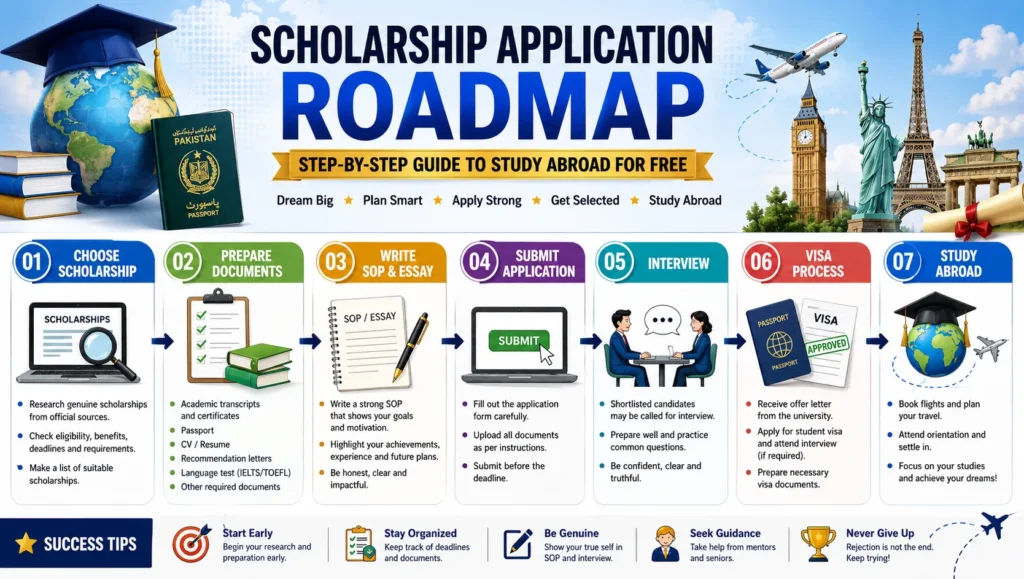
A simple game plan of Fully Funded Scholarships for Pakistani Students 2026 if you’re starting from zero
Pick two or three scholarships max not all seven. Trying to apply everywhere at once means doing everything badly.
Book your English test early: IELTS slots in Pakistan get booked out weeks in advance around scholarship season. The British Council and IELTS Ryan’s free YouTube prep videos are genuinely useful if you can’t afford paid classes.
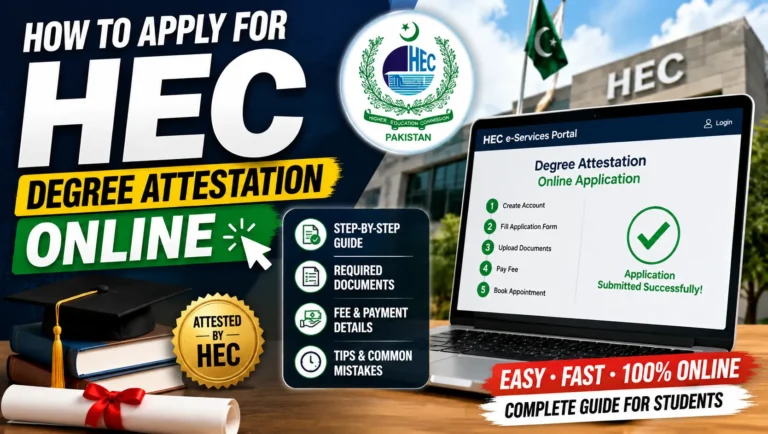
Start HEC attestation of your documents months ahead not weeks. This step alone has delayed more applications than any essay or test score ever has.
Write your Statement of Purpose in drafts: Write it badly first, then rewrite it three or four times. Run it through Grammarly for grammar, but don’t let any tool write your actual story for you selection committees can tell.
Line up your recommenders early and give them at least a month’s notice, with a short summary of your goals so their letter isn’t generic.
Applying with an IELTS score that’s about to expire by the time the interview round happens most scores are only valid for two years, and universities often want validity through your enrollment date, not just the application date.
Skipping the fine print on service bonds. Several of these scholarships (Fulbright, HEC nominated programs) require you to return to Pakistan for a set number of years. Know this before you commit, not after you’ve accepted the offer.
Submitting a Statement of Purpose that’s basically a copy of your CV in paragraph form. Committees want to know why you specifically, not just what you’ve done.
For Commonwealth and CSC, forgetting that HEC’s portal and the scholarship’s own international portal are two separate submissions. Completing one without the other means your file doesn’t get considered.
Is IELTS compulsory for all fully funded scholarships?
Most English taught programs require it or an equivalent like TOEFL, but some, like parts of Türkiye Bursları or CSC China, may waive it if your medium of instruction was already English and the university accepts that. Always confirm with the specific university.
Can I apply for more than one scholarship in the same year?
Yes, and it’s a smart move as long as timelines don’t clash for instance, Chevening and Commonwealth application windows sit close together in the calendar, so plan your document prep accordingly.
Do I need work experience to apply?
It depends. Chevening requires two years of experience. Fulbright and DAAD Master’s programs generally don’t, though a research or internship background helps your Statement of Purpose stand out.
What if my university isn’t HEC-recognized?
Check HEC’s recognized universities list before you even start building an application an unrecognized degree can disqualify you outright from HEC linked scholarships like Commonwealth and CSC.
How early should I start preparing?
As a rule of thumb, start about 10–12 months before your target intake. That covers test prep, document attestation, recommendation letters, and multiple SOP drafts without the last minute panic.
Bilal Ahmad
Bilal Ahmad is the Founder and Editor of GlobalNewsHubz. He writes about technology, world news, government schemes, and digital trends. His goal is to provide readers with accurate, well-researched, and easy-to-understand information using trusted and official sources.