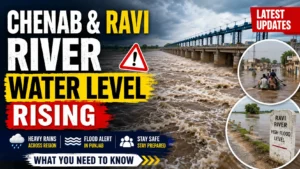
Chenab & Ravi River Water Level Rising 2026, My phone buzzed at 1 a.m. with a voice note from my cousin in Hafizabad. No “hello,” no context, just: The Chenab is rising again, everyone’s awake.Twenty minutes later, our family WhatsApp group turned into a wall of videos brown water pushing against embankments, someone’s tractor half-submerged in a field near Chiniot, a kid pointing at a marker pole that had water almost at the top.If you’ve grown up anywhere near the Chenab or Ravi belt in Punjab, you know this feeling. It’s not panic exactly. It’s more like a low hum of “here we go again” mixed with genuine worry, because every year the water seems to test a slightly higher line.
This isn’t a one time scare. As of late July 2026, both rivers have pushed into flood territory at multiple points, and I’ve spent the last few days doing what I always do when this happens refreshing irrigation department updates, checking in on relatives, and trying to separate real information from the forwarded voice notes that make everything sound worse than it is.
Here’s what I’ve actually learned from going through this cycle year after year, and what I’d tell anyone living near these rivers right now.
Table of Contents
What’s actually happening on the ground
This year’s rise came from a strong monsoon system meeting a westerly weather wave, which dumped heavy rain across the catchment areas Gilgit-Baltistan, Azad Kashmir, Indian-administered Kashmir, and parts of Punjab. That combination is exactly what pushes river flows up fast, and it’s what happened here.
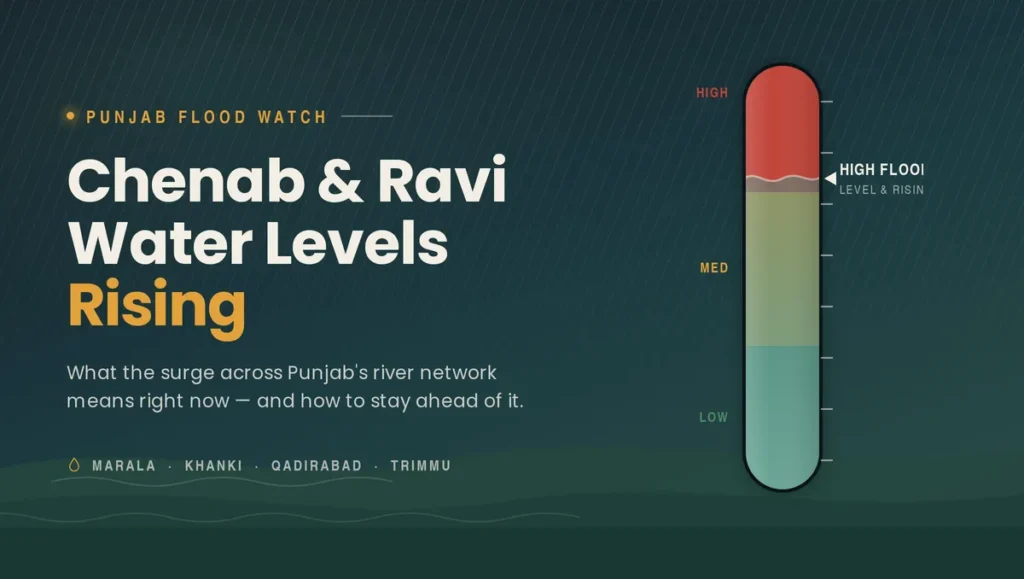
On the Chenab, the Irrigation Department recorded high-level flooding at Head Marala, with inflow crossing 275,000 cusecs. Khanki saw medium-level flooding, and Qadirabad moved into the high flood category with inflows around 236,000 cusecs. Downstream at Chiniot Bridge, discharge climbed past 177,000 cusecs and kept rising through the day. Low lying pockets around Chhin Mehar Shah, Burj Ali, Chak Sarkar, and the village of Sambhal which has flooded repeatedly since 2014 went under water again, along with farmland near Alipur Chattha and Kot Bela, where riverbank erosion started threatening homes.
The Ravi has been calmer but still moving. Balloki Headworks recorded a moderate flood around 73,000 cusecs, and near Okara, water at Mouza Jandraka and Mouza Pir Ali sat around 61,000 cusecs a low-level flood, but enough to damage sesame, fodder, and paddy crops in the area.
Trimmu Headworks, where the Chenab and Ravi systems interact, was placed on high alert as more upstream flow made its way south.
Reports have also pointed to increased water releases from dams upstream in Indian-administered territory as an added factor this monsoon, on top of the rainfall itself. That’s a recurring theme in how these rivers behave, and it’s part of why flows here can jump faster than local rain alone would explain.
Punjab’s disaster management authority (PDMA) responded by putting Rescue 1122, WASA, and district administrations on round the clock alert, and Chief Minister Maryam Nawaz ordered desilting work at multiple points along Nala Dik to reduce pressure on the system.
I didn’t know this word existed until my first flood season paying attention to irrigation updates. A cusec is just “cubic feet per second” a way of measuring how much water is flowing past a point every second.
Roughly, here’s how Punjab’s irrigation authorities usually categorize it at major barrages:
Low flood: flow is above normal but manageable
Medium/moderate flood: noticeable rise, low-lying areas start to flood
High flood: serious risk to embankments, crops, and homes near the river
You don’t need to memorize exact numbers. Just knowing which category your nearest barrage is in tells you how seriously to take the situation.
How I actually track Chenab & Ravi River Water Level Rising 2026 instead of relying on WhatsApp forwards
I made this mistake for years trusting whatever video or message came through family groups. The problem is those clips are often old, from a completely different year’s flood, or exaggerated by the time they’ve been forwarded ten times.
Here’s what I do now, step by step:
Check PDMA Punjab’s website directly (pdma.punjab.gov.pk). They post flood alerts and bulletins with actual barrage by barrage numbers, not guesses.
Follow the Flood Forecasting Division (FFD) bulletins, issued through the Pakistan Meteorological Department. These come out regularly during monsoon season and tell you what’s expected over the next 24–48 hours, not just what already happened.
Check specific barrage names relevant to you Marala, Khanki, Qadirabad, and Trimmu for the Chenab; Jassar, Shahdara, and Balloki for the Ravi.
Save Rescue 1122’s number just 1122 for your area. They handle evacuations, medical help, and rescue operations, not just road accidents.
Cross-check anything alarming you see on social media against an official source before reacting or sharing it further.
This habit alone has saved my family from a few unnecessary panic-driven decisions, like moving belongings for a flood level that turned out to be a low level advisory, not an emergency.
If you live near the Chenab or Ravi right now, here’s a practical checklist
Know your nearest relief camp location district administrations set these up in vulnerable areas during high alerts, and PDMA lists active ones.
Keep important documents (CNIC, land papers, medical records) in a waterproof bag, ready to grab.
Move livestock and valuables to higher ground before the water arrives, not after.
Charge your phone and any power bank fully once an alert is issued networks and electricity are usually the first things to go.
Avoid driving or walking through moving floodwater, even if it looks shallow. This is where most flood-related injuries actually happen, not from the river itself.
If you’re told to evacuate, go. I’ve seen relatives delay because “our house survived last time,” and that’s not a reliable measure of what a fresh high flood level will do to already-weakened embankments.
Mistakes I’ve seen people make (myself included)
The biggest one is waiting for the water to actually reach the house before doing anything. By that point, roads are already flooded and moving becomes ten times harder.
The second is treating every flood alert the same. A low-level flood advisory and a high-flood emergency call for very different responses, and panicking equally at both means you’re not saving your energy for when it really matters.
The third and I’ve been guilty of this is assuming embankments that held last year will hold again. Riverbanks erode a little more with every flood season, especially in places like Sambhal and Kot Bela that have flooded repeatedly.
Where to actually get help
If you or someone you know is affected:
Rescue 1122 for evacuation, medical assistance, or if someone’s stranded near the water
PDMA Punjab for relief camp locations and official updates
Edhi Foundation, Alkhidmat Foundation, and Saylani Welfare Trust all active on the ground providing food, shelter, and medical support during Punjab floods, and easy to reach through their websites or local offices
Every monsoon, there’s a version of this same night a voice note, a video, a barrage name I have to look up again to remember what “high flood” actually means for that spot. What’s changed for me isn’t the river. It’s that I stopped reacting to every forwarded video and started checking two or three official sources before deciding how worried to actually be.
If you’re near the Chenab or Ravi belt right now, that’s really the whole point: know your nearest barrage, know what category it’s in, and have a plan ready before the water asks you to make one on the spot.
Is the Chenab River currently in high flood?
At several points including Marala and Qadirabad, yes flows have been recorded in the high flood category as of late July 2026, though this changes daily depending on rainfall and upstream releases. Always check PDMA Punjab’s latest bulletin for the current status.
What’s causing the water levels to rise this year?
A strong monsoon system combined with a westerly weather wave brought heavy rain across the catchment areas, including Kashmir and northern Punjab. Increased water releases from upstream dams have also been reported as a contributing factor.
How do I know if my area is at risk?
Check which barrage or headworks is closest to your location (for example, Marala, Khanki, or Trimmu for the Chenab, and Balloki or Jassar for the Ravi) and look up its current flood category on PDMA Punjab’s site.
What number do I call in an emergency?
Dial 1122 for Rescue 1122, which handles flood evacuations and emergency medical response across Punjab.
Is it safe to drive through flooded roads?
No, Moving floodwater is deceptive even water that looks shallow can hide damaged roads or strong currents. Most flood injuries happen this way, not from the main river itself.
Bilal Ahmad
Bilal Ahmad is the Founder and Editor of GlobalNewsHubz. He writes about technology, world news, government schemes, and digital trends. His goal is to provide readers with accurate, well-researched, and easy-to-understand information using trusted and official sources.