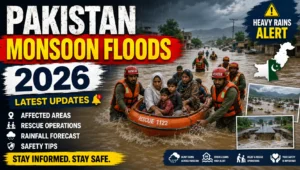
Pakistan Monsoon Floods 2026, My phone buzzed at almost 1 AM last week. Not a WhatsApp message, not a random spam call a PDMA alert about rising water in the Chenab. I sat up in bed and did the thing I do every monsoon now: checked the river level, checked Rescue 1122’s updates, and texted my cousin in Gujranwala to ask if their street was flooding again.That’s monsoon season in Pakistan now. It’s not just rain anymore. It’s alerts, river levels, and a low-grade anxiety that sits in the back of your mind from late June to September.
If you’ve lived through even one bad flood year here, you know exactly what I’m talking about. If you haven’t, this monsoon is a good time to actually understand what’s happening and what you can do about it because the rain isn’t stopping any time soon.
Table of Contents
What’s actually happening this Pakistan Monsoon Floods 2026
This year’s monsoon kicked off around June 26, and it’s been a strange one. The Met Office actually predicted below normal rainfall for most of the country this season. Sounds like good news, right?
Except it isn’t, really. Less total rain doesn’t mean less danger. It just means the rain comes in short, brutal bursts instead of spreading out evenly and those sudden downpours are exactly what causes flash floods and city streets turning into rivers within an hour.Khyber Pakhtunkhwa has taken the worst hit so far this year, with Punjab close behind. Deaths since the season started have climbed past 70, and most of them aren’t from big dramatic river floods they’re from collapsed walls and roofs during heavy rain and windstorms, which honestly catches a lot of people off guard. You think about floods and picture water. You don’t picture your neighbor’s wall coming down on a rainy Tuesday night.
On top of that, NDMA and PDMA Punjab have been issuing alerts almost non-stop for the Chenab, Jhelum, and Ravi rivers, with urban flooding warnings for cities like Lahore, Rawalpindi, Gujranwala, Sialkot, Gujrat, Faisalabad, and Sargodha. Up north, Chitral and Gilgit-Baltistan have been dealing with landslide risk on top of everything else.
And this is all happening before the actual peak of the season. August and September are usually when things get worse, not better.
Last year’s floods were brutal over a thousand deaths and close to three million people displaced at the worst point. A lot of families in Punjab, Sindh, and KP were still rebuilding homes and replacing lost livestock when this year’s rains started.That’s the part people outside the affected areas don’t always get. It’s not one flood, recover, repeat. For a lot of households, it’s flood on top of flood, with barely enough time in between to catch a breath financially or emotionally.
I noticed this myself when I visited relatives in a flood hit area last year. Houses that had just gotten new roofs were already worried about the next spell. That kind of exhaustion doesn’t show up in news reports, but it’s real.
The tools I actually use now (learned this the hard way)
For years, I relied on random WhatsApp forwards for flood news. Big mistake. Half of them were outdated, some were flat out wrong, and by the time a message reached me it had usually been re-forwarded five times with no source.
Here’s what actually works:
The NDMA Disaster Alert App : it’s the official app from the National Disaster Management Authority, free on both Android and iOS. It pushes real alerts for your area, shows active hazards, and even has a resources section for nearby shelters and help centers. I keep notifications on for this one specifically.
PDMA Punjab’s website and Twitter/X account : if you live in Punjab, this is where the actual river discharge numbers come from (cusecs at places like Marala, Khanki, Qadirabad). It sounds technical, but once you get used to checking it, you’ll know whether “flood alert” means “watch the news” or “start moving your stuff upstairs.”
PMD’s official Twitter account (@pmdgov) : the Met Office posts short, clear weather bulletins here faster than most news channels report them.
Google Maps traffic layer : not built for flood alerts, but genuinely useful for seeing which roads are backed up or closed after heavy rain, especially in cities like Lahore and Rawalpindi.
Rescue 1122 (dial 1122) : for anything urgent: trapped in rising water, injuries, someone needs evacuating. It covers Punjab, KP, Islamabad, AJK, and Gilgit-Baltistan.
Edhi Ambulance (dial 115): works nationwide as a backup, especially useful if 1122 lines are busy during a bigger emergency.
None of these apps or numbers will stop the rain. But they’ve genuinely saved me from making bad calls literally, in the case of driving somewhere I shouldn’t have.
My actual step-by-step routine
I didn’t have a system for years. Now I do, and it’s not complicated.
Before the season even starts (June, if possible):
Charge a power bank and keep it charged not “I’ll do it later,” actually do it.
Put important documents (CNIC copies, property papers, medical records) in a ziplock bag or waterproof pouch.
Save NDMA, PDMA, and Rescue 1122 numbers as favorites in your phone.
Check that your phone has the NDMA app installed and notifications turned on.
When an alert actually comes in:
Don’t panic, but don’t ignore it either read what it actually says. “Urban flooding alert” and “high flood alert on the river” mean very different levels of urgency.
Move vehicles to higher ground if you’re in a low-lying area.
Unplug non-essential electronics if water is expected to reach your street.
Keep your power bank charged and phone topped up you lose signal awareness fast once the power goes.
If water starts rising near you:
Move to higher floors or higher ground immediately don’t wait to “see how bad it gets.”
Never drive through moving water, even if it looks shallow. Cars stall or get swept faster than people expect.
Call 1122 early rather than waiting until it’s a full emergency response times are much better when lines aren’t overwhelmed.
After the water goes down:
Don’t drink tap water until it’s confirmed safe boil it or use purification tablets.
Check for structural damage (cracks, leaning walls) before going back inside.
Watch for waterborne illness symptoms in kids especially diarrhea and fever spike hard after flooding.
Two monsoons ago, I drove through what looked like a few inches of water on a street near Sialkot because I was late for something and assumed it was fine. It wasn’t fine. The car stalled halfway through, water got into the engine, and I ended up paying a repair bill that cost more than a month’s fuel budget plus I had to get pulled out by some very unimpressed locals with a tractor.
That one mistake taught me more than any advisory ever did. Moving water, even ankle-deep, can hide a much deeper pothole or a stronger current than it looks like from the driver’s seat. Now I just turn around. Every single time.
Common mistakes people make (myself included)
Ignoring official alerts because “it’s always exaggerated.” Sometimes it is. Sometimes it’s the one time it isn’t, and that’s the time that matters.
Driving or walking through flowing water. This is genuinely one of the biggest causes of flood related deaths and it’s completely avoidable.
Running generators indoors or in closed spaces during power cuts. Carbon monoxide doesn’t announce itself, and this has caused real, preventable deaths during past flood seasons.
Keeping cash, CNIC, and documents loose in a drawer. A waterproof pouch costs almost nothing and saves you weeks of paperwork later.
Waiting for “official evacuation” before moving. In fast-moving flash flood situations, that announcement can come too late. If your instinct says move, move.
Trusting random forwarded messages over official sources. Check NDMA, PDMA, or PMD directly before acting on panic-inducing WhatsApp forwards.
I won’t pretend there’s a neat way to wrap up something like this. Monsoon season in Pakistan isn’t going away, and honestly, with how the climate’s been shifting, it’s probably going to keep getting trickier to predict rather than easier.What’s changed for me isn’t the weather it’s how seriously I take the small, boring stuff. Charging the power bank before it’s needed. Actually reading the alert instead of skimming it. Turning the car around instead of chancing it.
None of that stops a flood. But it’s made the difference between a stressful week and a genuinely dangerous one, more than once. If this article gets even one person to download that NDMA app or save 1122 in their contacts today instead of “eventually,” it did its job.
Stay safe out there this season, and keep an eye on those river levels.
Is the 2026 monsoon season worse than previous years in Pakistan?
Overall rainfall was forecast to be below normal this year, but intense, short bursts of rain have still caused serious flash flooding and urban flooding, especially in Khyber Pakhtunkhwa and Punjab. It’s a different kind of dangerous rather than simply “worse” or “better” than 2022 or 2025.
How can I get real-time flood alerts on my phone in Pakistan?
Install the official NDMA Disaster Alert App (available on Android and iOS) and follow PDMA’s official account for your province along with PMD’s official Twitter/X account. These are far more reliable than WhatsApp forwards.
What number should I call during a flood emergency in Pakistan?
Dial 1122 for Rescue 1122, which covers Punjab, KP, Islamabad, AJK, and Gilgit-Baltistan for ambulance, fire, and rescue needs. Edhi Ambulance (115) is a solid nationwide backup.
Should I evacuate as soon as I get a flood alert?
It depends on the alert type an urban flooding advisory isn’t the same as a high flood alert on a major river. But if you’re in a low-lying area or near a hill torrent and water is visibly rising, don’t wait for a formal evacuation order before moving to safety.
What should go in a basic flood emergency kit?
A charged power bank, a torch, a first aid kit, ORS sachets, water purification tablets, waterproofed copies of important documents, some dry food, and cash in small denominations. Keep it packed before the season starts, not after the first alert.
Bilal Ahmad
Bilal Ahmad is the Founder and Editor of GlobalNewsHubz. He writes about technology, world news, government schemes, and digital trends. His goal is to provide readers with accurate, well-researched, and easy-to-understand information using trusted and official sources.