Google Jobs 2026, A cousin of mine sent me a WhatsApp forward a few months back. Screenshot of a “Google Jobs 2026” post, bold red text saying she’d been shortlisted, a link to click, and a note that she just needed to pay a small “registration fee” to confirm her seat. She was genuinely excited. She’d never applied to any Google job in her life.
That message is the reason I’m writing this. Not because I work at Google, but because I spent a good chunk of last year actually going through the real process searching real listings, messing up my resume twice, getting one recruiter call, getting ghosted after another and I realized almost nobody explains what this actually looks like from the outside. Most of what shows up when you search “Google Jobs 2026” is either scam bait or recycled listicle content that doesn’t tell you anything you can act on.
If you’ve ever applied for a government job FPSC, PPSC, NADRA, that kind of thing you’re used to a specific pattern. A notification gets announced on a certain date, there’s a fixed deadline, a test date, a result date. Everyone applies in the same window.Google doesn’t work like that, and this trips up a lot of first time applicants.
There’s no single “Google Jobs 2026 recruitment drive” with one apply by date. Roles open individually, all year round, whenever a team actually needs someone. A data center technician role in Singapore and a UX researcher role in Zurich could post on completely different weeks for completely unrelated reasons. Some roles stay open for a few days, others sit up for months.
This is exactly why so many blog posts throw around specific numbers like “300 vacancies open this October” it sounds authoritative, but it’s usually just made up to look like an official notification. Treat any post that gives you a fixed “last date to apply” for Google as a red flag, unless it’s actually pulling from Google’s own site.
Where the Real Vacancies Actually Live
There’s exactly one place I’d trust for this: careers.google.com. Specifically the jobs search page under “Search jobs.” Everything else the recycled listicle sites, the “Google Recruitment 2026” pages full of ads is just repackaging or, worse, phishing.
Here’s how I actually use it:
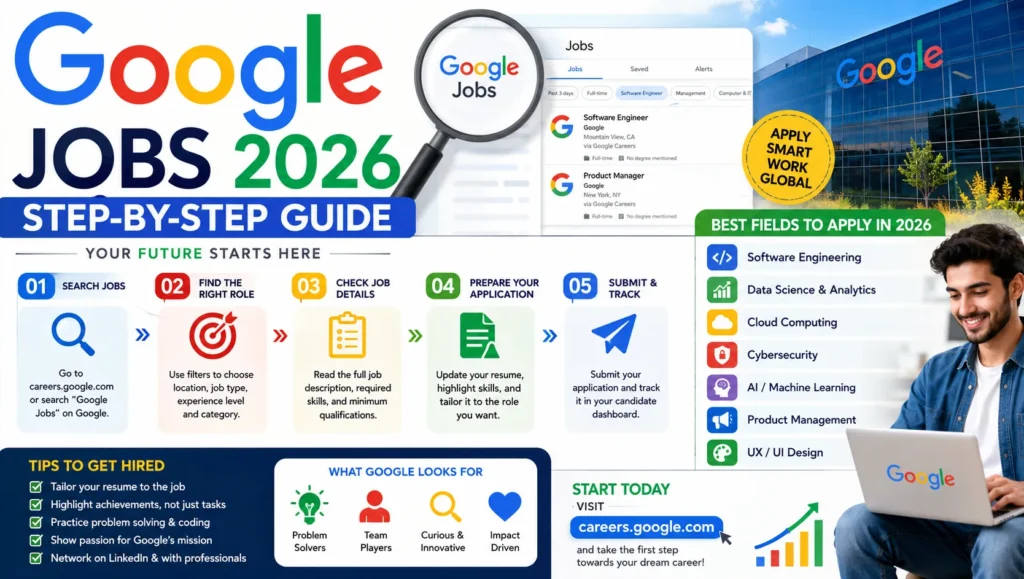
Step 1 — Set your location filter first, not your job title. If you’re applying from outside the US or Europe, this matters more than people think. Google has offices across roughly 50+ countries places like Dublin, Warsaw, Bangalore, Hyderabad, Singapore, Tokyo, and Sydney all have real, active teams. Filtering by region first shows you what’s genuinely reachable instead of roles that quietly require existing work authorization in a country you’re not in.
Step 2 — Browse by category, not by guessing keywords. The site groups roles into categories like Engineering & Technology, Business Strategy, Sales & Account Management, Technical Solutions, and User Experience. I wasted a week typing random job titles into the search bar before I noticed the category filter did the job for me in ten seconds.
Step 3 — Read the “minimum qualifications” line carefully. A lot of postings say something like “Bachelor’s degree in a related field, or equivalent practical experience.” That last part is real and it matters Google explicitly leaves room for people without a traditional degree if their hands-on experience covers the same ground. Don’t self reject just because you didn’t finish a specific degree.
Step 4 — Turn on job alerts for your saved searches. New roles get added constantly, and the good ones don’t stay up long once a strong pool of candidates applies. I missed two roles I was actually qualified for simply because I checked the site once a week instead of letting it email me.
Once I stopped browsing randomly and got serious, this is roughly what the process looked like on my end:
Picked 2–3 roles, not twenty. I made this mistake early applying to anything remotely related to my background. Recruiters can tell when a resume isn’t tailored, and honestly, so could I when I read my own applications back.
Rewrote my resume around outcomes, not duties. Instead of “responsible for managing social media accounts,” I wrote what actually changed because of the work numbers, growth, specific tools used. One page. No walls of text.
Matched my resume’s language to the posting. Not keyword stuffing, just making sure if the posting said “cross functional stakeholder management,” and that’s genuinely what I’d done, I used those actual words somewhere.
Applied directly through the careers site, never through a random link someone sent me.
Waited. This is the part nobody prepares you for.
What Happens After You Hit Submit
If your application gets picked up, here’s roughly the order of events, based on what I went through and what recruiters and past candidates describe consistently:
Recruiter screen a 30 to 60 minute call, mostly about your background, why you’re interested, and logistics like timeline and pay expectations. It’s not usually technical.
Phone or technical screen(s) for technical roles, expect one or two rounds testing how you think through an unfamiliar problem, not just whether you know the “right” answer.
Onsite loop (now mostly virtual) several back to back interviews with different Googlers, often covering role specific skills plus a behavioral round.
Hiring committee review this part surprises people. Your interviewers don’t make the final call. A separate group of Googlers who never met you reviews all the written feedback and decides.
Team matching if approved, you get introduced to teams actually looking for someone with your profile. This step can take a few weeks on its own.
The whole thing, start to offer, tends to run somewhere between one and three months for most roles, sometimes longer once you add compensation review and team matching. I didn’t hear back on my strongest application for almost four weeks and that’s apparently normal, not a bad sign. If you’ve got a competing offer with a deadline, tell your recruiter directly; they can sometimes move things along, but only with a real deadline, not just impatience.
The Visa Question Nobody Explains Properly
This is the part most “Google Jobs 2026” posts get vague or flat out wrong about.
Google does sponsor work visas for some roles in the US, that’s typically H-1B, sometimes H-1B1 or E-3 (E-3 is specifically for Australian citizens). But sponsorship isn’t automatic, and it isn’t attached to every posting. A lot of listings explicitly state whether visa sponsorship is or isn’t available for that specific role, and it’s worth reading that line before you invest hours tailoring an application.
A few things I picked up along the way:
Sponsorship decisions come after a hiring decision, not before. You clear the same technical and behavioral bar as everyone else first.
Technical and specialized roles engineering, machine learning, data infrastructure historically have stronger odds of sponsorship than generalist roles.
If relocation and visas feel like a long shot right now, look at remote eligible postings within your own country or region instead. Google does have location-flexible roles, and they sidestep the entire visa question.
Relocation isn’t instant even when it’s approved. Between paperwork, background checks, and immigration processing, plan for months, not weeks.
Mistakes I Made (and See Other People Make Constantly)
Applying to too many roles with one generic resume. Quality beats volume here, consistently.
Ignoring the recruiter screen because it “felt casual.” It’s not just small talk it shapes how your file gets written up later.
Not asking the recruiter what the actual loop looks like. They’ll usually tell you which rounds to expect if you just ask. I didn’t ask the first time and walked in blind.
Going silent after a rejection instead of asking for feedback. You won’t always get a detailed answer, but sometimes you do, and it’s useful.
Assuming no response after a week means rejection. It usually just means the process hasn’t caught up yet.
How to Spot a Fake Google Job Offer
Back to my cousin’s WhatsApp message this part matters more than any resume tip.
Real Google recruiters don’t cold message you on WhatsApp, Linkedin or Telegram announcing you’ve been “shortlisted” for a role you never applied to. They don’t ask you to reply “YES” or “INTERESTED” to a random text. And they will never, under any circumstance, ask you to pay a fee for registration, training, a laptop, or to “unlock” your first paycheck.
Job scam losses have climbed sharply worldwide over the past couple of years, and fake recruiters increasingly use real company names, logos, and even AI generated profile photos to look convincing. If a message pushes urgency, asks for money, or moves you off a proper platform fast, that’s the pattern not a fast moving opportunity.
If you want to double check something that looks suspicious, cross-reference it against the actual listing on careers.google.com, or report it through the FTC’s ReportFraud.ftc.gov if you’re US-based. When in doubt, slow down. Real hiring processes don’t punish you for taking a day to verify.
Google’s Interview Warmup (free, at grow.google/certificates/interview-warmup) an AI-based practice tool that asks you real interview style questions and gives feedback on your answers. It’s not a substitute for practicing with an actual person, but it’s genuinely useful for getting comfortable speaking your answers out loud before the real thing.
LinkedIn mostly to check whether a “recruiter” contacting you is a real employee with a real, connected profile. Zero mutual connections at a company that size is worth noticing.
Is there an official Google Jobs 2026 application deadline?
No, google posts and closes individual roles continuously throughout the year there’s no single recruitment window or fixed last date to apply.
Can I apply to Google jobs from outside the country the role is based in?
Yes, but check the posting for visa sponsorship details first. Some roles support relocation and sponsorship, many don’t, and remote-eligible roles are worth checking as an alternative.
Does Google require a specific degree to apply?
Many postings accept “equivalent practical experience” instead of a formal degree, so don’t rule yourself out without reading the full requirement line.
How long does the Google hiring process usually take?
Commonly somewhere between four and twelve weeks from application to offer, depending on the role and how many interview rounds are involved.
How do I know if a “Google recruiter” message is real?
Real recruiters use official channels tied to your actual application, never ask for payment, and won’t pressure you to reply instantly. Verify anything unexpected against careers.google.com before engaging further.
Bilal Ahmad
Bilal Ahmad is the Founder and Editor of GlobalNewsHubz. He writes about technology, world news, government schemes, and digital trends. His goal is to provide readers with accurate, well-researched, and easy-to-understand information using trusted and official sources.