How AI is Changing Education in 2026, Last month my cousin’s daughter, she’s in 9th grade, showed me her “study buddy” on her phone and asked if I wanted to see something cool. It wasn’t a game. It was Khan Academy’s AI tutor walking her through a quadratic equation, one hint at a time, refusing to just hand her the answer even when she typed “just tell me lol.”That’s when it hit me. This isn’t the “AI in schools” we were promised five years ago, with smart boards and cartoon robots. It’s quieter than that. It’s sitting inside apps kids already use, and most parents and teachers have no idea how deep it goes.
I’ve spent a good chunk of the past year testing these tools myself, partly out of curiosity, partly because I help a few students with their assignments on the side.
I always pictured “AI in education” as something schools roll out officially, with training sessions and permission slips. In reality, it snuck in through the back door.Students were using ChatGPT to write essays long before any school had a policy on it. Teachers were using Grammarly’s AI rewrite feature to draft feedback comments faster. Nobody announced it. It just became normal, the same way spellcheck did.
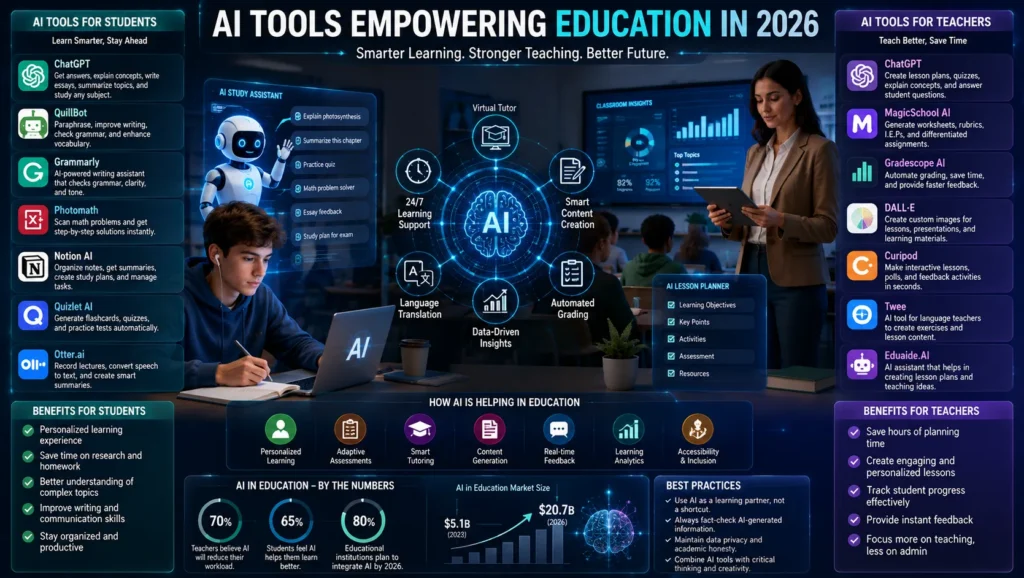
AI tutors that don’t just give answers.Khanmigo (Khan Academy’s tutor) and similar tools built into Google’s Gemini for Education are designed to ask leading questions instead of solving the problem for the student. The first time I tested it on a algebra problem, I tried to trick it into giving me the final number. It wouldn’t budge. It kept asking “what do you think happens if you divide both sides by 2?” That was honestly a relief to see, because the lazy version of AI in school would just be a cheating machine.
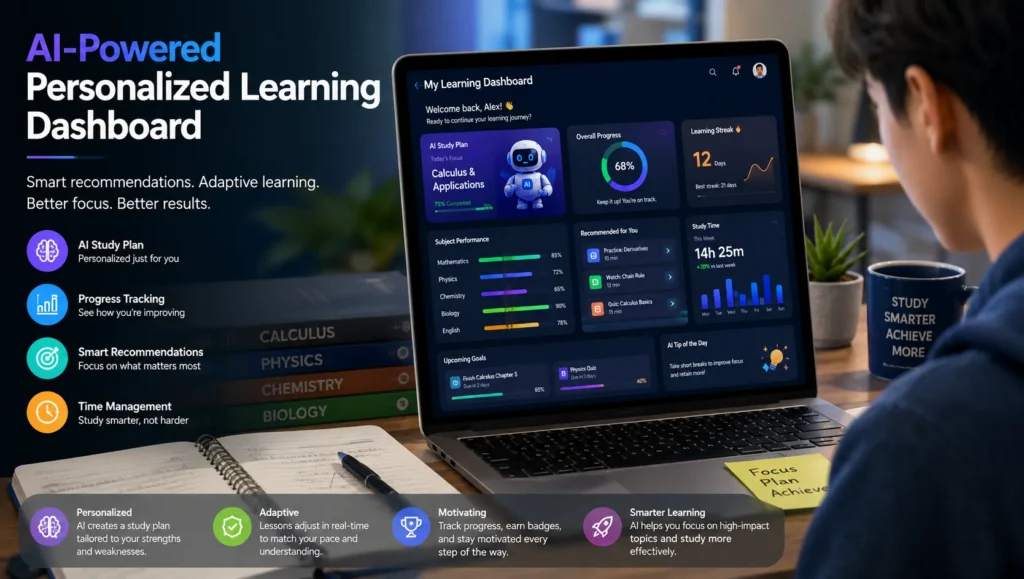
Instant, personalized practice.Photomath and similar apps scan a handwritten problem and don’t just solve it, they show the steps in a way that adjusts to how you got it wrong. My nephew used it for geometry and his actual grades went up over one semester, not because the app did his homework, but because he finally understood where his mistake was instead of just copying a solution manual.
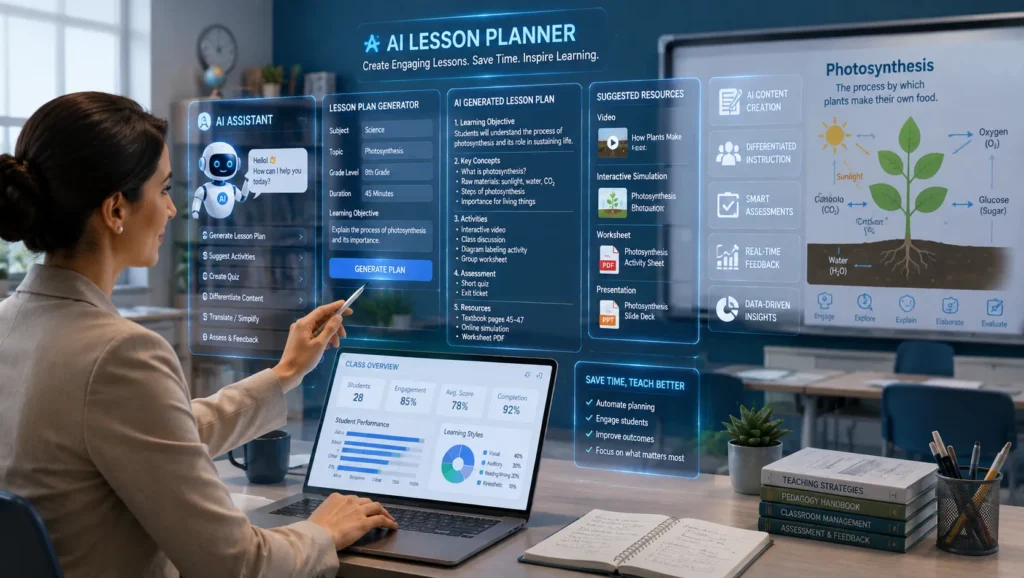
Teachers using AI to survive grading season. A teacher friend of mine uses MagicSchool AI to draft rubrics, differentiate reading material for students at different levels, and write the first draft of report card comments for 30+ kids. She still edits every single one, but says it saves her roughly 4-5 hours a week. That’s not a small thing when you’re already underpaid and overworked.
Language learning that actually adapts.Duolingo Max added a feature where you can have a real back and forth conversation with an AI character in the language you’re learning, and it corrects you mid sentence instead of just marking you wrong at the end. I tried it for Spanish and it felt closer to actually talking to someone than any app I’d used before.
The mistake I made (and one I watched a student make)
Here’s the part nobody likes to admit in these articles: it’s not all smooth.
I once asked ChatGPT to help me summarize a research paper for a blog post, and it confidently gave me a statistic that sounded exactly right, specific number, specific year, real sounding source. I almost used it. Then I went to check the original paper and that number didn’t exist anywhere in it. The AI had basically made it up but said it with total confidence.That’s called hallucination, and it happens more than people think, especially with anything involving dates, statistics, or citations. If you’re a student using AI for research, that’s the single biggest trap. It doesn’t sound uncertain when it’s wrong. It sounds exactly as confident as when it’s right.
The other thing I watched happen to a student I was helping, she wrote a genuinely good essay, all her own words, and got flagged by an AI-detection tool as “likely AI-generated.” She had to sit through an uncomfortable meeting with her teacher over something she didn’t even do. AI detectors are still unreliable, and they disproportionately flag writing from non-native English speakers and people who just write in a more formal, structured style. That’s a real problem schools are still figuring out, and honestly, some are handling it badly.
A simple way to actually use AI for studying (without cheating yourself)
If you’re a student, or a parent trying to figure out how to let your kid use this stuff responsibly, here’s the approach that’s worked for the students I’ve helped:
Do a first attempt on your own first. Even a bad, messy attempt. This matters more than people realize, because AI explanations only stick if you already have a question in your head to attach them to.
Use AI to explain, not to answer. Literally type “explain this like I’m trying to learn it, don’t just give me the answer.” Tools like Khanmigo do this by default, but even ChatGPT will do it if you ask directly.
Ask it to quiz you back. After reading an explanation, ask the AI to test you on the same concept with different numbers or a different example. If you can’t answer, you didn’t actually learn it, you just understood the explanation.
Double-check anything with a number, date, or citation. Every single time. This one habit alone would have saved me from that fake statistic mistake.
Keep a “why” journal for essays. Before writing with any AI assistance, jot down in your own words why you’re making the argument you’re making. It keeps the thinking yours even if a tool helps with phrasing later.
Common mistakes I see people make with this stuff
Treating the AI’s tone of confidence as proof it’s correct. It isn’t. Confidence and accuracy are two completely different things with these tools.
Letting AI write the whole thing and just changing a few words. Detection aside, this is the fastest way to stop actually improving as a writer or thinker.
Assuming every school has the same rules. Some schools now openly encourage AI tutoring apps, others ban them outright, and a lot are somewhere confused in between. Always check what your specific teacher or institution allows before assuming.
Ignoring the accessibility side of things. One thing that doesn’t get talked about enough: AI reading tools and speech to text features have been genuinely life changing for students with dyslexia or other learning differences. That part of the story deserves more attention than it gets.
Where I think this How AI is Changing Education in 2026 is actually headed
I don’t think AI is replacing teachers, and honestly, every teacher I’ve talked to says the same thing, it’s replacing the boring repetitive parts of their job, not the parts where they actually connect with a struggling kid and notice something’s wrong before the kid even says it out loud.
What I do think is happening is that the gap between students who know how to use these tools well and those who just use them to shortcut homework is going to become a bigger deal than the gap in access to the tools themselves. Everyone has access to ChatGPT now. Not everyone knows how to use it in a way that actually makes them smarter instead of lazier.
Is AI in education safe for kids to use?
Generally yes, especially tools built specifically for education like Khanmigo or Duolingo Max, which have guardrails around content and don’t just hand out answers. The bigger risk isn’t safety, it’s over reliance, where a student stops thinking for themselves.
Can teachers actually detect AI-written essays?
Not reliably, AI detection tools have a real problem with false positives, especially for non-native English speakers or naturally formal writers. Many schools are moving away from relying on detectors alone and toward in class writing samples for comparison instead.
What are the best free AI tools for studying in 2026?
Khan Academy’s Khanmigo, Google’s Gemini (free tier), Photomath for math specifically, and Duolingo for language learning are all solid free starting points with genuine educational design behind them, not just repurposed chatbots.
Will AI replace teachers?
Based on what’s actually happening in classrooms right now, no. It’s taking over repetitive tasks like first-draft grading and practice quizzes, freeing teachers up for the parts of teaching that actually require a human, like noticing when a student is struggling emotionally, not just academically.
Is AI good for learning?
Yes, when used responsibly. AI helps explain difficult topics, provides personalized feedback, and saves time, but students should always verify information and avoid relying on AI to complete assignments without understanding the material.
Bilal Ahmad
Bilal Ahmad is the Founder and Editor of GlobalNewsHubz. He writes about technology, world news, government schemes, and digital trends. His goal is to provide readers with accurate, well-researched, and easy-to-understand information using trusted and official sources.