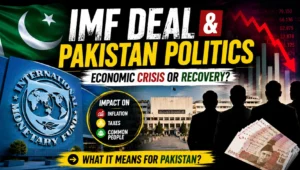
IMF Deal and Pakistani Politics 2026, Last month I was scrolling through my electricity bill app at 11 pm, refusing to actually open the PDF because I already knew it was going to hurt. Same week, the fuel price notification popped up on my phone petrol up again. Same week, my cousin who does freelance design work messaged me asking why his Payoneer withdrawal suddenly felt “off” compared to what he expected.None of these three things looked connected on the surface. But they all trace back to the same thing: Pakistan’s ongoing arrangement with the IMF, and the political tug-of-war happening around it in Islamabad.
I’ve been tracking this stuff for over a year now, partly out of necessity (freelance income + rupee volatility is not a fun combination) and partly because I got tired of half-understanding budget season news every June. So this isn’t a textbook explainer. It’s what I’ve actually learned from watching bills, prices, and parliament sessions collide in real time.
Table of Contents
Quick Reality Check: What’s Actually Happening Right Now
Pakistan has been running a multi-year program with the IMF a $7 billion Extended Fund Facility signed back in 2024, plus a separate climate-linked facility added in 2025. Every few months, IMF staff review how the government is doing against agreed targets (tax collection, energy sector losses, inflation control, that sort of thing). If the review goes fine, another chunk of money gets released.
As of this year, total disbursements under both arrangements have crossed roughly $4.8 billion. The government also worked out the broad shape of the FY2026-27 budget with IMF input before it was even presented in parliament which is exactly why every June, budget day turns into a political circus.
That’s the part I want to focus on, because the money math is honestly less interesting than watching how it plays out politically and how that politics ends up in your monthly expenses.
If you watched any local news channel this June, you probably saw clips of PTI lawmakers surrounding the speaker’s dais, chanting, and tearing up copies of the budget document. That wasn’t random theater opposition parties have consistently framed the budget as an “IMF-dictated” document rather than one shaped by elected representatives.
The ruling coalition’s response is basically the opposite framing: that following through on these commitments is what’s kept the rupee relatively stable, kept reserves climbing, and avoided a repeat of the 2022-23 default scare. Both sides have a point, and I’ve stopped trying to pick a “correct” side it’s genuinely a real trade-off, not a simple right-versus-wrong story.
What I do pay attention to is the actual friction points, because they predict what’s coming next in my own budget:
Energy tariffs (gas and electricity) getting revised on a schedule tied to the program
Tax measures aimed at bringing more people and sectors into the net including things like freelancer and small trader income
A push to keep fuel and power prices matched to actual cost, instead of subsidized
Every one of these shows up in my life within weeks of being announced, not months.
Where This Actually Hits Your Pocket
Here’s where the “hands-on” part comes in because I made the mistake early on of thinking a signed IMF review meant things would settle down for a while. They didn’t.
Fuel prices. Petrol used to move every two weeks based on OGRA’s fortnightly review. This year it’s been closer to a rolling weekly (sometimes near-daily) adjustment, bouncing between roughly the 290s and low 320s per litre depending on global crude and the rupee. If you commute by bike or car, that’s not background noise it directly changes your monthly transport cost, and it feeds into grocery delivery and ride-hailing fares within days.
Electricity and gas bills. Tariff reviews are scheduled well in advance as part of the program I now know roughly when to expect the next adjustment instead of getting blindsided by a bill that’s suddenly 20-30% higher.
Inflation. Projections this year sit around 8-8.5%, which sounds mild next to the near-40% peak Pakistan saw a couple years back, but it’s still a real bite when it lands on food, rent, and transport all at once.
Taxes for freelancers and small businesses. Recent budget cycles have specifically targeted areas like social media income, retail/wholesale minimum tax, and stricter FBR enforcement. If you’re earning through Upwork, Fiverr, or getting paid via Payoneer or Wise, this is the part people miss until tax season actually arrives.
Mistakes I Made (So You Don’t Have To)
Mistake 1: Assuming “deal signed” meant “problem solved.” I treated the March staff-level agreement news as a sign that prices would stabilize. Instead, the very next fuel review came with a jump of over Rs 13 a litre in one go, driven by a regional oil price spike. A signed review clears one hurdle; it doesn’t freeze the market.
Mistake 2: Ignoring the energy tariff calendar. I got hit with a much bigger electricity bill than expected because I wasn’t tracking that gas and power tariff revisions were scheduled months in advance. Now I actually bookmark the news around each budget cycle instead of finding out from the bill itself.
Mistake 3: Not adjusting freelance invoicing for tax changes. A friend who does contract work assumed his income was too small to matter under the new revenue push. It’s worth actually checking FBR’s official portal (IRIS / Tax Asaan) rather than assuming last year’s rules still apply.
A Simple Way to Actually Track IMF Deal and Pakistani Politics 2026
This is the part I wish someone had handed me a year ago:
Check fuel prices directly from OGRA or the Petroleum Division notification: not a random news headline prices are announced officially and the exact effective date matters for planning.
Follow the State Bank of Pakistan’s exchange rate page: if you get paid in dollars. The interbank rate and what Payoneer/Wise actually give you can differ, and knowing the “real” number helps you spot when a platform’s spread is worse than usual.
Mark budget season on your calendar: Budget is presented in early-to-mid June and passed later that month. Tax and tariff changes from that budget usually kick in from July 1st.
Use a basic expense tracker: something as simple as Google Sheets, or an app like Wallet by BudgetBakers, to see month-over-month how fuel and electricity are actually moving your total spend. Numbers convince you faster than news articles do.
Read the IMF’s own press release summary: after each review (it’s public on imf.org) instead of relying only on local political commentary it’s dry, but it tells you exactly which conditions are coming next.
Common Mistakes People Make With This Whole Topic
Treating every price hike as purely “IMF’s fault” or purely “government mismanagement” it’s usually a mix of global oil prices, rupee movement, and program conditions together.
Waiting for the bill to arrive instead of checking scheduled tariff dates in advance.
Assuming freelance or informal income is invisible to tax authorities enforcement has been tightening, not loosening.
Panicking and converting savings on rumor rather than checking the actual SBP rate.
A small trader friend of mine adjusted his pricing model the moment the fixed tax scheme for shopkeepers was announced in the budget he didn’t wait for enforcement, he just built the extra cost into his margins early. Saved him a scramble later.
On the flip side, someone I know running a small delivery bike service didn’t factor in the near-weekly fuel price mechanism into his per-order pricing, and spent two months quietly losing margin on every trip before he noticed his fuel cost as a percentage of revenue had crept up significantly.
Final Thoughts
Honestly, the IMF-Pakistan relationship isn’t going anywhere soon, and neither is the political noise around it every party in Islamabad uses it as ammunition against whoever’s in power at the time, and that’s been true across multiple governments, not just this one. What’s actually useful is separating the political theater from the practical calendar: tariff dates, budget dates, and price review cycles that genuinely affect your monthly numbers.
I’m not saying ignore the politics it matters, and it shapes which conditions get negotiated and how painful they are for ordinary people versus businesses. But if you’re trying to actually manage your own money through it, tracking the concrete dates and numbers gets you a lot further than doom-scrolling talk show clips.
Is Pakistan’s current IMF program the same as the older bailout programs from 2019 or 2023?
No — it’s a newer arrangement. Pakistan signed a fresh $7 billion Extended Fund Facility in 2024, with an additional climate-focused facility added in 2025. Earlier programs were separate and have since concluded.
Why do opposition parties always call the budget an “IMF budget”?
Because major budget parameters (revenue targets, fiscal deficit limits, energy pricing) are shaped in coordination with IMF review conditions before the budget is presented. Opposition parties use this to argue parliament has limited real control; the government argues these commitments are what’s kept the economy from a bigger crisis.
How often do fuel prices change in Pakistan now?
Historically it was a fortnightly review. Through parts of 2026, adjustments have come more frequently, sometimes close to weekly, tied to global crude prices and rupee movement. Always check the official OGRA or Petroleum Division notification for the current rate rather than relying on an old figure.
Does the IMF deal affect freelancers and small online businesses directly
Yes, indirectly and sometimes directly — through tax measures targeting online/social media income, stricter FBR enforcement, and general exchange rate policy that affects what freelancers actually receive through platforms like Payoneer or Wise.
Where can I check reliable, updated information myself instead of relying on secondhand news?
The IMF publishes official press releases after each review on imf.org. For domestic numbers, OGRA and the Petroleum Division handle fuel pricing, and the State Bank of Pakistan publishes the official exchange rate — all publicly accessible and more reliable than social media summaries.
Bilal Ahmad
Bilal Ahmad is the Founder and Editor of GlobalNewsHubz. He writes about technology, world news, government schemes, and digital trends. His goal is to provide readers with accurate, well-researched, and easy-to-understand information using trusted and official sources.