Europe Wildfires & Climate Crisis 2026, Two summers ago I was sitting on my balcony in the south of France, drinking coffee, when the light went weird. Not sunset orange. Ash orange. Within an hour my phone was buzzing with alerts I didn’t even know I’d signed up for, and my neighbor was hosing down her roof “just in case.” That was my real introduction to European wildfire season not a headline, but a very personal “wait, is this actually coming toward us?” moment.
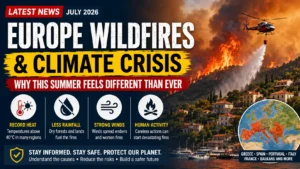
I bring this up because 2026 is shaping up to be another rough one. As of late July, EU monitoring data shows 254,388 hectares have burned since the start of the year above the long-term average, though still slightly below the 270,449 hectares that had burned by the same point in 2025, which was the worst year on record. Spain, France, and Italy are all dealing with active, serious fires right now. Spain has declared a national emergency with fires spreading west of Madrid and across Avila and Guadalajara, France has ordered mass evacuations along the Atlantic coast including Lege-Cap-Ferret and Biscarrosse, and in Sicily there have been more than 1,000 firefighting interventions since July 18. “European CommissionPOGODNIK“
If you live in Europe, travel here in summer, or just have family in the Mediterranean, this isn’t abstract climate talk anymore. It’s a “do I need a go-bag” kind of situation for a lot of people. So I want to walk through what I’ve actually learned the useful stuff, the mistakes I made, and some real tools that helped.
Table of Contents
Why Europe Wildfires & Climate Crisis 2026 Keeps Happening (Without the Textbook Explanation)
I’m not a climate scientist, so I won’t pretend to give you a lecture. But after living through a few of these summers, the pattern is pretty obvious even without a science degree.
It’s hotter, earlier, for longer. The ground dries out in spring instead of staying damp into June. Then when a heatwave hits and they’re hitting harder every year everything is basically kindling waiting for a spark. A dropped cigarette, a barbecue, a spark from machinery, even lightning with no rain behind it. That’s it, that’s the fire.
The scary part isn’t just the flames. It’s how fast they move when wind picks up. The fire near Bordeaux this year reportedly grew fast enough to force the evacuation of over 20,000 residents and holidaymakers in a short window. That’s not “pack calmly” fast. That’s “grab the passports and go” fast. IQAir
What I Actually Do Now (Lessons From Getting It Wrong)
The first year I experienced fire smoke nearby, I made almost every mistake possible. Here’s what I’d tell my past self.
Mistake 1: Ignoring air quality until it’s visibly bad. I used to think if I couldn’t smell smoke, the air was fine. Wrong. PM2.5 particles from wildfire smoke travel way further than the visible haze, and they mess with your lungs even on a “clear-ish” day.
Now I actually check an air quality app before deciding whether to keep windows open or go for a run. IQAir’s app and website are solid for this they track wildfire smoke plumes specifically, not just general pollution. I also keep windy.com bookmarked because it layers in wind direction, which tells you whether smoke (or the fire itself) is heading your way or away from you.
Mistake 2: Not knowing where the actual fire perimeter was. Local news gives you the headline, but not always the map. The tool that changed this for me is EFFIS the EU Forest Fire Information System. It’s a bit clunky looking, very “official government website,” but it shows real satellite hotspot data updated regularly during fire season. There’s also a more visually friendly option some people use called the Pogodnik Europe wildfire map, which overlays hotspots for a quicker read.
Step-by-step, this is what I do when there’s a fire within maybe 50km:
Check EFFIS or a hotspot map for the actual burn perimeter, not just the town name in the news.
Cross check wind direction on Windy smoke travels with the wind, way beyond the fire line itself.
Check the regional civil protection or town hall page (in France it’s often the préfecture site) for official evacuation zones, not social media rumors.
Set a physical alarm point in your head like “if it crosses X road, I’m leaving,” so you’re not deciding under panic.
Mistake 3: Assuming insurance “probably covers it.” This one bit a friend of mine hard. She assumed her home insurance in Spain automatically covered wildfire damage. Some policies do, some have exclusions or require specific natural catastrophe riders depending on the country. If you own property anywhere in the Mediterranean fire zones Spain, Portugal, southern France, Italy, Greece it’s worth an actual phone call to your insurer, not an assumption. Takes 15 minutes, saves potential heartbreak.
Mistake 4: Waiting to pack a go-bag until it feels necessary. It never feels necessary until it very suddenly does. Mine now sits by the door from June through September: passports/ID copies, a phone charger and power bank, any medications, a couple changes of clothes, cash (card readers don’t always work if power’s out), and pet stuff if you have animals. Took me twenty minutes to put together. I’ve needed it exactly once so far, and that one time made the other summers of “wasted effort” completely worth it.
I get a lot of messages from people planning trips to Spain, Portugal, Greece, or southern Italy asking if it’s “safe” right now. Honestly, most of the country is fine fires are usually localized to specific regions, not blanket-covering whole nations. But a few practical tips:
Before booking, check EFFIS or search “[region] wildfire” for current conditions don’t rely on outdated blog posts (including this one, six months from now).
If you’re renting a car in a fire-affected region, keep the tank at least half full. During evacuations, gas stations get slammed or close entirely.
Download offline maps for your destination. Cell towers can get overloaded during mass evacuations, and data can crawl to a halt exactly when you need directions most.
If local authorities say evacuate, don’t negotiate with yourself about “just one more hour to pack.” Fire behavior with wind can change in minutes, not hours.
Common Mistakes I See Other People Make
Trusting a single social media post over official sources fire rumors spread faster than actual fires sometimes.
Driving toward a fire to “get a look” or film it. I’ve seen people do this. Please don’t. You’re taking up road space emergency vehicles need.
Assuming smoke smell but no visible flame means you’re safe to stay put. Smoke inhalation from a distance is a real health risk, especially for kids, elderly folks, or anyone with asthma.
Forgetting pets and outdoor animals in evacuation planning a lot of last minute panic happens over this specifically.
I won’t pretend I have some tidy solution to Europe’s wildfire and climate situation that’s a much bigger conversation involving forest management, funding for firefighting resources, and genuinely reducing emissions long-term. Unions across Europe have actually been warning for a while that firefighter staffing hasn’t kept pace with how often and how big these fires have gotten, even as the EU has been deploying more aircraft and crews this season.
What I can tell you is that treating this as a “someone else’s problem” thing stopped working for me the day the sky went orange. Having a plan, checking the right apps, and not waiting until the fire is on the news to take it seriously that’s made a real difference for me and the people around me. Hopefully some of this helps you feel a bit more prepared too, whether you live here or you’re just visiting for the summer.
Why are wildfires in Europe getting worse every year?
It comes down to hotter, drier conditions lasting longer each year. Spring droughts leave vegetation parched by early summer, and repeated heatwaves turn forests and grassland into easy fuel. Add strong winds, and a single spark a cigarette, a barbecue, machinery, even lightning can spread fast. Climate scientists point to rising average temperatures and shifting rainfall patterns as the main drivers behind this trend.
Which countries in Europe are most affected by wildfires in 2026?
Spain, France, and Italy have seen the most serious fires this summer, with Portugal, Greece, and Turkey also affected. Spain declared a national emergency due to fires near Madrid, Ávila, and Guadalajara, while France ordered mass evacuations along the Atlantic coast, and Sicily recorded over 1,000 firefighting interventions since mid-July.
Is it safe to travel to Spain, Portugal, Italy, or Greece during wildfire season?
In most cases yes, fires are usually localized to specific regions rather than affecting entire countries. Before booking or traveling, check current conditions through EFFIS or a quick search for your specific destination, keep your fuel tank topped up in affected regions, and download offline maps in case cell networks get overloaded during evacuations.
Does home insurance cover wildfire damage in Europe?
It depends on your country and specific policy. Some insurers automatically include wildfire coverage, while others require a separate natural catastrophe rider or have exclusions. If you own property in a fire-prone region like southern France, Spain, Portugal, Greece, or Italy, it’s worth calling your insurer directly to confirm your coverage rather than assuming.
What’s the difference between 2025 and 2026 wildfire seasons in Europe?
2025 was the worst wildfire year on record for the EU, with over one million hectares burned. As of late July 2026, the total area burned is running above the 20-year average but still slightly below where 2025 stood at the same point in the season meaning 2026 is serious, but the peak fire season is still ahead.
Bilal Ahmad
Bilal Ahmad is the Founder and Editor of GlobalNewsHubz. He writes about technology, world news, government schemes, and digital trends. His goal is to provide readers with accurate, well-researched, and easy-to-understand information using trusted and official sources.