Tesla’s Future Projects in 2026, Last month I was sitting in an Austin coffee shop when a Model Y with nobody in the driver’s seat pulled up outside. No safety driver up front, just a passenger in the back scrolling their phone. I’d read about Tesla’s Robotaxi service for months, but watching it roll past a Starbucks drive-thru like it was the most normal thing in the world hit different. That’s the moment I decided I needed to actually sit down and figure out what Tesla is building next not the Twitter hype version, the real one.
I’ve been following this company closely since I bought my first Model 3 back in 2019, and I’ve watched enough “coming next year” promises turn into “coming in three years” to know the difference between a real product and a slide in an investor deck. So here’s my honest, hands-on-as-possible breakdown of where Tesla’s future projects actually stand right now, in mid-2026, and what I’d tell a friend who asked me over dinner.
Table of Contents
The Robotaxi Thing Is Real, But It’s Smaller Than People Think
Let’s start here because it’s the one I’ve actually experienced. Tesla launched its Robotaxi service in Austin back in June 2025, and I finally rode in one this past spring. My honest first impression? It felt weirdly boring in a good way. The car didn’t do anything dramatic. It just drove. Smooth lane changes, patient at intersections, no jerky braking. That’s actually the whole point of good self-driving: you want it to feel unremarkable.
What I didn’t expect was how limited the service area still is. You can’t just hail one anywhere in the city. There’s a defined zone, and outside of it, nothing happens no matter how many times you refresh the app. A friend of mine tried to get picked up near the airport and waited twenty minutes before realizing he was standing three blocks outside the coverage map. That’s the kind of detail nobody mentions in the flashy demo videos.
Here’s where things are heading, based on what Tesla’s own investor updates have said:
Paid Robotaxi miles nearly doubled in the first few months of 2026 compared to the quarter before, so ridership is genuinely growing, not just idling.
Tesla is laying groundwork permitting, testing, mapping to expand the service into more major U.S. metros, not just Austin.
The current fleet is mostly regular Model Ys with the steering wheel removed from the equation functionally, not physically. The actual purpose-built robotaxi, called the Cybercab, is a different animal entirely.
Step-by-step, if you want to try it yourself: download the Tesla app, check if Robotaxi service shows up for your city (right now that mainly means Austin, with select expansion happening), set a pickup point inside the mapped zone, and book like you would an Uber. Don’t expect it everywhere that’s the mistake most first-timers make.
Also Read: Tesla cars: Launches expected between 2026 & 2028
This is the one that actually surprised me. The Cybercab isn’t a modified Model Y it’s a dedicated two-seat vehicle designed from scratch with no steering wheel and no pedals at all. Production has actually started at Gigafactory Texas, which is further along than I expected given how many times Tesla has slipped its own timelines.
The target price being talked about is around $30,000, which if it holds, would make it one of the cheapest “car-like” products Tesla has ever sold. The idea is that over time, Cybercab replaces a chunk of the existing Model Y robotaxi fleet and eventually becomes the highest-volume vehicle Tesla builds, not because people buy it individually, but because it’s the backbone of the ride-hailing network.
My honest take: I wouldn’t bet my own money on the exact timeline, because “production has started” and “thousands of these are picking people up nightly” are two very different milestones. I’ve learned the hard way not to confuse a factory press photo with an actual fleet on the road.
Optimus: The Robot Everyone’s Curious About, Fewer People Understand
I got to see an early Optimus unit in person at a Tesla event, and honestly, watching it fold laundry (slowly, a little clumsily) was more impressive to me than any of the flashy dance videos Tesla has put out. It’s not science fiction yet. It’s a machine learning to do basic physical tasks the same slow, awkward way a toddler learns to stack blocks.
Here’s where it stands as of mid-2026:
Gen 3 mass production reportedly started in January 2026, which is a real milestone after years of delays.
The initial units coming off the line aren’t going straight into factories or homes. They’re being used internally in what Tesla calls its “Optimus Academy” basically a training program where the robots collect data and improve their functionality before wider deployment.
Musk has talked about a $20,000–$30,000 price target for eventual commercial versions, with actual customer deployment expected later in 2026.
The mistake I see people make constantly online is assuming Optimus is basically ready to be a house servant. It’s not. It’s closer to a very expensive, very early-stage employee that still needs a lot of supervision. If someone tells you they’ve pre-ordered one for home use this year, take that with a mountain of salt.
The Shared Brain Behind Both Robots
Something I didn’t appreciate until I dug into this more: Cybercab and Optimus aren’t really separate projects running in parallel. They share the same underlying AI system. Tesla’s newer AI5 chip and the FSD computer-vision architecture that powers the cars are the same foundation being used to teach Optimus how to see and move through the world.
Think of it like this — it’s the same brain wearing two different bodies. A car body that drives, and a humanoid body that walks and grips objects. Every improvement Tesla makes to how its cars “see” the road technically also improves how the robot “sees” a countertop or a doorway. That’s a smart way to spread out a massive R&D budget, and it’s honestly the part of Tesla’s strategy I find most interesting, more than any single product.
Nobody talks about these as much, but they’re both moving forward steadily:
The Tesla Semi, the electric class 8 truck, is ramping production this year out of a new plant in Nevada. I haven’t ridden in one, but a trucker I know who did a demo route said the torque off the line is “unreal” compared to a diesel rig, though charging infrastructure for long-haul routes is still the real bottleneck.
Energy storage (the big Megapack batteries that utilities and companies buy) has actually been one of Tesla’s quieter success stories. Deployment volumes have kept climbing through 2026, and honestly, this business gets a fraction of the attention robots and cars get despite being solidly profitable.
Common Mistakes People Make When Following Tesla’s Future Projects in 2026
After watching this space for years, here are the traps I see people fall into constantly:
Confusing an announcement with a delivery. Tesla loves to reveal things years before they ship. Treat “unveiled” and “available” as two completely different words.
Assuming nationwide availability from a single city demo. Robotaxi in Austin does not mean Robotaxi in your driveway.
Ignoring the regulatory side. Full self-driving approval in places like Europe has been a slow, multi-year regulatory process, not just an engineering one. Even if the tech works, government sign-off is its own separate timeline.
Betting money on exact dates. If you’re an investor or just curious, build in a buffer of at least six months to a year beyond whatever date gets announced. It’s been the pattern for a decade.
Also Read: Google Just Got Slapped With Another EU Fine
I’ll be straight with you some of what Tesla is building genuinely impresses me, and some of it I think is still more promise than product. The Robotaxi ride I took felt like a real glimpse of where city driving is headed, even if it’s confined to a small zone right now. Optimus folding laundry awkwardly felt more real to me than any of the polished robot dance clips, because awkward is what actual progress looks like.
If you’re curious to see any of this yourself, the easiest entry point right now is just trying the Robotaxi app if you’re near Austin, or watching Tesla’s quarterly investor updates instead of relying on headlines they’re public, free to read, and a lot more grounded than the social media version of the same news. That’s genuinely how I keep track of this stuff without getting swept up in the hype cycle.
What is the difference between Robotaxi and Cybercab?
Robotaxi is the name of the ride-hailing service itself. Right now, most of those rides happen in regular Model Y vehicles. Cybercab is the actual purpose built vehicle Tesla designed for this service a two seater with no steering wheel or pedals, meant to eventually replace the Model Y fleet.
Is the Tesla Optimus robot for sale to regular people?
Gen 3 Optimus units began mass production in early 2026, but the first units are being used internally for training through what Tesla calls the “Optimus Academy.” Commercial customer deployment is expected later in 2026, with a rumored price range of $20,000–$30,000, but home use for average consumers isn’t happening yet.
Do Optimus and Cybercab use the same technology?
Yes, Both run on the same underlying AI foundation Tesla’s AI5 chip and its FSD computer-vision system. Improvements made for self-driving cars also help Optimus understand and move through physical environments, since both products share the same “brain” in different bodies.
Is Tesla’s Full Self-Driving (FSD) approved everywhere?
No. FSD approval varies heavily by region and is a separate process from the technology itself. Regulatory approval in places like Europe has moved slowly and is subject to its own government review timelines, separate from how ready the software actually is.
What are Tesla’s main future projects right now?
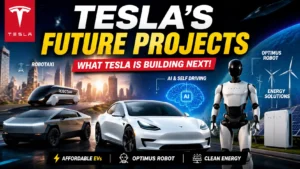
Tesla’s biggest projects at the moment are the Robotaxi ride hailing service, the Cybercab (its purpose-built driverless vehicle), the Optimus humanoid robot, the Tesla Semi electric truck, and its energy storage business (Megapack).
Bilal Ahmad
Bilal Ahmad is the Founder and Editor of GlobalNewsHubz. He writes about technology, world news, government schemes, and digital trends. His goal is to provide readers with accurate, well-researched, and easy-to-understand information using trusted and official sources.