Global Shipping Disruptions 2026, last winter I ordered a set of monitor arms from a supplier in Shenzhen. The listing said 12-18 days. It took 47. When I finally messaged the seller, they didn’t even apologize properly they just said “sorry, ship problem, Red Sea.” That was the first time global shipping disruptions actually cost me money and time instead of being a headline I scrolled past.
If you run an online store, import anything for resale, or you’re just someone who’s noticed random price hikes and delayed Amazon orders over the past couple of years, this one’s for you. I’m going to walk through what’s actually happening out on the water, why it keeps happening, and what you can actually do about it instead of just shrugging and waiting.
It’s Not One Problem — It’s Three or Four Stacked Together
When people say “supply chain issues” they usually lump everything into one blob. But if you’ve actually tracked a shipment through this mess, you start to notice it’s really a handful of separate headaches hitting at the same time.
The Red Sea situation. Since late 2023, attacks on commercial vessels near the Bab el-Mandeb Strait pushed most major carriers to stop using the Suez Canal route entirely. Instead of the short cut between Asia and Europe, ships started going all the way around the southern tip of Africa. That’s not a small detour it can add 10 to 14 days to a voyage. There was a ceasefire in the region in late 2025 that let some carriers cautiously start testing the waters again, but as of mid 2026 it’s still shaky.
The Panama Canal squeeze. This one surprised me the most because it has nothing to do with war or politics it’s just water. The canal needs a huge amount of fresh water to operate its locks, and a few years of drought in the region meant the Panama Canal Authority had to cap the number of ships allowed through per day. Fewer transit slots means backups, and backups mean either you wait in line for days or you pay a premium to jump the queue.
Port congestion and labor contracts. Even when ships get where they’re going, ports themselves get jammed sometimes from container imbalances, sometimes from staffing shortages, and sometimes from labor negotiations. The East Coast US port workers’ contract situation has been a recurring source of anxiety for importers, because even the threat of a strike makes carriers reroute cargo defensively, which causes congestion somewhere else.
Just general overcapacity chaos. Here’s the part nobody talks about shipping lines massively overbuilt their fleets after the pandemic boom. Global container shipping capacity increased by 27 percent between September 2022 and September 2025. So you’ve got too many ships chasing not enough cargo in some lanes, while other lanes are jammed from rerouting. It’s a weird mix of “not enough capacity here” and “too much capacity there” happening at the same time.
What This Actually Looks Like If You’re Running a Small Store
I help a friend manage inventory for her Etsy adjacent home goods brand, and the past year has been a genuine lesson in humility. Here’s what we actually experienced, mistake by mistake.
Mistake #1: We trusted the “estimated delivery” date on the supplier’s site. That date assumes zero disruption. It’s basically a best-case fantasy number. Now we automatically add 2-3 weeks buffer to whatever the platform tells us, especially for anything coming from Asia via ocean freight.
Mistake #2: We didn’t check whether our freight was going through the Red Sea route. Turns out our forwarder had quietly rerouted us around the Cape of Good Hope without telling us clearly. We only found out because tracking showed the ship near South Africa when it should’ve been near Egypt.
Mistake #3: We ordered in small, frequent batches. This felt smart for cash flow, but each shipment ate a flat customs and handling fee, and with rates up across the board, those small orders got hit hardest on a per unit basis. Consolidating into fewer, bigger shipments actually saved real money once rates spiked.
The unexpected result: Insurance costs on ocean freight quietly crept up too. Vessels transiting riskier waters get charged higher premiums, and that cost trickles all the way down to the person buying a $19 candle holder. Nobody warns you about that line item until you see your invoice.
A Step-by-Step Way to Actually Deal With Global Shipping Disruptions 2026
If you’re importing goods, running an online store, or just trying to plan around this stuff instead of getting blindsided, here’s the actual process that’s worked for us.
Step 1: Track the route, not just the tracking number. Most freight forwarders will tell you the routing if you ask Suez vs. Cape of Good Hope vs. Panama vs. transpacific direct. Apps like MarineTraffic or VesselFinder let you actually watch your container ship’s live position on a map, which sounds nerdy but genuinely helps you predict delays before your supplier even tells you.
Step 2: Build in a real buffer, not a token one. If a route normally takes 25 days, plan for 35-40 right now. Don’t promise your customers a delivery date based on the old normal.
Step 3: Diversify your suppliers or ports of origin if you can. This is easier said than done, but even having a backup supplier in a different region (say, one in Vietnam alongside one in China) gives you an option if one route gets worse.
Step 4: Consolidate shipments where possible. Fewer, larger shipments spread fixed costs (customs fees, port handling, admin) over more units, which softens the blow when per shipment costs rise.
Step 5: Lock in rates when you can, but don’t panic-book everything at once. Spot rates on ocean freight can swing wildly. If your forwarder offers a contract rate for a set period, it’s often worth it for predictability, even if it’s not the cheapest number on a good week.
Step 6: Communicate proactively with your customers. This one’s free and it matters more than people think. A simple “hey, due to ongoing shipping delays this might take an extra week” email prevents way more angry messages than staying silent and hoping nobody notices.
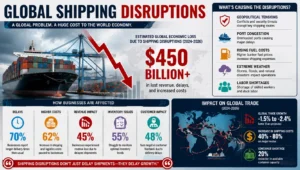
Roughly 30 percent of global container trade used to pass through the Red Sea and Suez Canal in a normal year.That’s not a niche route that’s a massive share of everything moving between Asia and Europe. When the attacks started, container spot rates from Asia to Europe jumped nearly five times higher than they’d been just before the crisis began.Even now, with things calmer, Suez Canal traffic in early 2026 was still running roughly 60 percent below where it was before the crisis started.That tells you this isn’t fully “fixed” just because the news cycle moved on.
For anyone in industries that depend on tight, predictable delivery windows automotive, electronics, and e-commerce are especially exposed because they lean on just in time manufacturing this isn’t a one time inconvenience, it’s a structural thing you now have to plan around permanently.
Common Mistakes People Make (Beyond What I Already Mentioned)
Assuming “the crisis is over” the moment headlines quiet down. Ceasefires and pauses are fragile. Plenty of carriers are still hesitant to fully return to old routes even when things look calmer, because reversing a decision mid shipment is expensive if things flare back up.
Ignoring the Panama Canal because it’s not in the news as much as the Red Sea. Water levels there are still a slow moving issue tied to weather patterns, not politics, so it doesn’t get the same dramatic coverage, but it affects transit slots just as directly.
Not asking your supplier which incoterms you’re using. Whether you’re buying FOB, CIF, or EXW changes who eats the cost when a shipment gets delayed or rerouted. A lot of small business owners never actually check this until something goes wrong.
Overcorrecting by holding way too much inventory “just in case.” I have seen people swing from zero buffer to six months of stock sitting in a warehouse, tying up cash they need elsewhere. The goal is a reasonable buffer, not panic hoarding.
Nobody’s got a crystal ball here, and I’m not going to pretend otherwise. But watching this space closely over the last year or so, a few patterns are clear. Carriers are testing the waters (literally) on returning to the Suez route, but cautiously nobody wants to be the line that pulls its ships back in right before something goes wrong again. Meanwhile the Panama Canal Authority is investing in longer term water management infrastructure, but that kind of project takes years, not months. And overcapacity in the broader shipping market means rates could actually soften in some lanes even while others stay expensive, which is a strange kind of good news or bad news situation depending on which route your goods travel.
If there’s one habit that’s genuinely helped me and the people I’ve talked to in this space, it’s just staying a little paranoid about assumptions. Don’t assume the delivery estimate is real. Don’t assume last month’s route is this month’s route. Don’t assume the crisis that made headlines eighteen months ago is actually resolved just because nobody’s talking about it anymore.
Why are global shipping delays still happening in 2026?
A few overlapping issues are still active at once carriers remain cautious about fully returning to the Red Sea and Suez Canal route even after the ceasefire, the Panama Canal is still limited by past drought driven water restrictions, and port congestion keeps flaring up around labor negotiations and container imbalances.
Is the Red Sea shipping crisis over?
Not fully,attacks paused after the late 2025 ceasefire, and some carriers like CMA CGM have started cautiously resuming Suez transits, but traffic through the canal is still running well below pre-crisis levels. Most major lines are watching the situation closely rather than committing back to the route completely, since the ceasefire has been fragile.
How much longer does rerouting around Africa actually add to a shipment?
Sailing around the Cape of Good Hope instead of through the Suez Canal typically adds 10 to 14 extra days to a voyage between Asia and Europe, sometimes more depending on the specific ports involved.
Will shipping costs go back down to pre-2023 levels?
It’s hard to say for certain. Some analysts expect rates to ease in specific lanes because carriers have overbuilt fleet capacity in recent years, but elevated insurance premiums and longer routes mean costs in disrupted corridors likely won’t fully return to older, cheaper norms anytime soon.
How can a small business protect itself from shipping delays?
Build a real buffer into your delivery estimates (not just a few extra days), ask your freight forwarder exactly which route they’re using, consolidate smaller orders into fewer larger shipments to spread out fixed costs, and communicate proactively with customers the moment you know a delay is likely.
Bilal Ahmad
Bilal Ahmad is the Founder and Editor of GlobalNewsHubz. He writes about technology, world news, government schemes, and digital trends. His goal is to provide readers with accurate, well-researched, and easy-to-understand information using trusted and official sources.