Football Transfer News 2026, Two summers ago I told my entire family WhatsApp group that a player was “basically done” to a new club because some account with 40,000 followers and a blue tick posted it with three fire emojis. I even sent a screenshot with “IT’S HAPPENING” typed in caps. Four days later the player signed for a completely different club, and my cousin still brings it up every single transfer window.
If you’ve ever refreshed Twitter (X, whatever we’re calling it now) at midnight waiting for a “here we go,” or argued with a mate about whether a deal is “close” or “basically done,” this one’s for you. I’m not a football journalist. I’m just someone who’s followed transfer windows way too closely for way too many years, made every dumb mistake in the book, and slowly figured out how to actually follow this stuff without getting played by fake accounts or clickbait headlines.
Why Football Transfer News 2026 Makes Everyone a Little Bit Unhinged
Right now, in early August 2026, we’re in the thick of it. The Premier League window opened back on 15 June and doesn’t shut until 1 September, and this year it’s extra chaotic because it’s coming right off the back of the World Cup clubs are watching how players performed on the biggest stage and adjusting their targets (and their valuations) accordingly.
Take Rodri. Before the World Cup, most reports had Real Madrid interest simmering quietly in the background. He wins the Golden Ball with Spain, and suddenly you’ve got Sky Sports saying Real Madrid might bid around £43–51m, Forbes reporting Manchester City want closer to £75m, another outlet saying City won’t go below £80m, and Real Madrid supposedly capping their offer at €50m. Same player, same week, four wildly different numbers.
That’s not journalists lying to you. That’s how negotiations actually work both clubs leak numbers that suit their own negotiating position, and reporters relay what their sources tell them in good faith. But if you don’t know that’s happening, you end up thinking someone’s making things up, or worse, you take one number as gospel and get disappointed when the real fee lands somewhere else entirely.
The Reliability Ladder I Wish Someone Had Shown Me Years Ago
This is the single biggest thing that changed how I follow transfers, so let me just lay it out plainly.
Tier 1: Club-confirmed. The actual club posts it on their official site or social account. This is the only tier where you should treat something as 100% done. Everything before this is still, technically, a rumour.
Tier 2: Trusted insiders with a track record. People like Fabrizio Romano, David Ornstein, or established outlets like The Athletic and Sky Sports’ Transfer Centre. Romano’s whole “here we go” phrase became a meme precisely because he only uses it once personal terms, medical, and paperwork are basically locked in not when talks start. When he says a deal is “advanced,” that’s a different (earlier) stage than “here we go,” and that distinction matters a lot.
Tier 3: National papers and regional outlets. Papers like AS, Marca, or Mundo Deportivo in Spain, or the various English tabloids, are useful for understanding a club’s mood and general direction, but they’re often working off single sources close to one side of a deal, which is exactly why fees reported here can swing wildly.
Tier 4: Aggregator sites and random social accounts. This is where I got burned. Sites that just repackage other people’s stories (sometimes badly translated) or accounts that post rumours with zero sourcing, purely for engagement. If a post doesn’t say where the information came from, be suspicious.
The habit that fixed 90% of my problems before I get excited about anything, I check if at least two Tier 2 sources are saying the same thing. One is a rumour. Two independent ones agreeing is usually a deal actually moving.
How I Actually Follow a Transfer Saga Now (Step-by-Step)
Pick two or three Tier 2 sources and stick with them. For me it’s Fabrizio Romano on X, the Sky Sports Transfer Centre live blog, and The Athletic’s football coverage. I don’t need fifteen tabs open.
Use Transfermarkt for the numbers, not the rumours. It’s brilliant for checking a player’s market value, contract length, and a clean, sourced history of confirmed transfers. I don’t treat their “rumours” tab as gospel, but the confirmed deals section is genuinely reliable.
Check the club’s official account before you believe anything is final. Sounds obvious, but I still see people arguing about a “confirmed” transfer that no club has actually posted about.
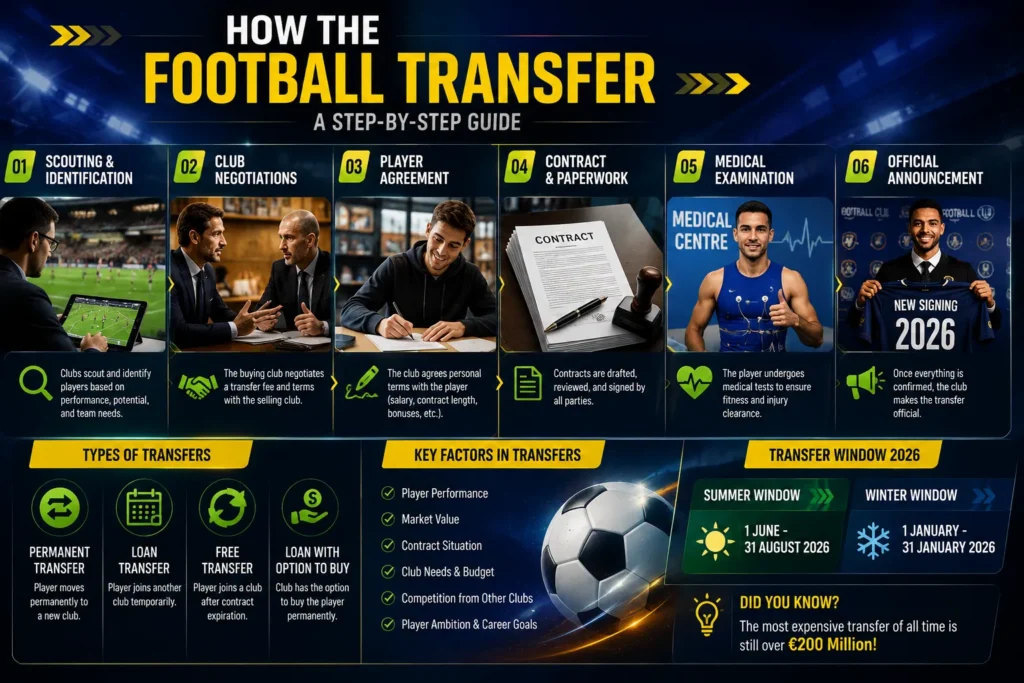
Learn the language. “Interested in” is the earliest, vaguest stage. “In talks” means clubs are actually negotiating. “Advanced talks” or “agreement close” means a fee is basically settled and it’s down to personal terms or paperwork. “Here we go” or “official, confirmed” means it’s done or as good as done.
Remember registration deadlines matter, not just transfer windows. A club can agree a fee before deadline day, but if the paperwork and league registration aren’t filed in time, the player can’t play which happened to more than one club last summer. Deadline day chaos exists for a reason.
If you play Fantasy Premier League, don’t make transfers off rumours. I moved a player out of my squad once because a “medical imminent” story about his replacement went around the medical didn’t happen for another eleven days, and I’d already wasted a transfer.
What Real Deals Actually Look Like (Using This Summer as the Example)
It helps to walk through an actual transfer from start to finish, so let’s use one from this window.
Newcastle sold Anthony Gordon to Barcelona for £69.3m. Here’s the timeline, roughly quiet interest for a while, then talks accelerating in private (not publicly known for long), a fee agreed, Gordon undergoing a medical, and then the actual unveiling at Camp Nou which, notably, got delayed almost eight hours because of paperwork issues. Even a “done deal” can sit in administrative limbo for hours because of things like international clearance, image rights contracts, or visa paperwork.
That last part is genuinely useful to know a medical happening does not mean the deal is announced that day. I’ve seen so many people panic post “it’s dead, the medical was three days ago and nothing’s official,” when in reality paperwork between federations can just take time.
Compare that to Bruno Guimarães, who’s been strongly linked with a move to Arsenal this window, with Manchester United and PSG also in the mix at various points. Newcastle reportedly wanted somewhere around £87m to even consider selling him. That’s a saga still playing out as I write this direct club to club talks reported, but no medical, no “here we go,” nothing club confirmed. That’s Tier 2 information, worth following, but not something I’d treat as fact yet.
And then there’s Gonzalo García at Fulham, which is a good reminder of how fast things flip. A year ago he was signing a new long-term contract at Real Madrid after a strong Club World Cup, with reports at the time saying the club had zero plans to sell him. Twelve months later, he’s completing an equal-club-record move to Fulham. Contracts and “no plans to sell” statements are true right up until they aren’t clubs change their minds constantly based on form, new signings, and finances.
Mistakes I Made So You Don’t Have To
Trusting a screenshot over a source. Screenshots get edited. If someone shares a “leaked” image instead of linking the actual post, be suspicious.
Confusing a loan for a permanent deal, or vice versa, because a headline didn’t specify and I didn’t bother checking the actual report.
Assuming a release clause guarantees a move. Plenty of players have release clauses that never get triggered because the buying club simply doesn’t want to pay it in one lump sum, or the player’s current club finds a way to negotiate around it.
Forgetting that “he wants the move” doesn’t mean “the clubs have agreed a fee.” Player desire and club to club negotiation are two completely separate hurdles, and a deal can die at either one.
Getting emotionally attached to a rumour I liked the sound of. This one’s less about facts and more about mindset I used to want a story to be true so badly that I’d ignore the parts of the report that were actually pretty uncertain.
Final Thoughts
Transfer news is genuinely fun to follow that’s not something I want to talk you out of. There’s a real thrill in watching a deal unfold in real time, especially in a window like this one where World Cup form is reshaping so many valuations overnight. I just wish someone had explained to me years ago that not every “sources say” is equal, and that the gap between “advanced talks” and “here we go” is where 90% of the wrong predictions happen.
What does “here we go” actually mean in transfer news?
It’s a phrase popularised by journalist Fabrizio Romano, used specifically when a deal is fully agreed between clubs, personal terms are sorted, and it’s essentially just medicals and paperwork left. It’s a later-stage signal, not an early rumour.
Why do different outlets report different transfer fees for the same player?
Because both clubs involved often leak numbers that favour their own negotiating position, and different journalists have sources on different sides of the deal. The final, official fee is usually confirmed only once the club announces it.
It’s very reliable for confirmed transfers, contract details, and market values. Its rumour or “hot” sections should be treated more cautiously, the same as any other secondary source.
What’s the difference between a transfer window closing and a registration deadline?
The transfer window is when clubs can legally negotiate and complete deals. Registration deadlines are set by each league or competition and determine whether a signed player is actually eligible to play missing that cutoff, even after a deal is agreed, can mean a player has to wait to feature.
How can I tell if a transfer rumour is fake?
Check whether the source names where the information came from, see if at least one established Tier 2 journalist or outlet is reporting the same thing, and be extra cautious of screenshots, unverified accounts, or stories with no club reaction at all.
Bilal Ahmad
Bilal Ahmad is the Founder and Editor of GlobalNewsHubz. He writes about technology, world news, government schemes, and digital trends. His goal is to provide readers with accurate, well-researched, and easy-to-understand information using trusted and official sources.