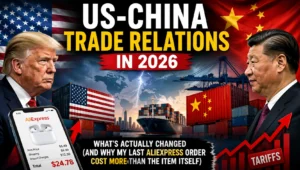
US-China Trade Relations in 2026, Last month I ordered a set of case fans and a GPU bracket from AliExpress. Total cart price about $38. Simple, right? I’ve done this a hundred times.Then three weeks later a customs notice showed up asking for an extra $19 before the package would even leave the warehouse it was sitting in.That never used to happen on an order that small. And that’s when it clicked for me I did been reading headlines about the US-China trade war for over a year without actually feeling it. Now I was feeling it, one overpriced cooling fan at a time.
If you build PCs, buy gadgets online, run a small store that sources from China, or just want to understand why your electronics keep getting pricier, this is the plain language version of what’s happening and what I’ve changed about how I shop.
Quick version of the timeline, because the details get messy fast:
In 2025, tariffs between the two countries spiked to genuinely absurd levels over 100% on some goods at the peak.
Both sides walked it back after talks, first in Geneva, then again after a Trump Xi summit in South Korea in October 2025, where they agreed to a one year truce.
In February 2026, the US Supreme Court ruled that the White House couldn’t keep using emergency powers (IEEPA) to impose tariffs the way it had been, which forced a rework of how some of these tariffs were legally applied.
Trump visited Beijing in May 2026, and both sides talked about cutting tariffs further and expanding agricultural trade.
As of this writing, there’s still a patchwork of overlapping tariffs general duties, national security tariffs on autos and metals, and targeted penalties tied to things like forced labor enforcement (a new 12.5% layer got added in late July 2026).
Nobody outside a trade lawyer’s office can rattle off the exact combined rate on any given product without checking, because it depends on the category, the ruling in effect that month, and whichever truce is currently holding. That’s genuinely part of the problem the rules keep moving.
The Part That Hit My Wallet: De Minimis Is Gone
Here’s the change that actually matters for anyone who shops on AliExpress, Temu, or Shein the “de minimis” exemption is dead.
For years, any package under $800 could enter the US duty free, no questions asked. That’s the rule that let a $6 phone case or a $12 fan controller show up with zero extra fees. It’s why Temu and Shein could undercut everyone on price.That exemption ended for Chinese origin goods back in May 2025, and then for every other country by the end of August 2025. So now, every package, regardless of value, can get a duty charge attached.
In practice, that’s meant prices on those platforms climbing somewhere in the 20-40% range compared to a couple years ago, and a growing number of orders arriving with a “pay this before delivery” notice instead of a clean, done at checkout price.
Rare Earths, Chips, and Why GPU and Laptop Prices Keep Twitching
This is the part that actually affects my PC building hobby more than the fan and bracket order did.
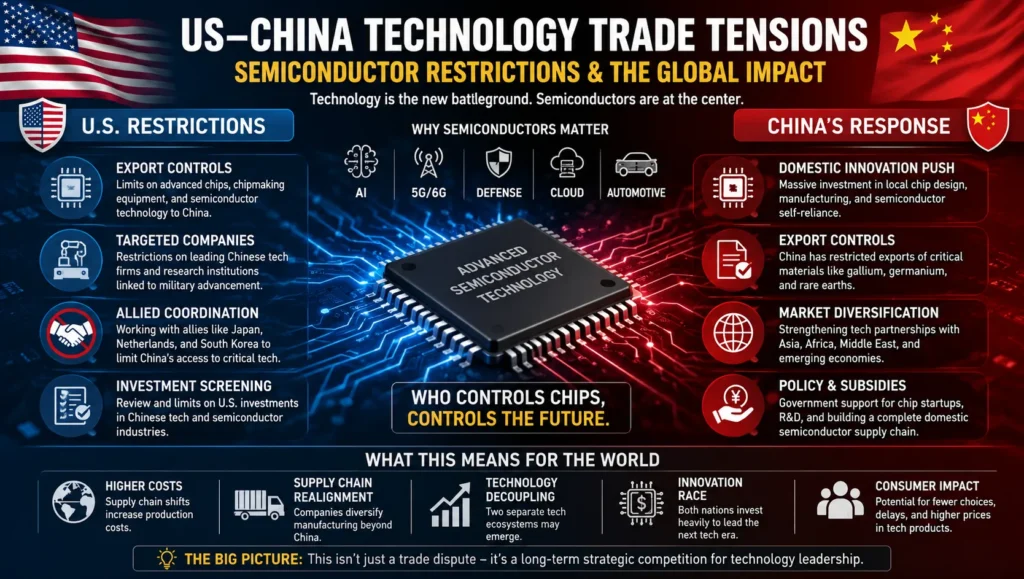
China controls the overwhelming majority of the world’s processing capacity for rare earth elements and materials like gallium and germanium. These aren’t used in the core silicon of a CPU or GPU, but they matter a lot for things like magnets in cooling fans and hard drives, RF components, and certain compound semiconductors.
Through 2025 and into 2026, China has used export controls on these materials as leverage in the broader trade fight tightening them, pausing them as part of truces, then adding specific companies back onto restricted lists (ten US firms got added in June 2026 alone, including a couple of rare earth producers).On the flip side, the US tightened its own export rules on advanced AI chips in January 2026, adding stricter performance based thresholds for what Nvidia and AMD can legally ship to China.
Put those two things together and you get a supply chain that’s genuinely twitchy. I haven’t seen mainstream reporting tie this directly to a specific GPU price hike yet the material costs involved (like the alloy used in rare earth magnets) have spiked over 20% in a single month at points this year, but that hasn’t fully shown up on shelf prices as of now. Still, it’s the kind of thing that makes we told you so headlines a real possibility if the truce breaks down.
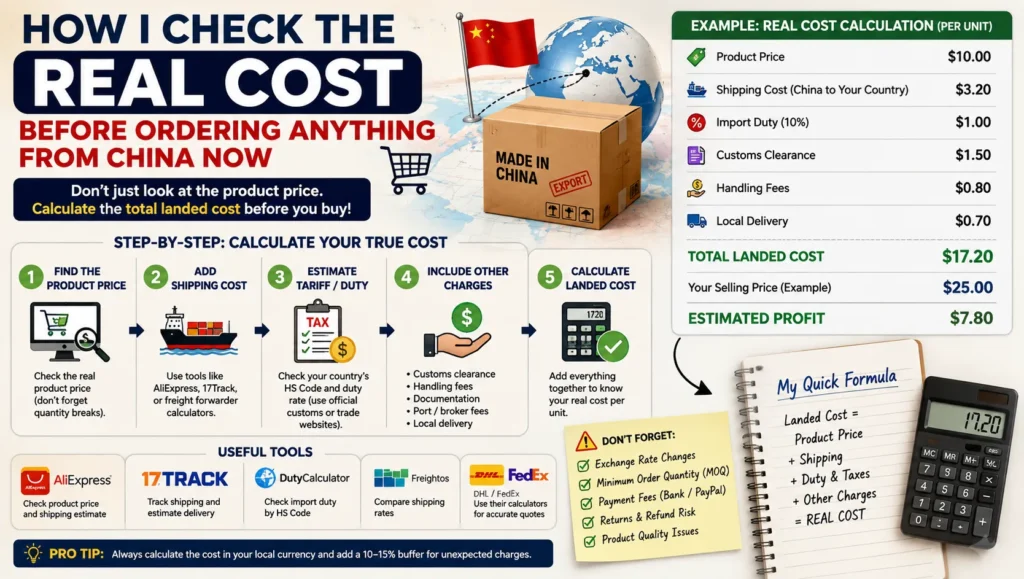
How I Check the Real Cost Before Ordering Anything From China Now
I stopped trusting the sticker price a while back. Here’s the actual routine I use now before I hit “buy” on anything shipping internationally:
Check the “ships from” and country of origin on the product page, not just the seller’s storefront name. A lot of AliExpress and even Amazon listings ship from US-based warehouses now, which sidesteps a lot of this entirely.
Look for a “local warehouse” or “fast shipping” tag on Temu or Shein. Items already sitting in a domestic warehouse were typically imported in bulk and pre-cleared, so you’re less likely to get hit with a surprise invoice later.
Run the total through a landed cost calculator for anything over $30 or so tools like Zonos or SimplyDuty let you plug in the category and origin and get a realistic “all in” number before you commit.
Compare against a domestic retailer before assuming the overseas price is still cheaper. I check Newegg or Micro Center against AliExpress now, every time, because the gap has shrunk a lot for PC parts specifically.
Watch for summit and truce news if you’re planning a bigger purchase. Rates have genuinely changed within days of a Trump-Xi meeting before, so timing a big order around known negotiation dates isn’t paranoid, it’s just practical.
Build in extra delivery time. Customs processing on parcels that now require duty assessment adds real delays, sometimes a couple of weeks, compared to the old de minimis days.
If You’re Not Shopping From the US, This Still Affects You
I get messages from readers outside the US asking why any of this matters to them. Fair question but the ripple effects aren’t really contained to American buyers.
Global chip and GPU pricing doesn’t stay local. When rare earth materials get more expensive or harder to source, or when a major manufacturer redirects inventory because of US export rules, that shows up in prices and availability everywhere, including on local PC building forums outside the US. The EU’s own crackdown on cheap Chinese parcels means Shein and Temu are adjusting their entire international logistics model, not just their US operations. And several Chinese platforms have been actively expanding warehouses in other regions specifically to route around these disruptions, which changes shipping times and pricing for buyers well outside America too.
So even if you’ll never personally pay a US customs bill, the trade war is quietly part of why that graphics card or phone you’ve been eyeing costs what it costs, or takes as long as it takes to arrive.
Common Mistakes to Avoid
Don’t assume last month’s price or shipping time still applies. This situation shifts fast enough that “I checked a few weeks ago” isn’t reliable anymore.
Don’t split orders to dodge fees. It doesn’t work under the current rules and usually backfires.
Don’t ignore the “country of origin” field just because the seller’s storefront looks local. Origin, not seller location, is usually what determines the tariff.
Don’t panic-buy everything at once assuming prices only go up. Rates have dropped meaningfully after truces before, more than once.
Don’t skip the calculator step for anything with real value a five minute check has saved me from a few nasty surprises.
Where Things Stand Heading Into Late 2026
The current truce between Washington and Beijing is set to hold into around November 2026, covering both broader tariff levels and the pause on some of China’s stricter rare earth controls. Whether it gets extended, renegotiated, or falls apart is genuinely an open question, and I wouldn’t trust anyone who tells you confidently which way it’ll go.
What I do trust is that this isn’t a “one big deal and it’s settled” kind of story. It’s been a back and forth for a couple of years now, and every summit, court ruling, or export control announcement seems to shuffle the numbers again.
I didn’t expect a $38 AliExpress order to be the thing that made global trade policy feel real to me, but here we are. The honest takeaway isn’t “stop buying from China” or “everything’s about to collapse” it’s that the old assumptions about cheap, duty free overseas shopping don’t hold anymore, and treating every order like it might carry a hidden cost has saved me money and headaches more than once.
If you’re building a PC, restocking a small store’s inventory, or just trying to snag a good deal on a gadget, spend the extra five minutes checking the real landed cost before you buy. The sticker price stopped telling the whole story a while ago.
Is the US-China trade war actually over in 2026?
No, there’s a truce holding through roughly November 2026, but tariffs, chip export controls, and rare earth restrictions are all still active in some form. It’s paused, not resolved.
Why did my AliExpress, Temu, or Shein order suddenly get more expensive?
The de minimis exemption that let low-value packages enter duty free ended for Chinese goods in 2025. Now most parcels carry some form of duty, which is why totals have climbed noticeably.
Will GPU and laptop prices keep rising because of this?
It’s possible but not guaranteed. Rare earth material costs have risen, and chip export rules have tightened, but that hasn’t fully translated into shelf price hikes as of now. It’s worth watching rather than panicking over.
Should I stop buying tech gear from Chinese platforms?
Not necessarily. Prices are still often competitive, especially for items shipped from local warehouses. Just check the total landed cost before you buy instead of trusting the listed price alone.
How can I check tariffs before I order something?
Look at the country of origin, use a landed-cost calculator like Zonos or SimplyDuty for bigger purchases, and compare against a domestic retailer before assuming the overseas option is cheaper.
Bilal Ahmad
Bilal Ahmad is the Founder and Editor of GlobalNewsHubz. He writes about technology, world news, government schemes, and digital trends. His goal is to provide readers with accurate, well-researched, and easy-to-understand information using trusted and official sources.