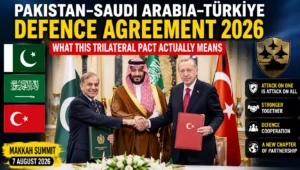
Pakistan Saudi Turkey defence pact 2026, I was scrolling through Twitter on Friday night, half paying attention, when my feed just exploded. Everyone was posting the same photo Erdogan, Muhammad bin Salman, and Shehbaz Sharif standing together in Makkah, shaking hands, cameras flashing everywhere. My first reaction was honestly confusion. I thought, “wait, didn’t Pakistan and Saudi Arabia already sign a defence deal last year?” Turns out yes, they did back in September 2025. But this one was different. This one had Turkiye in it too, and within an hour my WhatsApp groups (the ones full of uncles who forward every breaking news screenshot at 11 pm) were already arguing about whether this meant war was coming or peace was coming.
That’s usually my cue to actually sit down and read the real reports instead of trusting group chat analysis. So I spent the whole evening going through Al Jazeera, CBS, The Guardian, and the joint statements from Pakistan’s Foreign Ministry and the Saudi Press Agency.
On Friday, August 7, 2026, in the holy city of Makkah, the leaders of three major Muslim majority countries put their signatures on something called the Makkah Joint Defence Agreement. Turkish President Erdogan, Saudi Crown Prince Muhammad bin Salman, and Pakistan’s Prime Minister Shehbaz Sharif signed it together, along with their foreign and defence ministers standing behind them.
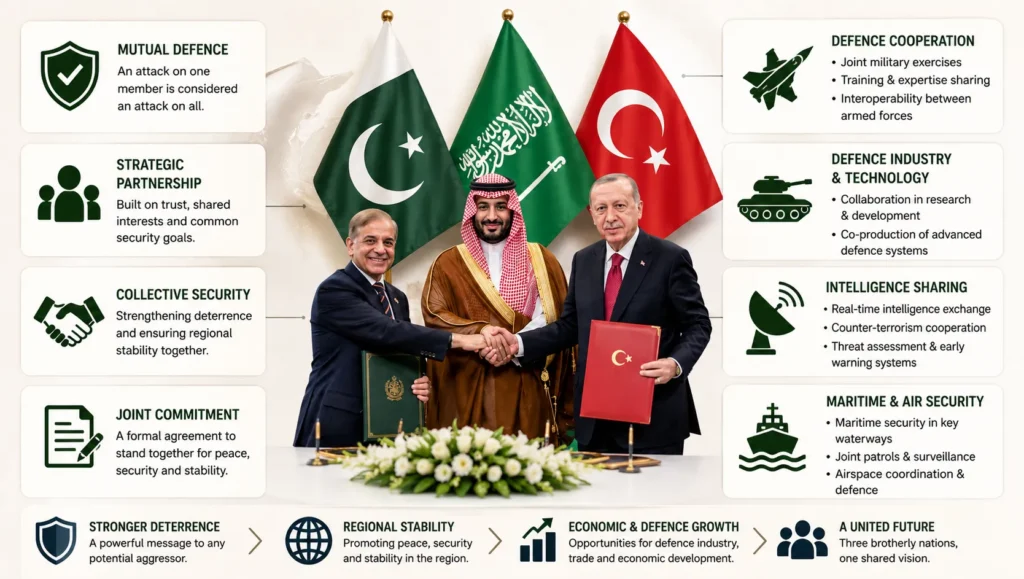
The core idea is simple, even if the politics around it are not an armed attack on any one of these three countries will now be treated as an attack on all three. That’s the whole spirit of it a collective defence commitment, similar in concept to how NATO’s Article 5 works, though nobody involved is calling it a formal military alliance in that sense.
What caught my eye reading through it is that this wasn’t some sudden, out of nowhere idea. It’s actually built directly on top of the Pakistan Saudi pact from September 2025 the Strategic Mutual Defence Agreement which already said an attack on one would be treated as an attack on the other. This new Makkah agreement basically pulls Turkiye into that same commitment, turning a two country pact into a three country one.
Why Now? The Timing Isn’t Random
If you’ve been following Middle East news at all this year, you already know the region has been on fire literally, in some places. Since the US and Israel struck Iran back in late February, Saudi Arabia has taken repeated hits from Iran itself, from Houthi forces in Yemen, and from Shia militia groups operating out of Iraq. That’s put serious pressure on Saudi oil exports and raised uncomfortable questions in Riyadh about whether relying on the US security umbrella is still a safe bet.
Pakistan brings something no other Muslim country can offer to this table it’s the only nuclear armed Muslim majority nation, and it has a battle tested, sizeable military. Turkiye brings NATO standard military hardware, a strong domestic defence industry (think Bayraktar drones, which most Pakistanis have already heard of thanks to regional conflicts), and its own regional weight.
Put those three together and you get, as one defence analyst quoted in the coverage put it, a “natural evolution” of decades of quiet military cooperation finally becoming formal and public.
The Part Everyone Got Wrong on Social Media
Here’s where I actually made a mistake myself before correcting it. My first draft notes for this article assumed the pact was framed around nuclear deterrence because that’s what a lot of the loud voices online were claiming, calling it a “nuclear umbrella” deal for Saudi Arabia. I almost wrote that as fact.
But when I actually checked the official statements, Pakistan’s own officials publicly pushed back on that narrative. On X, it was directly stated that the agreement “does not represent any intention to build a military axis or a sectarian/religious bloc,” and importantly that it is “not linked to nuclear ambitions or an arms race, but rather to building sustainable, self reliant capabilities.” Erdogan echoed something similar, describing it as being based on “collective deterrence” and reaffirming Turkiye’s preference for resolving regional conflicts through dialogue rather than escalation.
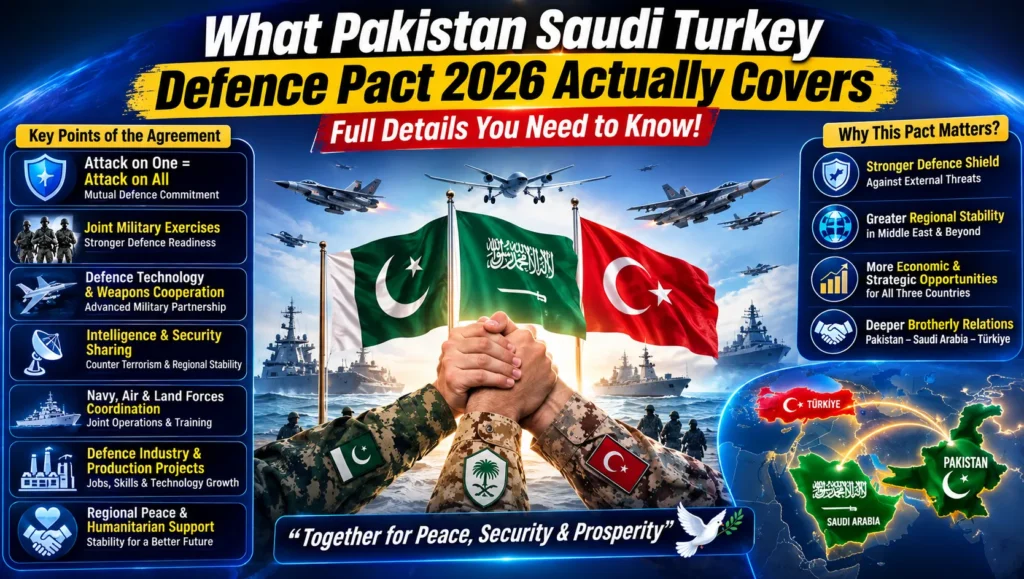
What Pakistan Saudi Turkey defence pact 2026 Actually Covers
Based on the joint statement and multiple credible reports, here’s what the agreement realistically includes, beyond just the “attack on one is attack on all” headline:
Joint military exercises and training the three militaries will likely coordinate drills together, which honestly already happens informally between Pakistan and Saudi forces (Pakistan has had troops rotating through the Kingdom in training and advisory roles for decades, sometimes over 1,500 personnel at a time).
Intelligence sharing a more structured flow of security information between the three states’ defence establishments.
Defence technology cooperation this is the one worth watching. Turkiye has real strength in drones and domestic weapons manufacturing, and closer ties here could mean more joint production deals down the line, not unlike what Pakistan and Turkiye have already done with naval projects.
Long-term strategic coordination basically an ongoing framework for the three governments to keep talking and planning together, rather than just reacting country by country when something happens in the region.
I’ll be honest the reaction here has been mixed, and not in a simple “everyone loves it” or “everyone hates it” way. A lot of people I’ve talked to genuinely feel proud that Pakistan’s military reputation is being recognised at this level, especially with PM Sharif being accompanied by Army Chief Asim Munir on this trip, right after they performed Umrah in Makkah before the signing.
But there’s also a quieter, more practical concern floating around the same one that came up after last year’s Saudi pact: does this mean Pakistani soldiers might actually get deployed if things escalate further in the Gulf? Officially, nobody’s confirming that as an automatic outcome, and the language of the pact is deliberately framed as deterrence, not an obligation to send troops the moment something happens. Still, it’s a fair question people are asking, and I don’t think it’s been fully answered yet.
What to Watch Next
If you’re trying to actually follow this story instead of just reacting to headlines, here’s what I’d personally keep an eye on over the coming weeks:
Whether the actual legal text gets published. Right now most of what we know comes from joint statements and briefings, not a released document that was the same pattern with the 2025 Saudi Pakistan pact too.
Iran’s official response. Their reaction to the earlier bilateral deal was surprisingly measured, with state media even calling it non threatening. Whether that tone holds with Turkiye added to the mix is worth watching.
India’s response, since New Delhi already said last year it would “study the implications” of the bilateral version for its own national security.
A Few Mistakes to Avoid If You’re Writing or Reading About This
Don’t call it a formal “military alliance” like NATO none of the three governments are using that language, and the official framing is specifically collective deterrence, not a full alliance treaty.
Don’t assume it’s linked to nuclear weapons sharing that’s been directly denied by Pakistani officials.
Don’t treat social media threads as primary sources go back to the actual joint statements from the Saudi Press Agency or Pakistan’s Foreign Ministry.
Don’t confuse this with the September 2025 pact that one was bilateral (Pakistan-Saudi only), this one is trilateral and formally brings Turkiye in.
What strikes me most about this whole thing isn’t really the military hardware or the political theatre in Makkah it’s the timing. Three major regional powers choosing to formalise a defence relationship right in the middle of a widening conflict says a lot about how uncertain the security picture in the Middle East and South Asia has become. Whether this pact stays mostly symbolic or actually gets tested is something none of us can predict yet. But if you’re someone who follows regional politics even casually, this is one of those stories worth bookmarking because how Iran, India, and the US respond to it over the next few months will probably tell us more than the signing ceremony itself did.
What is the Makkah Joint Defence Agreement?
It’s a trilateral defence pact signed on August 7, 2026, between Pakistan, Saudi Arabia, and Turkiye, committing all three countries to treat an attack on any one of them as an attack on all three.
Is this different from the Pakistan-Saudi Arabia defence pact signed in 2025?
Yes, the September 2025 Strategic Mutual Defence Agreement was a bilateral deal between only Pakistan and Saudi Arabia. The 2026 Makkah agreement expands that same principle to include Turkiye, making it a three way pact.
Does this agreement involve nuclear weapons or a nuclear umbrella for Saudi Arabia?
No, pakistani officials have publicly stated the agreement is not linked to nuclear ambitions or an arms race, and is instead focused on building self reliant defence capabilities and collective deterrence.
Will Pakistan send troops to defend Saudi Arabia or Turkiye automatically?
The pact is framed around collective deterrence rather than an automatic troop deployment obligation. Pakistan has had military personnel rotating through Saudi Arabia in training and advisory roles for decades, but no automatic combat deployment has been confirmed under this agreement.
What does this mean for the average person in Pakistan?
In the short term, not much changes in daily life. Longer term, it could mean deeper defence industry cooperation, more joint military training, and a stronger regional voice for Pakistan in Middle East security matters but it’s still early to say how it plays out in practice.
Bilal Ahmad
Bilal Ahmad is the Founder and Editor of GlobalNewsHubz. He writes about technology, world news, government schemes, and digital trends. His goal is to provide readers with accurate, well-researched, and easy-to-understand information using trusted and official sources.